


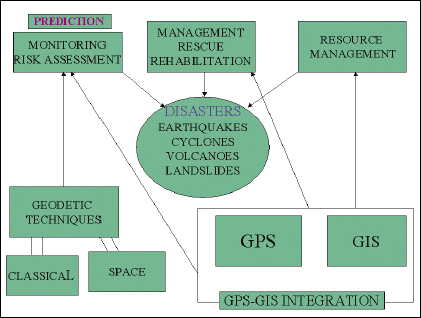
The 26th July 2005 floods in Mumbai, which caused widespread destruction, deaths and damage to property and infrastructure, have once again highlighted the importance of disaster mitigation and management using modern technology. Monitoring natural disasters like floods, earthquakes, volcanic eruptions, landslides, avalanches, cyclones, etc., with the ultimate aim of predicting them, and managing the rescue and rehabilitation operations during and after such calamities, have been discussed in various forums in the past. The devastating Latur earthquake of 1993, the Bhuj earthquake of 2001, the Orissa cyclone, and the recent tsunami after the Sumatra earthquake, which caused extensive damage in terms of human lives and property, have drawn the attention of the Indian scientific community to the immediate need of monitoring and managing such disasters in our country in the most effective, efficient and economic manner. Traditionally, maps are being used for this purpose, as an effective tool, since ancient times. However, with the introduction of computeraided techniques in map-making, and the space technology in surveying and mapping, the utility of geodetic and map data for this important activity has increased many-fold. However, a well-coordinated programme for optimum utilization of these important technological tools, resulting in efficient management of the disasters, still remains an elusive dream of administrators, scientists and technologists.
The unveiling of the National Map Policy by Ministry of Science and Technology, Government of India in May 2005 is a historic decision, a major step forward. However, the policy raises both expectations and questions. The section contains National Map Policy and views of following experts
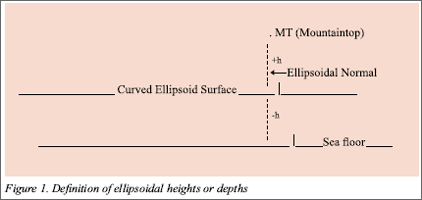
In Today’s world, with GPS, we can survey ellipsoidal heights (h) with 5-10 cm accuracy for geodetic control points on land and differential heights (?h) between well defi ned topographic features with relative accuracy of 1: 1Million or better. In few specific cases, this type of accuracy may require specially designed GPS surveys. In navigational mode, an instantaneous positional accuracy of about ± 5 m is easily possible. As these heights are the direct product of the GPS survey(s) and thus defi ned with respect to the ellipsoid, which is a time-invariant zero reference surface, they can be used without any reference to the geoid or Mean Sea Level (MSL). If we recall, in the classical surveys, e.g., triangulations and/or traverses, the vertical angles used to provide the “?h” and thus there will not be any need to convert them to orthometric heights.

The environment of a Municipal Information system has undergone a sea change over last few years. Couple of years back the requirements of information system was designed and projected primarily from the planners community. They were satisfi ed if the physical information was supplied on a scale of 1:5000/ 1:10,000.

Microsoft releases a beta of Virtual Earth
Microsoft released a beta of Virtual Earth, its web-based mapping service that combines local search with maps and aerial photography according to a recent report. The move comes some three weeks after Google released a beta of its Google Earth, and nearly a month after MSN unveiled a service combining satellite imagery with maps with its local search results. However, MSN’s Virtual Earth, like Google Earth, is focused primarily around maps and aerial views, allowing users to zoom in and out of maps or images and drag them around within the display area. MSN Virtual Earth for now covers only the U.S. and major Canadian cities, and offers fewer local-search options. http://www.marketingvox.com
China’s first digital long distance pipeline
Ji-Ning line is China’s first pipeline featuring digital technologies. World advanced technologies are applied in it, including remote sensing technology, GIS, large database, virtual reality technology, web application technology, project management, enterprise resource planning, exploring a new idea and method of in the design and operation management of long-distance pipeline. Welding has been completed for over 700 kilometers along the Ji- Ning line (from Hengshui in north China’s Hebei Province to Nanjing in east China’s Jiangsu province) for West-East Gas Transmission project. The line extends across north and east China and connects the area around Bohai Sea with Yangtze River Delta. It is expected the main pipeline will be put into operation at year-end. The pipeline will put an end to the coal-dominated energy structure in the areas alongside.
http://english.people.com.cn
USS Cape St. George is first ship using digital mapping system
Sailors on the USS Cape St. George is the first in the U.S. Navy fleet to switch from paper maps to a new digital charting system, linked to GPS and instant updates on ocean obstructions. The Navy, which has been working on the new technology since 1998, plans to install and use the new digital maps on the entire flee by 2009.
http://www.estripes.com
MapInfo Delivers OGC Compliance
MapInfo Corporation the announced that its MapXtreme® family of products has been certified as fully compliant with the Open Geospatial Consortium’s (OGC) OpenGIS® WMS Specifi cations.







 (5.00 out of 5)