



Space borne Remote Sensing technology has proved to be an important tool in rapid assessment and mapping of natural resources over a large area with reasonable accuracy. Application of satellite data in assessment of forest cover in India was first demonstrated by the National Remote Sensing Agency (NRSA), Department of Space, Hyderabad in 1985 when it came out with first ever estimate of country’s forest cover based on interpretation of Landsat (an American Satellite) data. Almost simultaneously, Forest Survey of India (FSI), Ministry of Environment & Forests started interpretation of satellite data for assessment of forest cover of the country and published country’s forest cover in 1987 using Landsat (MSS) data, the most reliable data at the time.

Says Michael Lindsay, Chief Operating Officer, NavCom Technology …
EU and the Republic of Korea seal their agreement
During the EU/South Korea summit held in Helsinki, the two parties formally signed an agreement on cooperation on the European satellite radio navigation programme GALILEO. The agreement provides for numerous areas of co-operation, including cooperative activities in the areas of scientific research and training, industrial cooperation, trade and market development, standards, certification and regulatory measures. http://europa.eu.int

Innovative battlefield learning experience for soldiers
The Singapore Armed Forces (SAF) has introduced an innovative training and learning system for its soldiers called Battlefield Instrumentation (BFI). Utilising modern laser and informationcommunication technologies, BFI System brings together soldiers, weapon systems and fighting platforms. It uses the GPS, computer simulation and data communication to record details of battlefield engagements between opposing forces. www.channelnewsasia.com
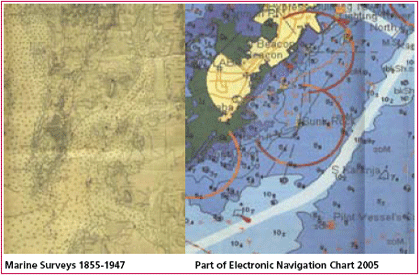
Mumbai acquired its port importance only with the advent of the Portuguese in 1508. Francis Almeida sailed into this harbour and called it as Bom Bahia or the Good Bay. The British corrupted the Portuguese name “Bom Baia” to “Bombay”. The Kolis used to call the islands “Mumba” after Mumbadevi.
It was the British who developed it into a centre of commerce to rival any other centres in the country then. The British embarked upon large-scale reclamations and engineering works to consolidate the seven islands. In 1803 Bombay was connected with Salsette by a causeway at Sion. A causeway now called Colaba Causeway joined the island of Colaba to Bombay in 1838 and the Causeway connecting Mahim and Bandra was completed in 1845. This gave access to the rich hinterland of the Deccan providing further impetus for the growth of then Bombay.
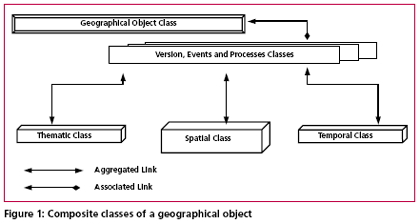
Despite the rapid advances in software and hardware technologies, the development of temporal databases capable of dealing with the evolution of geographical entities remains a challenging task. The aim of this paper is to discuss a proposed model that is able to handle spatial entities over time as a continuum.
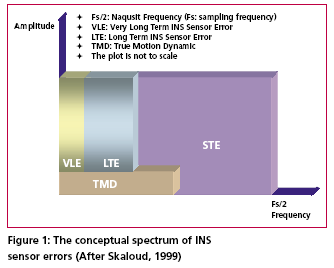
According to Skaloud [1999], the inertial sensor errors are composed of long term errors (low frequency components) and short term errors (high frequency components). Therefore, a conceptual plot of the frequency spectrum of the inertial sensor errors in the measurements can be illustrated as in Figure (1).

Forest Survey of India celebrates 25 years. On this occation …
China ‘tightens’ control over foreign surveying, mapping…
China will step up supervision of foreigners who conduct surveys and map areas of the country. Foreign organizations and individuals, who engage in surveying and mapping in scientific research and teaching programs, travel or exploration, must obtain approval from the government and accept supervision, the State Bureau of Survey and Mapping said.
The bureau notice said that foreigners who illegally survey, gather and publish geographical information on China will be severely punished. Chinese partners or translators will be fined if they fail to stop illegal mapping activities as soon as they find out about them. http://english.people.com.cn
Glonass full deployment by 2010
Russia’s 24-satellite navigational and GPS, Glonass, will be fully deployed by 2010 as per Russia’s Defense Ministry. The ministry’s press office said the development and use of Glonass was discussed in Moscow at a meeting between Deputy Prime Minister and Defense Minister Sergei Ivanov and members of a government military commission. Also discussed were ways to improve the competitiveness of navigational services, the mass production of navigational equipment for consumers, as well as legal issues. http://en.rian.ru






 (5.00 out of 5)