



Scanning the Heritage
In a unique project aimed at preserving the country’s rich heritage, the 16th century Humayun’s Tomb in New Delhi, India will become the first monument in the country to be measured to sub centimeter accuracy. Each stone will be measured using a high-density laser scan, colour images and 3D visualisation. Leica Geosystems High-Defi nition Survey (HDS) technology will assist archaeologists and conservationists in getting near accurate data and records of the entire Humayun’s Tomb complex within weeks. The technology developed by Leica Geosystems has been widely used at heritage sites across the globe, including the Blue Mosque in Turkey and Leaning Tower of Pisa in Italy. This project is being undertaken by the Aga Khan Trust for Culture as part of the ongoing partnership project with Archaeological Survey of India (ASI).
The process of HDS requires a 3D high defi nition laser scanner which scans the entire monument. While scanning depends on the size of the structure and takes only a few days’ time, documenting all the details can take a few weeks with 99% accuracy. This is a significant leap from the traditional method of using a measuring tape and other such tools which takes several months. According to offi cials, this technology will give the ASI an opportunity to document the 5,000 monuments in its charge in a short span of fi ve to six years.
Following are the excerpts of the interview conducted with Mr. Faheem Khan, Regional Segment Manager, GIS and Scanning, ISAK Region, Leica Geosystem about the HDS technology.
1. What are key the points about the procedure for scanning and documentation that will be used on the Humayun’s Tomb?
Leica Geosystems’ (HDS) High-Defi nition Surveying technology presents a quantum leap in technology offering users the ability to document sites and facilities, from crime scenes to oil platforms, in speeds, accuracy and quality that is not possible using traditional methods. This technology will allow site managers at Humayun’s Tomb to use the automatic data collection capabilities offered by the ScanStation and capture complete and accurate data in minutes and stream the results over the internet using the free and easy-to-use Leica TruView webpublishing solution.
2. How does ScanStation manage to give such high accuracies?
As indicated in various independent studies carried out around the world the Leica ScanStation features some of the lowest data noise levels and ultra-fi ne laser spot size in the industry. This coupled with our heritage in optics and distance measurement technology and manufacturing quality allow our customers to enjoy unprecedented quality and accuracies in measurement results.
3. What all other kind of application can a Scan Station is useful for?
The ScanStation is actively used by the Forensic community for anti-terrorist and forensic mapping activities. In addition, various engineering users deploy ScanStation to carry out accurate plant as-builts to support the design, installation, operations and documentation process. Mining users are also taking full advantage of the speed and completeness in which the data is captured to calculate accurate volumes, monitoring excavation and support in engineering efforts. Higher education community are today educating students across the departments – Civil Engineering, Geomatics, Geography etc. to train them in HDS technology.
One last example comes from the Survey fraternity where traditional topographic/civil survey is completed faster, cheaper and safer than traditional methods.
December 2008
GEOExpo 2008 China
2 – 4 December 2008,
Shanghai, China
sales@chinageo-expo.com
http://www.ChinaGeo-Expo.com
January 2009
ESRI Asia Pacific User Conference
20-21 January 2009
Singapore city,Singapore
http://www.esri.com/events/apuc/index.html
Intergeo East
27-29 January 2009
Istanbul,Turkey
http://www.intergeo-east.com
February 2009
Trimble Dimension 2009
123-25, February 2009
The Mirage, Las Vegas, USA
http://www.trimbleevents.com/dimensions09
March 2009
Munich Satellite Navigation Summit Conference
March 3-5,2009
Munich, Germany
http://www.munich-satellite-navigation-summit.org
April 2009
GEO Siberia 2009
21-23 April
Novosibirsk, Russian
nenash@sibfair.ru
http://www.geosiberia.sibfair.ru
May 2009
International Conference on …

In this article students from around the globe were canvassed on their views on their studies in geomatics and GNSS. Interesting commentaries and views were received from twelve students. There were a number of common threads that run through their views and these include the major challenges of costs of equipment and software, distinctions between geomatic education, training and research, beyond space, time…

Signal design criteria and parametric analysis
F Zanier, M Crisci, M Luise
Voices of Future
George Cho,
Adam Yau, Chris Goodall, Deok Won Lim, Hedeki Yamada, Karla Edwards, Malambo Moonga Lonesome, Ruzinoor Che
Mat, Sheelan SH.Vaez, Simone Savasta, Suddhasheel Ghosh Susham Biswas, Thilantha Lakmal Dammalage, Xiaofan Li
Land record information system
Dr Aruns Saxena, Sanjeev Saxena And Akanksha Patil

says Dr V Jayaraman, director, National Remote Sensing Centre, Indian Space Research Organisation, in …
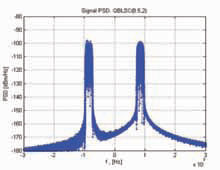
Current global navigation satellite systems (GNSSs) [1] are based on signals lying within the L-band of the radio-navigation satellite service (RNSS) spectrum. Since the need for more systems and signals is emerging, new alternative frequency resources are needed. In particular, the C-band frequency portion is envisioned as an option for future GNSSs…
U-blox supplying GPSS for Longcheer chinese handsets
Chinese mobile phone designer Longcheer Holdings Ltd will integrate Swiss chip maker u-blox’ single chip UBX-G5010 GPS receiver into a series of handsets. The models built incorporating the device, the G600, G800, and G630 have just become available while the G801 and G900 are expected to begin shipments to the Chinese market later in this quarter. www.u-blox.com
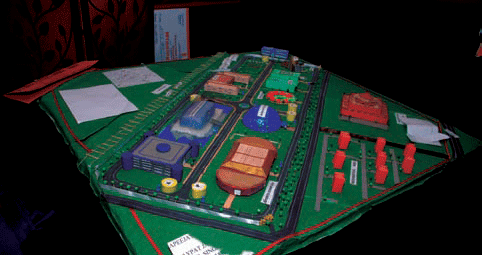
The competition started nearly two decades ago in the United States as the National Engineers Week Future City Competition with the aim to provide fun and exciting educational engineering programs for school students by combining stimulating engineering challenges with ‘hand-on’ application to enable them to present their vision of a city of the future…
EU developing ‘militarised’ space policy which could trigger ‘arms race’
The European Space Agency is accused of developing technology to dominate the “high ground” of space, including a multimillion pound EU Satellite Centre in Spain. The Transnational Institute, a Dutch think-tank, said: “EU-financed communication and spy satellites are slowly becoming reality and in the long term the inclusion of space-based missile defence and other more offensive uses of space are real options for an increasingly ambitious EU military space policy.” The report said French ambitions for the “militarisation of space” have led to arguments with Britain – particularly over Galileo, the much-delayed European global positioning system. President Nicolas Sarkozy of France, who currently holds the Presidency, said in June that space agenda was one of his priorities. Galileo would be vital in any European deployment of the sort of GPS-guided artillery now being used by the US in Iraq and Afghanistan
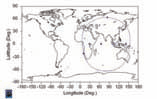
Demand for Satellite Navigation technology and applications keeps on increasing in a wide range of economical, social, technological and environmental sectors. This growing interest in the development of Satellite Navigation Systems is demonstrated by the interest of several countries in starting the development of new systems or contributing to existing ones. The major rational behind is…






 (5.00 out of 5)