



says Lt Gen Ranjit Singh, SM, Engineer-in-chief and …
The 49th Annual General Meeting of Institution of Surveyors …

As the GPS surveying techniques started showing promise of high accuracy geodetic positioning in the early 1990s, few “open-minded” geodesists realized the possibility of using ellipsoidal heights in place of orthometric heights. Many conceptual approaches were mentioned and proposed in various applications. However, Steinberg and Papo were the fi rst to publish a paper entitled “Ellipsoidal Heights: The Future of Vertical Geodetic Control” (GPS World, Vol. 9, No. 2, 1998). As could be expected, Petr Vanicek, a geodesy professor, was quick to downplay the proposed new “type” of vertical control (GPS World, Vol. 9, No. 4, 1998). It seems that Steinberg and Papo did not “defend” their new proposal. Thus, in this paper, a review has been made to check and comment on Vanicek’s example against the ellipsoidal heights, reference to orthometric islands, and issuance of a warning for non-dissemination of ellipsoidal heights to Canadian users.
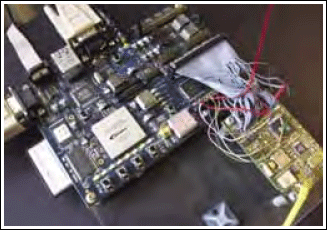
In early 2004 a plan was hatched to develop a Global Navigation Satellite System (GNSS) receiver based around Field Programmable Gate Array (FPGA) technology as a platform to support research in this fi eld. A joint project was set up between the School of Surveying and Spatial Information Systems (SISS) at the University of New South Wales and the National ICT Australia (NICTA), and soon after a small team was established. The team consisted of Kevin Parkinson, a post-graduate student at SISS with experience in FPGA and circuit board design, Frank Engel, a researcher with NICTA with software, Real Time Operating Systems (RTOS) and VHDL design knowledge and me, Peter Mumford from the SISS GNSS research group. At the end of the project we hoped to have an L1 GPS receiver running on a custom circuit board with the baseband processor and navigation solution processor running on an FPGA chip. The project is coming to an end now, and in this article, I will describe our design path, what has been achieved to date and then some potential research areas, but fi rst a little background.
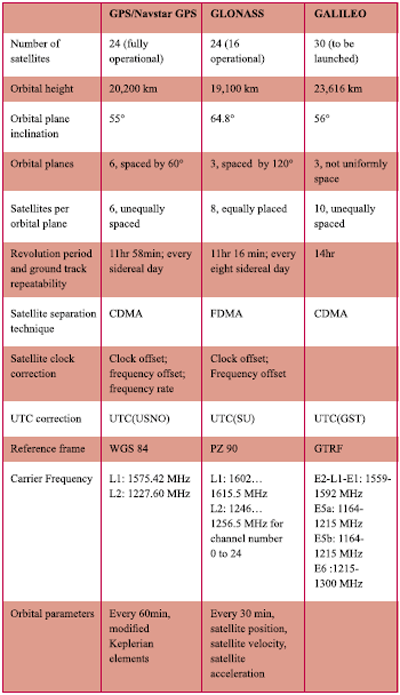
GNSS is a global navigation satellite system comprising of network of satellites that transmit ranging signals used for positioning and navigation anywhere around the globe; on land, in the air or at sea. The US Global Positioning System (GPS/Navstar GPS), the Russian Global Navigation Satellite System (GLONASS) and the upcoming European GALILEO system, Data communications satellites with navigation payloads and Augmentation systems are all part of GNSS.
In the present paper, a method making a long baseline kinematic positioning possible in the present dual frequency system is discussed
In the discussion, the wide lane observation equations are used, since the initial ambiguities of wide lane combinations are calculated easily by using HMW (Hatch- Melbourne-Wübbena) combinations.
Filmmaker Rakesh Sharma has sued New York City for being `detained and harassed’ by its police while making a documentary about ordinary folks in a post-9/11 world. Backing Sharma’s suit, the New York Civil Liberties Union has challenged curbs on people’s right to photograph public places. Police offi cers confronted Sharma in May 2005 for allegedly fi lming a “sensitive building”. They interrogated him for three hours. Despite “cooperating with them, they treated me like a criminal,” the maker of Final Solution, a documentary on the Gujarat riots, said. Mr Sharma was told he needed a permit to fi lm on city streets and then was denied one without explanation when he applied to the Mayor’s Offi ce of Film, Theatre and Broadcasting, the lawsuit said. (Hindustan Times, January 12, 2006, New Delhi).

Under the lens-’Right’ Vs ‘Rights’ BAL KRISHNA
Wide-lane kinematic positioning in multiple frequencies H ISSHIKI
Advances in GPS/GNSS data processing SRIDEVI JADE
An open GNSS receiver platform architecture PETER MUMFORD, KEVIN PARKINSON AND FRANK ENGEL
Ellipsoidal heights and engineering applications MUNEENDRA KUMAR
Recovery status a year after the tsunami ANSHU SHARMA
Rationalising the village planning process AKSHIMA DOGRA






 (5.00 out of 5)