



US expresses concern over satellite-killing test by China
The USA, Australia and Canada have voiced concerns to China over the fi rst known satellite-killing test in space in more than 20 years. The capability demonstrated by China was no surprise to the Bush administration, which revised U.S. national space policy in October to assert a right to deny space access to anyone hostile to US Interests. The US has been researching satellitekillers of its own, experimenting with lasers on the ground that could disable, disrupt and destroy spacecraft. http://news.scotsman.com
NATO awards GIS contract to TENET
NATO NC3 Agency has awarded the GIS Data Preparation Contract to TENET supported by Galdos Systems Inc. and IIC Technologies Inc in Canada. The project involves the generation of a wide range of geospatial data models compliant with some of the latest spatial open information standards from OGC and ISO and the conversion of many terabytes of vector, raster and gridded data. A large proportion of NATO’s paper holdings of maps and charts will also be digitized and converted to the same set of open standards. The objective is to create an open and shareable map database as part of NATO core GIS infrastructure withinz the Alliance. At the forefront of these open standards are the two key encodings of GML and GMLJP2 to provide effective encoding for Raster and Coverage data.
www.galdosinc.com
Russia, India sign agreements on GLONASS
Russia and India has signed two cooperation agreements on GLONASS, which will be used by Moscow’s longtime partner in the military-technical sector. The agreements were signed by the head of Russia’s Federal Space Agency, Anatoly Perminov, and Madhavan Nair, chairman of the Indian Space Research Organization (ISRO). Perminov earlier said Russia and India plan to jointly use GLONASS. Russian Defense Minister Sergei Ivanov said that Moscow and New Delhi had agreed to launch GLONASS-M satellites with the help of Indian booster rockets, and to create new-generation navigation satellites. The Russian Ministry of Defense has already lifted all restrictions on obtaining and using the geospatial information provided by the GLONASS.
http://en.rian.ru
Leica FCMS Flight & Sensor Control Management System
Sweden-based Leica Geosystems’ Flight & Sensor Control Management System (FCMS), assists pilots and sensor operators to effi ciently control GPS-based survey fl ights. It performs all tasks, such as fl ight guidance, sensor recording and sensor monitoring, on a single man-machine interface, providing automated operation and minimized user interaction.Leica Geosystems also introduces the Rugby 50 and Rugby 55. With the Leica Rugby 50 and 55 are two new lasers that are designed for different applications: The Rugby 50 is dedicated to general construction contractors, being a tough, affordable laser with a single button. Whereas the Leica Rugby 55 is designed for the interior contractor – a versatile laser, perfect for almost any leveling and alignment job. In addition, Leica Geosystems has also announced a new enterprise software licensing program called Leica EnterpriseElite. Qualifi- ed companies benefi t from simplified software license management tools, fl exibility to immediately react to changing project demands, signifi cant software cost savings, and the ability to effi ciently standardize an entire global organization. www.leica-geosystems.com

As part of the 17th United Nations Regional Cartographic Conference for Asia and the Pacific (UNRCC-AP) held in Thailand in September 2006, Working Group 3 of the Permanent Committee for GIS Infrastructure for Asia and the Pacifi c (PCGIAP) organised a one-day international workshop (21st September 2006) on the‘Integration of Built and Natural Environmental Datasets within National SDI Initiatives’. The workshop was conducted with the support of the Centre for Spatial Data Infrastructures and Land Administration, the University of Melbourne.

GPS has demonstrated a stellar performance ever since its inception. In fact the satellites typically operate beyond their expected lifetime which potentially creates obstacles to the timely modernization of the system. GPSGAP (GPS, Geodesy and Application Program) is an online educational initiative by the University of Maine that offers in-depth knowledge about this fantastic system and its uses.
My enthusiasm for GPS began when testing the experimental Macrometer receiver during the summer of 1982 at M.I.T. over a 30 km baseline from Woburn, MA, to Mount Watchusett. The satellite visibility ranged from about 6 p.m. to midnight in New England. Many of the sunset watchers at the summit were puzzled by my activities and impressed by the huge piece of equipment in the back of my station wagon, the abundance of cables, and the strange looking antenna (so they thought). Their puzzlement about what I was up to was refl ected in some of their comments, such as“Is this thing taking off?”, or “Are you on our side?” Of course, there was plenty of time until midnight to be entertained by Fourier transforms and such on the computer screen, and to ponder the unlimited potential of GPS. Whatever has evolved since those days in terms of civil uses of GPS needs no further explanation.

In India, for topographical mapping, we are using an old Geodetic Datum (reference ellipsoid on which the coordinates: Latitude and Longitude are projected, and mapping is carried out), called Everest 1880, defined by the work of Col. George Everest (one of the greatest Geodesists, for whom the highest peak in the world is named). It is a local datum, best-fi tting for India (as in 1880), but not fi tting the Earth as a whole in the best possible manner.
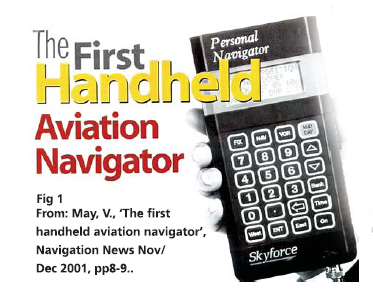
Today’s professional navigators may well be the last. As recently as a generation ago, navigation was almost solely the specialised art of a small number of highly-skilled people. They wore uniforms with emblems on their shoulders. They had years of training.They used complex, expensive, equipment. They bestrode the bridges of ships and the fl ight decks of the large commercial aircraft and took star shots.
Sales contract from Cessna Aircraft Company to Leica
The Metrology Division of Leica Geosystems, Switzerland announced USA based Cessna Aircraft Company, a Textron company, has signed a sales contract for eight portable Leica Geosystems CMM systems used for industrial measurement and inspection. The acquisition consists of four Leica LTD840 Laser Trackers, and four Leica LTD640 Laser Trackers. Cessna is a manufacturer of general aviation airplanes. Leica Geosystems’ 3D coordinate measurement systems are used by manufacturers worldwide in the aerospace, automotive and shipbuilding industries. www.leica-geosystems.com

The U.S. National Space Policy (NSP) was authorised by President Bush on August 31, 2006. This NSP establishes an overarching national policy that governs the conduct of U.S. space activities and supersedes the 1996 NSP.
The unclassified ten-page summary of the NSP consists of 13 self-contained sections including the principles, goals, guidelines (both general and specific to national security space, civil space and commercial space), international space cooperation, space nuclear power, radio frequency spectrum, orbital debris, effective export policies and space-related security classification.






 (5.00 out of 5)