
| GIS | |
Technology advances in healthcare and public health management
As we architect the next generation of Research Projects and National Health Data Stacks, our conclusion must be rooted in a “Phy-gital” reality where technology does not replace the Physician or experience, but empowers them with planetary-scale health insight intelligence. |
 |
|
Disease has been a subject of fear and challenge in equal measures for humanity. Over centuries, many technology discoveries have changed the medical landscape – each medical discovery has brought us a crucial step closer to better understanding the complex mysteries of disease and medicine. Humans have been able to adapt to evolving and improved knowledge of human body and our environment and develop medical breakthrough treatments that have been instrumental in saving millions of lives; combatting deadly diseases; bringing relief, betterment and increasing longevity to human life.
In any human endeavour, technology has always been the primary catalyst for the expansion of human potential. In the realm of human biology, this relationship is at its most profound. Indian civilization was perhaps the world’s “first principle” of systemic health that modern technology is finally able to quantify at scale. For many centuries, medicine developed as an art of observation and intuition. Around 1800s, there was a major shift – the “Technology” of the 1800s introduced the stethoscope—a simple wooden tube that first allowed listening to the internal heartbeat symphony of the human body. Since then, the trajectory of healthcare has been defined by our ability to see further into the microscopic scales of human biology and create images of human body. Technology has transitioned healthcare from episodic intervention (treating the sick) to continuous management (maintaining wellness).
In my talk, I want to highlight key technology domains that are driving progress and delivery in healthcare management, including digital health, artificial intelligence, biotechnology, and—crucially—geospatial technologies. To understand the sophisticated “prognostic” world we are building today for intelligent Healthcare, I would quickly trace the specific technological triggers that turned the tide of human history in healthcare, with the foundational mastery of the biological and chemical worlds.
A] Technology in healthcare management – A retrospective
The technical foundations of Healthcare can be categorised into 5 broad stages:
• The era of biological mastery (1800s) – The Vaccine-Anaesthesia Antibiotics revolution: For centuries, human healthcare was trapped in superstition and seen as the wrath of the Supreme. It was Vaccines that changed the concept – inoculations to tame the infamous smallpox virus by Edward Jenner brought on the usefulness and popularity of vaccines and helped to combat some of the world’s deadliest diseases, including smallpox, rabies, tuberculosis, and cholera and in our recent memory Covid pandemic. Similarly, General anaesthetics, in 1846 changed the field of surgery when William T. G. Morton successfully used ether as an anaesthetic during surgery, and thereon safer anaesthetics were developed, allowing millions of life-saving, painless surgical operations to take place. In 1861, French microbiologist Louis Pasteur proved invasion of specific microscopic organisms – also known as pathogens – and then started the Germ Theory – marked a significant turning point in how diseases were treated, controlled and prevented – especially plague, dysentery, typhoid fever, Covid and many others. We are all grateful beneficiaries of Alexander Fleming’s penicillin, the world’s first antibiotic in 1928, by which the war against deadly bacteria began. It was a great healthcare technology tool that has served humanity – but, nowadays increasingly resistance to antibiotics is emerging and routes for new anti-bacterial treatments are being discovered.
• The era of systemic medicalengineering (1950s – 1980s) – The hardware and software of human biology. Organ transplants were first done in 1954 with successful kidney transplant done for first time; in 1963, the first lung transplant was carried out, followed by a pancreas/kidney in 1966, and liver and heart in 1967. Transplants have saved thousands of lives; transplant procedures have also become increasingly innovative and diverse, with doctors successfully completing the first-hand transplant in 1998 and full-face transplant in 2010! Just last year, in 2024, the first transplant of a genetically-edited pig kidney into a living human was accomplished.
Development of antivirals in 1960s revolutionised healthcare management further – Viral bonding with cells is so structural, isolating the virus (and not affecting the cells) was overcome by “molecular interference” for blocking the rapid reproduction of viral infections, and even stimulate the immune system to attack the virus. The development of effective antivirals has been significant in treating and controlling the spread of deadly virus outbreaks such as HIV/AIDS, Ebola and rabies.
• The imaging revolution (1970s-90s) – Imaging and Digitisation of Anatomy: The technology of Medical imaging started a revolution in 1895, when William Rontgen created the X-Ray imaging – providing the first pictures of inner body parts. Then came Ultrasound for metabolic diagnosis in 1955, and in 1967, the CT scanner fused X-ray detectors and computers to diagnose many different types of disease. In 1973 Paul Lauterbur produced the first MRI – nuclear magnetic resonance images for detecting various metabolic lifethreatening conditions. CT and MRI didn’t just show us organ images; they converted human anatomy into a 3D Visualisation System. We began to visualise the “Body Map” and study the anatomy in spatial patterns, enabling the transition from “exploratory” surgery to “targeted” intervention. We stopped “cutting to see”; we saw images so that “surgery could be with precision”.
• The era of regenerative & precision defense (1990s – Present) – Bio-Programming Health care. In 1970s Stem cell therapy (The Regenration) enabled renewal through cell division even after being inactive, and under certain conditions used to make any type of human cell. This technology has enormous potential in cancer treatment. However, ethical issues have also been raised for use of Stem Cell – especially in embryonic stem cells.
Immunotherapy (1970s) (Precision Defence) enabled stimulating the immune system to fight off a disease, particularly in respect to treating cancer. In the last decade, immuno-oncology has become one of the most revolutionary cancer therapies in existence. Without use of toxic chemicals (Chemo) to kill cancer; one can “train” the patient’s own immune T-cells to recognize and incinerate the tumor.
• The genomic leap (2000s) – The Blueprint of the Cellular: The completion of the Human Genome Project turned biology into an information science. The value wasn’t just in identifying the 3.3 billion base pairs that make up a human; it was in the fundamental reclassification of biology in a digital code and emergence of Bioinformatics and Genomics surveillance. It provided the fundamentals for personalized medicine. The Human Genome Project was like the “GPS for the Cell.” It provided the static map of our body code; it gave us the Syntax of Life. In the past, we treated diseases by their location— breast cancer, lung cancer, liver cancer. Today, they can be treated by their Instructional Error – so, ‘cancer’ is seen not as a tumor, but as a corrupted line of digital code. The future is no longer just to cut or cauterize; it is to debug and repair the biology code – enabling newer painless treatment to emerge.
• The continuous measurement era (2010s) – Advances in Device Technology & Measurement: The proliferation of IoT democratized medical data; High-speed internet enabled tele-health, breaking the barriers of geography for the first time. In the past, a medical “measurement” was a single data point in time—a blood pressure reading at a clinic or a once-ayear blood test. Today, we have moved from snapshots to Body-Graphs – we look at the trend. “Smart Device” is a piece of strapped-hardware as a Software-Defined Medical Instrument. Next-Gen Wearables & “Invisible” Sensors that measure Continuous Glucose Monitors (CGM) provide a 24/7 metabolic map, revealing how specific foods or stress levels impact blood chemistry in real-time. Medical-Grade Smart Rings & Patches track Heart Rate Variability (HRV), blood oxygen saturation (SpO2), and even ElectroDermal Activity (EDA) to predict the onset of illness or a cardiac event days before physical symptoms appear. Micro-Smart Implants are embeddable in the body sub-cutaneous and provide stream of observations throughout the day. A smartwatch doesn’t just record an irregular heartbeat; it runs an ondevice algorithm to distinguish between harmless caffeine-induced palpitations and life-threatening Atrial Fibrillation (Afib). The Internet of Medical Things (IoMT) is now a reality – the mobile “Connectivity” and software algorithms are the backbone of this device revolution.
One can see that in just 200-250 years, the human body is no longer a biological mystery; it has become the most complex data architecture in existence. So now, every clinical encounter— every ECG trace capturing the electrical rhythm of a heart, every CT and MRI slice mapping the 3D coordinates of our internal geometry, and every longitudinal blood report tracking the chemical signatures of our metabolism—is digitized into a monumental, trillion-parametric knowledge base. This “Human Body Graph” is not merely a collection of individual records; it is a multi-dimensional tapestry that spans across lifetimes, across diverse genetic lineages, and across the vast “Where” of our global geography. We have effectively spatially indexed the human condition in a unique human biology coordinate system. This colossal repository of high-fidelity health measurements represents the best setting for an ultimate frontier for Artificial Intelligence…the stage is perfectly set!!
B] Generative AI – The future of healthcare
We are already witnessing the beginnings of Generative AI era in Healthcare!! Generative AI and Predictive AI are starting to significantly alter the healthcare landscape. AI is the “cognitive infrastructure” of modern medicine – it has moved beyond simple pattern recognition (like identifying a fracture on an X-ray) to content and medical knowledge synthesis.
The AI awakening (2020s) – Democratisation of Predictive and Precision Healthcare
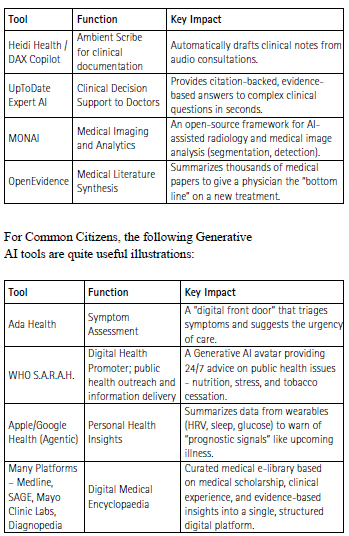
Life science research institutions are teaming up with pioneering AI technology giants (Google, IBM and Apple, OpenAI, Claude, OpenDialog etc) to create more effective ways to deal with diseases and healthcare for patients. The current applications of AI in healthcare are broad, from disease diagnosis and drug discovery to personalised treatment plans, patient monitoring, and human-like chatbots.
Ambient Clinical Documentation that generate instant structured, compliant medical notes (SOAP notes); De Novo Drug Discovery to generate molecular structures that have never existed and reduce drug discovery process/time by half; Synthetic Patient Data that creates “synthetic” patient populations that mirror the statistical complexities of real humans etc are some visible AI developments in Healthcare management. Large Language Models (LLMs) and Neural Networks are outperforming humans in pattern recognition, from detecting early-stage carcinomas in radiology to predicting protein folding. AI is now performing Multi-Modal Fusion—taking a satellite image of a city’s air quality, a patient’s genomic predisposition, a MRI image, and their real-time heart rate to predict an asthma attack 48 hours before the first wheeze.
C] Geospatial technology: from mapping to planetary intelligence
Geospatial technology has moved beyond the era of static maps or a niche survey tool used for mapping resources, administration boundaries and topography. Today, it has matured into a Live GIS Agentic Model – a digital, searchable, and temporal 3D coordinate system where every square inch of our world is a living geospatial data point.
The “Eye in the Sky” has evolved from simple optical snapshots into a regime of Multi-modal Transparency. With 100s of highrevisit Earth Observation (EO) constellations and Synthetic Aperture Radar (SAR), operated by United States, China, Japan, Russia, and India, we can now detect the “daily heartbeat” of our people, our actions and changes in Earthscape—from the moisture levels in a forest that signal a zoonotic spillover to the urban heat islands that predict a spike in respiratory distress. Tremendous innovations are happening in Satellite Imaging, some of the key ones are:
• 30-cm and Sub-30-cm Resolution on daily basis: The commercial EO market is pushing towards 30 cm resolution (or better), offering unprecedented clarity to identify small ground objects, such as vehicles and detailed infrastructure, which is highly valuable for health assets mapping and urban planning.
• Advanced Hyperspectral Imaging: Beyond traditional multispectral imaging (RGB + NIR), future sensors will capture hundreds of spectral bands, allowing for precise chemical composition and object analysis of the Earth’s surface. This will enable better detection of biota, minerals, pollutants, and methane leaks and contribute to Healthcare applications.
• Next-Generation SAR (Synthetic Aperture Radar): SAR technology is advancing to provide upto 1m high-resolution, day-and-night, allweather imaging. This is critical for all-weather monitoring, as it can penetrate cloud cover to detect ground movement, such as in floods or landslides and in emergencies.
• On-Orbit AI and Edge Computing: Instead of transmitting massive amounts of raw data to the ground for processing, future satellites will feature AI-enabled, on-orbit data processing. This will enable satellites to filter out cloud-covered images, detect anomalies, and recognize objects in real-time, reducing bandwidth usage and increasing operational speed. In fact, we may get not just images but also processed information in real-time.
• Increased Revisit Rates and RealTime Data: The growth of small satellite (CubeSat) constellations, such as those from Planet Labs, means higher frequency imaging, enabling near-real-time monitoring of rapid changes on Earth. Almost on daily basis, anywhere in the world!!!
• Foundation for Geospatial.AI Architecture:
Future Geospatial. AI systems will integrate diverse image datasets—combining satellite optical, radar, and hyperspectral data with ground-based, drone, and IoT sensor information and Health records —to create a holistic, unified view for Healthcare Management and be the foundation for the Generative AI LLMs.
• Quantum Sensing and Advanced Communication: Emerging technologies like quantum sensors will improve accuracy, while laser communications will offer higher bandwidth for transmitting data in 2-ways – to the satellite (in terms of ground information for Edge Processing) and from the satellite (to receive the processed information).
In the modern architecture of governance, GIS is no longer a desktop software or an “information System”; it is a Cloud-Native Utility of spatial intelligence. Mapping has migrated to the “Edge”, where mobile or device applications serve as bi-directional sensors, fusing crowdsourced human intelligence with authoritative spatial registries. In this new paradigm, the “Live Map” is the primary interface for the Internet of Medical Things (IoMT).
The true “Prophetic” shift, however, lies in the fusion of Generative AI and Geospatial technology. Geospatial AI (GeoAI) is now a reality that is beyond simple feature detection. By training Foundation Models on decades of satellite imagery and health outcomes, we are building systems that don’t just ask “What is there?” but “What will happen there?” or “When will it happen”; we are automating the extraction of intelligence from terabytes of imagery in minutes, allowing us to predict the structural vulnerability of a city’s health infrastructure years before a crisis hits.
The ultimate goal of using Geospatial. AI for Healthcare Management must not be just to treat maps and datasets as static repositories. Geospatial data and Health data and Medical knowledge will fuse into a “single data currency” for future Healthcare governance. We need to build an advanced spatial intelligence for Health and Healthcare —the ability to understand the “where” dimension of diseases/patients and convert it into actionable insights for efficient and quality Healthcare services.
Geospatial Applications in Karnataka
In 2016, Government took the decision of establishing the Karnataka Geographic Information System (K-GIS) in support of scientific planning, proper decision-making for equitable governance, industrial development and citizen empowerment in the state. K-GIS has geotagged Health Assets and created a GIS Dashboard to visualize statistics, generate reports and compose maps of user choice. Last year, Government decided to assimilate many emerging and advanced technological developments – especially, Generative AI modelling; Spatial (Data) Analytics (SA), Artificial Intelligence (AI) and Deep Learning (DL), Internetof-Things (IoT), advanced computational and image vision etc to expand to K-GIS Ver 2.0, as a next generation, technological and state-wide GIS infrastructure to cater to the future needs of Karnataka’s governance, industrial development and citizen-centric services.
In a very stimulating study by IIIT-B, have defined GeoHealth Karnataka, a new end-to-end geospatial framework that incorporates advanced spatial analysis methods to assess healthcare accessibility by integrating high-resolution population rasters, mapping of healthcare facilities, travel-time estimation with friction surfaces. The study highlights Healthcare Infrastructure Gaps and need for focused interventions could improve accessibility for over 12 million underserved residents by up to 52%.
JSS AHER in a study of 2022 has also studied GeoAI and its potential for disease diagnosis, treatment planning, resource allocation and identifying health disparities.
Geospatial.AI in Healthcare – Live Healthcare Spatial Intelligence.
Health is inherently spatial – it has a location tag – either by the location of the patient or by the location of disease treatments or by location of medicine sales or by location of environmental/ climate shifts in air/water/land qualities or location of drastic climate changes and patterns. It also has a geographic spread – in terms of a region. Hospital can have command area regions; pandemic can have a spread region; polluted water can have a region of vulnerability, and so on. Even the body images are in spatial character – in a unique body coordinate system and their own topology – thus geographic coordinates twine with body coordinates data in the Geoaspatial.AI for Healthcare.
Some of the unique applications in Geospatial Healthcare arena are:
• Disease vector modeling: Satellite imagery is used to map disease vectors by geospatial integration of environmental factors like temperature, humidity, rainfall, and vegetation, which dictate the habitat and breeding of mosquitoes, ticks, and flies. Satellite Based Environmental Surveillance is undertaken by analyzing data from satellite images to map land cover, water bodies, and urbanization, identification of high-risk areas for diseases like Malaria, Dengue, Rift Valley fever, and Cholera is possible. Using satellite data stagnant water bodies and vegetation indices (NDVI) are quickly mapped and integrated with clinical records and daily weather data; this allows health officials to predict Malaria and Dengue outbreaks 2-3 weeks before they hit urban centers. Disease vectors for Tse-tse flies for sleeping sickness in Africa have shown positive vector mortality rates correlation with mean monthly NDVI values from satellite images. High Resolution Spatial Epidemiology analysts integrate disease case counts with environmental, demographic, and mobility layers. During the Ebola outbreak in West Africa, GIS supported contact tracing, mapping of transmission chains, and optimization of treatment center placement. During COVID, many nations, including India, created GIS Dashboards of infections, O2 availability, hospitals saturation etc – in fact the Johns Hopkin University COVID Dashboard was the most unique example of GIS application in COVID management.
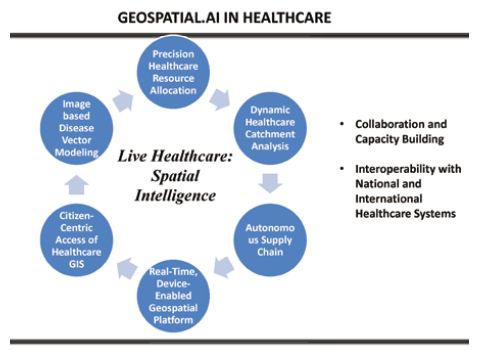
• Precision healthcare resource allocation: In the classical model of public health, resource allocation is driven by historical averages and administrative boundaries—a “top-down” approach that often results in simultaneous surpluses and catastrophic shortages. Today, Precision Resource Allocation (PRA) has transformed into a realtime, predictive discipline that treats medical supplies, oxygen, and human capital as a fluid, geolocated inventory on a Geospatial platform. The PRA leverages spatiotemporal Load Balancing and integrating live feeds from Hospital Management Information Systems (HMIS) with traffic data and weather models, one can now predict “surge clusters” before they overwhelm a hospital facility.
• A critical evolution is Dynamic Healthcare Catchment Analysis. We no longer view a hospital’s reach as a static circle on a map. Using Isochrone Mapping—which measures travel time rather than distance—we account for real-time urban congestion, jammed or flooded roads, or infrastructure bottlenecks real-time. This ensures that a “Precision Dispatch” system doesn’t just send the nearest ambulance, but the one with the fastest optimized path to a facility that has the exact specialized capacity (e.g., an available Cath Lab) required for that specific patient. Furthermore, the “Cold Chain” for vaccines and temperature-sensitive biologics has been revolutionized by IoT-GIS Integration. Every vial is now a “connected node” on a map. We aren’t just tracking where the vaccine is; we are monitoring its thermal integrity via satellite-linked sensors. If a refrigeration unit fails in a remote district, the system automatically triggers a Geospatial Re-routing Logic, identifying the nearest functional cold-storage point and recalculating the logistics to salvage the batch. During the COVID-19 pandemic, GIS dashboards were the “Command and Control” centers, identifying oxygen-deficit zones and optimizing the supply chain in real-time.
• For a hospital or a state health department, an important frontier is the Autonomous Supply Chain. We are looking at a future where drone swarms, guided by high-resolution 3D terrain models, perform “LastMile Precision Drops” of blood units or anti-venoms to inaccessible terrains. Medically, the “Golden Hour” Optimization would require Geospatial network analysis to help locate ambulance hubs so that 90% of the population can be reached within 8–10 minutes, significantly improving survival rates for acute cardiac events.
• Transition from static health paperrecords to a Real-Time, MultiDevice-Enabled Geospatial Platform is a reality —the “command and control” center for Healthcare in next few years. In this paradigm, healthcare will be no longer a building you visit; it is a continuously updated, highfidelity digital twin of the community’s collective biology. Modern healthcare would thus become an interconnected network of thousands of “living nodes”: patient wearables tracking vital prognostic signals, hospital assets like ventilators and beds and lab instruments tagged with spatial sensors, and the precise, real-time locations of doctors and nurses mapped across the facility.
Imagine a futuristic Geospatial.AI Healthcare Dashboard that “breathes” with the city: it visualizes a sudden cluster of respiratory distress signals in a specific neighbourhood, correlates it instantly with a localized spike in PM2.5 air quality detected from pollution and climate sensors, and automatically triggers an alert to the nearest hospitals and health units. On the clinical floor, the dashboard acts as an health-traffic control system, dynamically routing patients to the least-congested diagnostic bays and “paging” the nearest available specialist based on their real-time indoor geospatial coordinates (IPS). This dashboard would provide a “God’s-eye view” for Healthcare managers to manage outbreaks, while simultaneously offering a “Precision View” for the expert doctors and clinicians and smoothen the life of the patient to utmost levels.
• Citizen-Centric Access of Healthcare GIS services – democratize spatial and healthcare data for use at the grassroots level—empowering citizens, Health officers at Panchayats, and local institutions, hospitals, emergency centres, pharma units and many others. The Geospatial Healthcare Platform would provide predictive medical analysis and spatial analytics for various Healthcare problems.
• Collaboration and Capacity Building by establishing a robust interaction for Geospatial. AI ecosystem between medical community and Geospatial.AI community and close-looping doctors, hospital managers, health officers, health professionals, medical colleges/academia, and health field staff to build and extend robust Healthcare services for future;
• Interoperability with National and International Healthcare Systems – Spatially explicit early state-/ national level warning systems are essential for healthcare management. Interface with NMC and WHO for Policies and Regulations; ISRO for space-assets for telemedicine and the Digital India Geospatial Ecosystem for seamless AI technology exchange and collaboration is called for. State efforts like K-GIS and national efforts at democratization of Geospatial data, driven by India’s 2022 Geospatial Mandate, can bring to reality that no citizen is “off the geospatial grid” and no health crisis remains “uncared.”
D] Some directions for future geospatial for healthcare
Technology is the only path forward for effective Healthcare because we face a global paradox: medical knowledge is expanding exponentially, yet healthcare systems are struggling under the weight of growing and aging populations and increasing chronic diseases. It is only technology that becomes a systemic necessity for:
• Addressing the Manpower Deficit: No nation can train doctors fast enough to meet the 1:1000 ratio recommended by the WHO. AI-driven triage and automated diagnostics would act as “force multipliers” for overworked healthcare systems – but under watchful “eyes” of human healthcare experts.
• Economic Sustainability: Modern healthcare costs are unsustainable. By moving toward Predictive AI, we can intervene when a patient is “pre-diabetic” or “prehypertensive,” saving costs in longterm healthcare and hospitalization.
• Equity of Access: Technology is the only tool capable of delivering “Level-5” specialist expertise to every citizen – say, in a primary health center in a remote village via Tele-medicine-enabled remote diagnostics and healthcare.
Looking 10-20 years ahead, we will move toward a “Post-Clinic” Era, where the primary site of healthcare shifts from the hospital to one’s “Living Environment” (home, personalised care). Every citizen will likely have a Physiological Digital Twin – a Generative AI model of “you”, updated in real-time by biosensors/devices; Doctors will test drug dosages on your digital twin first to see if it causes a reaction before prescribing medication. The “Pharmacy in a Box” will be a reality with Generative AI and advanced chemical synthesis and we may see the rise of decentralized drug manufacturing. Instead of massproduced pills, AI will design a personalized daily formulation that combines hypertension medication, vitamins, and a new anti-inflammatory, 3D-printed at your local pharmacy or even at home. Predictive Public Health will become hyper-local where AI will integrate satellite data (air quality, humidity, land, water, climate, disease vector patterns etc) with anonymous community health “signals” (e.g., a sudden spike in cough-syrup purchases in a specific zip code) to predict and ring-fence an outbreak before it becomes a pandemic. The Death of the “Average” will be the most profound shift away from “standard of care.” Medicine will be N-of-1. We will no longer say “This drug works for 70% of people.” We will say “This drug works for YOU because of his specific genetic markers and current environmental stress level.
For a premier academia and research Agency (such as JSSAHER), the next few years must be defined by Actionable Implementation, starting with robust pilot projects:
• Unified Health Data Exchange (UHDX): Build a secure, blockchain-backed Health Data Stack. Research is only as good as the data; we need anonymized, longitudinal data from our citizens to train Indian-centric AI models.
• The “Tele-Health” Initiative: Leverage India’s prowess in space and mobile technology to develop an advanced “Tele-medicine and Tele-Robotics” system linked with advanced wearable diagnostics and Predictive AI analytics.
• Standardization for Interoperability: Define Standards that every medical device, from a village BP monitor to a metro hospital’s MRI or CT scan or Blood Report or Surgical Procedure – all speak the same digital language (FHIR standards).
Space Medicine: The Ultimate Proving Ground
I have also suggested to JSS to lead the way and create a Vision for “Space Medicine: The Ultimate Proving Ground”. With India planning Gaganyaan and Bharatiya Antariksha Station (BAS) orbiting around Earth, it is not far when Indians will be flying in and from Space. So understanding and building healthcare systems for Space environment becomes very critical and JSS should lead the way.
But when we discuss Space Medicine, we are not merely talking about the health of human astronauts alone; we are actually talking of an “Extreme Health Laboratory for Terrestrial Innovation”. In Space’s isolation, every health resource will be finite, and every biological signal needs to be amplified and analysed so that instant care and treatment can be administered in Space. This constraint forces us to develop the most precise, low-power, and reliable medical measurement and analytics technologies for Space – in fact, the wearables were first successfully tried out on space astronauts in the 1960-1980 timeframe.
On other hand, all the technologies of Space Medicine would be actually the ultimate proving ground for “Frugal Healthcare High-Tech on Earth,” where we learn to manage complex health conditions with optimised measurement systems and maximum intelligence analytics —a Predictive AI model that can also be perfectly suited for the rural and remote stretches of the Indian subcontinent and its people. The innovations born from space— such as Digital Twins of Humans or Tele-robotic surgery with active latency compensation—are tools of tomorrow’s Earth-bound clinics and healthcare. After all if Healthcare is REMOTE for human astronauts in space; so is it for millions of citizens/ patients in rural areas too!! While we learn how to “re-program” the body’s response to extreme space environments remotely, the same technology can translate directly into treating the “extremes” of remote patients, aging population, chronic disease, and environmental stress.
By integrating AI, Space-grade reliability with Geospatial precision and embedding into modern Healthcare, we would be building a system where the “Space-to-Symptom” link is instantaneous, intelligent and ensuring that HEALTHCARE SPECIALIST’s touch can reach the patient “remotely”, as effectively as in a hospital, even in the furthest corners of space orbits or the farther rural villages in the state or even on Himalayan peaks – as if they were all in the same room.
E] In conclusion
The technology in healthcare has undergone a fundamental shift; we have moved from the Era of Discovery— where we celebrated the isolation of Penicillin and the first mapping of the human genome—to the Era of Intelligent Integration. The points that I have highlighted—from the precision of satellite images and dronederived digital twins to the “n-of-1” biological blueprints provided by genomic sequencing—are no longer disparate technological silos. They are the converging threads of a single, Cognitive Healthcare Intelligence.
Ultimately, the future of healthcare and public health management in India will not be just defined by the sophistication of individual technologies, but only by the prophetic intelligence of our Healthcare experts – without the expert’s intelligence, the future AI models will be mechanistic and a black-box. As we architect the next generation of Research Projects and National Health Data Stacks, our conclusion must be rooted in a “Phy-gital” reality where technology does not replace the Physician or experience, but empowers them with planetary-scale health insight intelligence. We are standing at the threshold of a world where geography is no longer a barrier to specialist health care, where “average” treatments are replaced by “absolute” precision, and where the Real-Time Autonomous Healthcare Dashboard serves as a silent, vigilant guardian for every citizen.
Referred materials:
• World Health Organization (2027) Global strategy on digital health 2020-2027 – https://www.who.int/ publications/i/item/9789240116870
• WHO GIS Centre for Health – https://www.who.int/data/GIS
• CDC (2020–2024) Public Health Surveillance and GIS Applications
• European Centre for Disease Prevention and Control (ECDC) GIS and Remote Sensing for Public Health – https:// www.ecdc.europa.eu/en
• McKinsey Global Institute (2023) The Future of AI in Healthcare – https://www.mckinsey.com/ industries/healthcare/our-insights/ generative-ai-in-healthcare-currenttrends-and-future-outlook
• Nature Medicine, various issues (AI diagnostics, genomics, public health modeling)
• The Lancet Digital Health (Digital public infrastructure and national digital health strategies)
• The top 10 medical advances in history – https://www.proclinical. com/blogs/2021-6/the-top-10- medical-advances-in-history
• Karnataka – GIS – https://kgis. ksrsac.in/kgis1/portal.aspx
• Geospatial AI for Health: A New Era of Insight, Intelligence, and Impact – https://www.esri.com/en-us/industries/ blog/articles/geospatial-ai-for-health
• Geospatial AI – https://www. esri.com/en-us/geospatialartificial-intelligence/overview
• Analysis of geospatial data services for healthcare – https:// www.infosysbpm.com/blogs/ geospatial-data-services/geospatialdata-for-healthcare.html
• Geospatial Artificial Intelligence (GeoAI): Applications in Health Care – https://journals.lww. com/jhas/fulltext/2022/10000/ geospatial_artificial_ intelligence__geoai__.4.aspx
• GeoHealth Karnataka: A Geospatial Framework for Comprehensive Healthcare Accessibility Analysis – https://dl.acm.org/ doi/10.1145/3748777.3748798 • Curated information and Processed using Generative AI – Google Gemini AI Pro.
The article is based on the keynote address titled “Geospatial Technologies for Healthcare and Public Health Management,” delivered during the Faculty Development Program (FDP) at JSS Medical College, Mysuru, India, on March 3, 2026. The keynote was shaped by insightful discussions and valuable inputs from Dr. H. Basavanagowdappa, Vice-Chancellor; Dr. Narayanappa, Principal; Dr. Vishal Gupta, Dean (Academics); and Dr. Madhu, Professor and Head.







Leave your response!