



What is the potential of high resolution imageries?
There has been a great increase in awareness about high resolution satellite and aerial imagery. The credit goes to the players like Microsoft Virtual Earth, Yahoo, and Google Earth. In many countries nowadays, even kids talk about on-line imagery and maps. It is bringing …
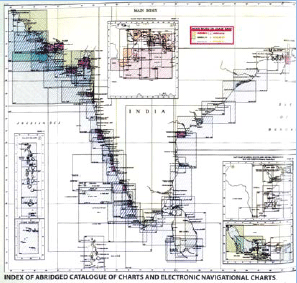
World Hydrographic Day is being celebrated on the 21st June every year to commemorate the establishment of the International Hydrographic Bureau by 19 member states in 1921 at the Principality of Monaco at the invitation of HSH Prince Albert I, a noted marine scientist and oceanographer, who had graciously offered the requisite space and facilities free of cost. In 1970, it was renamed as the International Hydrographic Organisation (IHO) and has presently 80 Member States, covering the vast majority of Ocean States. IHO plays a very useful role in Standardisation, International Charts, Capacity Building and Technical Cooperation, Education and Training, Hydrographic Surveying, Charts (paper and digital), Regional Hydrographic Commissions, Cooperation with other International Organisations, Tsunami Information, and nautical Publications.
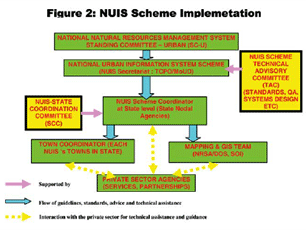
State of the art global communication technologies and thriving economy is facilitating Indian cities to compete in the global environment. The constant transformation of urban areas into complex entities has brought forth new challenges and opportunities for Planners to design and implement a variety of activities in spatial terms. There is need to tread common ground so as to address problems and issues in the right perspective to assist cities in coping with economic realities and thereby produce high quality responsive environment and demonstrate successful urban solutions.
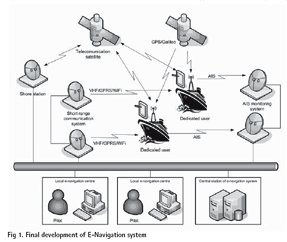
The common objective shared by all the Member States of IMO (International Maritime Organization) is a commitment to deliver safe, secure and effi cient shipping on clean oceans. The co-sponsors of this submission believe that IMO now has an opportunity to develop and map out a clear strategic vision for one common integrating and utilizing all the navigational technological tools at our disposal to secure a greater level of safety and incident prevention which will, at the same time, deliver substantial operating efficiencies with resulting commercial benefi ts, whilst also continuing to respect the freedom of navigation rights.
July 2007
Cambridge Conference 2007
15-20 July Cambridge, UK
www.ordnancesurvey.co.uk/
Asia Oceania Geosciences Society, 4th Annual Meeting
30 July – 3 August, Bangkok, Thailand
August 2007
7th International Workshop of Geographical Information System
1-3 August Beijing, China
iwgis@lreis.ac.cn
XXIII International Cartographic Conference
4-10 August, Moscow, Russia
info@icc2007.com.
GIS 14 Conference
14-15 August 2007
Vietnam
2nd Indonesian Geospatial Technology Exhibition
29 August – 1 September
…

NovAtel Inc launches new OEMV products
NovAtel has launched its new OEMV-1G and FlexPak(TM)-V1G products with GPS+GLONASS positioning solutions. Also, full GPS+GLONASS AdVance RTK (Real Time Kinematic) positioning capabilities are available on all existing OEMV-2 and OEMV- 3 products via its 3.2 Firmware release. www.novatel.com.
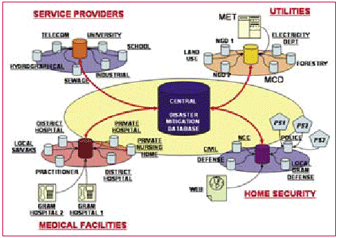
In recent past , humanity has suffered an increasing number of natural disasters affecting more than 2.5billion people, killing 478,100 and causing economic losses of about US$690bn (UNEP/ GRID-Arendal, 2005). Some of the distinctive instances are: December 2004 Indian Ocean earthquake and its concomitant tsunamis, The US eastern coast and Central America, hurricanes Katrina, Rita, Mitch, Stan and Wilma in September-October 2005, Pakistani earthquake of 2005, and now the current avian influenza in Asia and Europe. Natural and manmade tragedies, such as earthquakes, foods, nuclear catastrophes, pose an ever-present challenge to emergency services. Victims and societies at large have responded differently in each case. Some were heroic, some responsible but many panicked and responded irrationally. This aggravated the already bad situation. All of them could have responded more effectively if they were better informed and aright managed.

Fifteen years ago people hardly had mobile phones; today it seems awkward if you do not possess one. After this success story the IT sector has its new gadget: Navigation systems. Similar to the mobile phone market it is growing tremendously.
Market structure
That fierce competition has served well to bring prices down. So, nowadays most players are sourcing their products from sub-manufacturers in China. However, this means that anybody can enter the market and source easily navigation devices, when the volume commitment is big enough.

Tsunami is a series of traveling waves of extremely long wavelength generated primarily by earthquake occurring below and near the ocean floor. Underwater volcanic eruptions and landslides can also generate tsunami. Though the return period of tsunami is infrequent, the destruction done by tsunami is widespread, in terms of life and property. The most devastating tsunami occurred in December, 2004 affected the coastal countries of the entire Indian Ocean. It became necessary to set up a system in India to monitor seismic activity and sea level to evaluate potentially tsunamigenic waves and disseminate tsunami alert or warning.
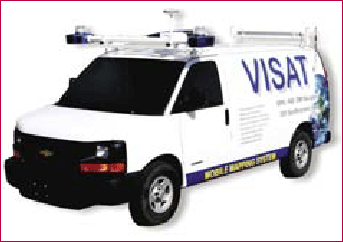
With the continued growth of urban centers all around the world, city planners are required to keep up with up-to-date geographical at a faster rate. This has led to the establishment of spatially-referenced Geographic Information Systems (GIS) for a variety of municipal applications. This information, however, is expensive to obtain by conventional methods. In addition, conventional methods supply only point solutions and are therefore not suited to support the increasingly complex requirements posed by urban centers in a timely fashion. Satellite remote sensing and aerial photogrammetry are two methods which can provide various GIS information at high rates and reasonable cost. However, with the first method, the associated accuracy is not suitable for many applications, and in the second case the near vertical field of view provides only part of the information required.




 (5.00 out of 5)