


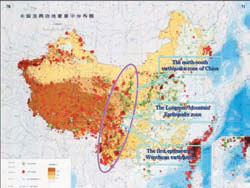
An earthquake, measured 8.0 on the Richter scale, struck Wenchuan County, Sichuan Province at 14:28 on May 12, 2008. The epicenter was at Yingxiu, a town in Wenchuan, as shown in Figure 1. As indicated in Figure 1, the middle segment of the Longmen Mountain earthquake zone encloses the epicenter, Yingxiu, with the Longmen Mountain zone being part of the north-south earthquake zone in China. According to records, there have been 9 earthquakes larger than a grade of 8 occurring in the north-south earthquake zone from 1739, and 7 of them were after 1897, when the greatest one was at Haiyun in 1920 and at Chayu in 1950, both of them measured 8.5.
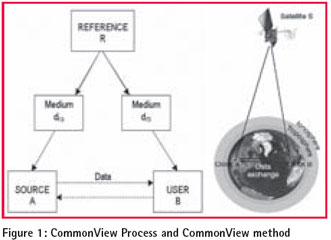
A central issue in designing complex networked systems for critical applicative domains is the possibility of keeping each node of the network synchronized with respect to a given system time scale. The problem is even more critical when the synchronization accuracy determines directly the performances of the whole system.

ESP SAS formed
ESSP SAS has been recently formed in Rome with objective to become the certified service provider for EGNOS. The Headquarters will be in Toulouse having two units: the Service Provision unit in Madrid and Operations in Toulouse. The negotiations between the European Commission and the EOIG experts have reached a conclusion on the EGNOS Agreement and foresee to initial the Agreement in the coming weeks.michel. calvet@aviation-civile.gouv.fr
China to investigate Google for illegal maps
China has launched an investigation into online mapping services by Google and Sohu in an effort to protect state secrets and territorial integrity. According to vice head, State Bureau of Surveying and Mapping, authorities hope to get rid of online maps that wrongly depict China’s borders or that reveal military secrets. The government began the investigation into the problematic maps in April and will continue it until the end of the year. Min cited five areas of concern – Taiwan, the Spratlys and Paracels island chains in the South China Sea and the Diaoyu Islands in the East China Sea. http://afp.google.com/

Very Long Baseline Interferometry (VLBI) is the unique space
geodetic technique which can provide the Celestial Reference Frame (CRF), the Terrestrial Reference Frame (TRF) and the relationship between the two frames — Earth Orientation Parameters (EOP) at the same time. VLBI has a widely usage in space geodetic, ground
geodetic, geophysical fields and so on. Presently, it can determine the position of the radio source outside the galaxy with 1mas precision, and determine several kilometers length of baseline on the earth’s surface with 1cm precision. Due to its high stability and high precision character, the Celestial Reference Frame outside the galaxy based on VLBI has been the best realization of the quasi-inertial referenceframe since 1980s. VLBI stations are the most important benchmarks in the International Terrestrial Reference Frame (ITRF), and VLBI is one main supporting technique which determines EOP. Till now, space and ground VLBI have accumulated more than 20 years’ data. They provide continuous and long-term data guarantee for space geodetic, ground
geodetic and geographical research.
RMSI ranked the ‘Best Workplace’ across all industries in India
RMSI has been ranked first in the Top 25 Great Places to Work in India by a study conducted by the Great Place to Work® Institute, US, along with The Economic Times, a financial daily in India. RMSI provides geospatial services, consulting to application development to spatial analysis and modeling to remote sensing and data conversion. www.rmsi.com

Satellite remote sensing has been used to varying degrees around the
world for over three decades. Over that time the degree to which the technology has been applied has varied greatly from country to country – from being broadly embraced to being used hardly at all. Simply stated, where remotely sensed data and related geospatial data are used in a limited fashion the full economic and social value of the data for resource evaluation, sustainable resource management, and environmental protection is not realized. This paper examines the key factors that appear to be associated with varying use of the data and consequent derivation of benefits. At one time it was thought that this use was related to the economic situation within a country or the quality of training and education. While these factors are of course important, this work isolates other factors as being equally if not more important. These factors include data policy, approaches to commercialization, the level of applied research and links to “real” users. This paper explores the importance of these other factors with special reference to data policy in Thailand and Canada.
India’s leap into space
On April 28, 2008, ISRO’s Polar Satellite Launch Vehicle, PSLV-C9, successfully launched the 690 kg Indian remote sensing satellite CARTOSAT- 2A, the 83 kg Indian Mini Satellite (IMS-1) and eight nanosatellites for international customers into a 637 km polar Sun Synchronous Orbit (SSO). PSLV-C9 in its ‘core alone’ configuration launched ten satellites with a total weight of about 820 kg.
Industrial GNSS market to Hit $240B by 2013
According to ABI Research, industrial applications such as network timing, land surveying, and machine control are quickly gaining momentum. It forecasts that by 2013 GNSS end-user devices and systems will generate yearly revenues of $240 billion. However, innovative workaround solutions based on the post-processing of the GPS signal are being developed, as is the use of assisted-GPS technology to provide location and satellite data to connected devices for faster fixes and better coverage http://www.abiresearch.com
Geospatial data to go online with Brunei Spatial Data Infrastructure launch
BSDI is the technology, standards, access system and protocols necessary to harmonise all of the Sultanate’s geospatial databases and make them available on the internet. It is facilitated by the Ministry of Development and led by the Department of Survey in partnership with the Land and Town and Country Planning. BSDI will publish base layers of geographic data such as elevations, transportation systems and water bodies that provide context and reference information for Brunei Darussalam. http://www.brunei-online.com






 (5.00 out of 5)