



A case study of El Salvador City has been done using various photogrammetric techniques. This project comprised the complete new mapping of the town including all features like buildings, boulevards, roads,manhole/ drainage, light / telephone polls, trees /tree areas, ponds, river and streams (with break lines), Monuments, playground / Parks etc. The vectorization of the model has been done on Digital (Socket Set) and analytical systems both. From speed point of views digital systems are as good as analytical systems. It also depends on the skills / expertise of the Operator who is preparing the maps.

HP announces expansion of Designjet
HP has expanded its Designjet largeformat portfolio with a range of new workgroup and multifunction printers, software solutions and new media choices to address the needs of vertical segments, IT managers and production operators. The new products, solutions and large-format papers are ideal for GIS, architecture, engineering and construction (AEC) and mechanical computer aided design (MCAD) workgroups. www.hp.com

The National Informatics Centre, Government of India is organizing NSDI-V during December 18- 21, 2005 at Hyderabad, India. On the occasion we present here the excerpts of recommendations of last four NSDI conferences. They, with the subsequent interviews, reveal moments of euphoria and despair, issues discussed and debated, and more importantly a resolve to pursue this dream.
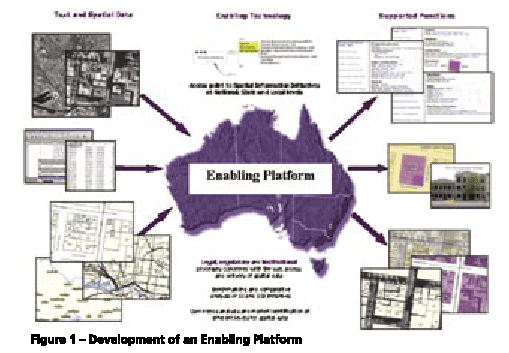
Users of positioning and spatial information services and tools require precise spatial information in realtime and real-world objects. Simply an accurate positioning of a future subdivision is no longer accepted, users require it to be visualized as well, in order to take into account outside in?uences. The capacity to meet such user needs and deliver services and tools within the spatial information market has gone beyond the ability of single organisations (Rajabifard, et al, 2005a). There is now a wide range of products and services available for a wide range of IT applications, and hence the development of an enabling platform can facilitate access to data and sharing resources and tools among different practitioners. The creation of an enabling platform for the delivery of these tools and positioning applications will allow users from diverse backgrounds to work together with current technologies to meet the dynamic market place.
China joins Galileo spacebased application projects
A Chinese general contractor for the European Galileo Project in Beijing recently obtained three space-based application projects. The Galileo Joint Undertaking (GJU) endorsed the China Galileo Industries (CGI) to develop search and rescue radar transponders (SART), laser retrore ?ectors and up-link stations (ULS). Meanwhile, the Early Galileo Services in China (EGSIC) and the Galileo Olympic Games Demonstration (GOGD) are also open for public bidding. China was the first country outside Europe to join the Galileo Project, agreeing to invest a total of 200 million euros into the global consortium. About 70 million euros of the Chinese investment have been put into technologies development and the remaining 130 million euros into deployment of space and ground infrastructure.
http://english.people.com.cn
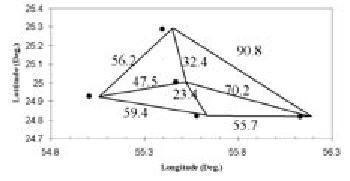
Interest in the use of Global Navigation Satellite Systems (GNSS) as a main source of navigation reference is increasing. The system employed for such a purpose should be capable of meeting the requirements of air navigation in terms of accuracy, availability, integrity, and reliability. At present, the accuracy requirements for all ?ight categories up to precision approach are summarized in Table 1. The accuracy requirement for Category I can be achieved most of the time using wide area differential systems such as the American “WAAS”, the European “EGNOS”, and the Japanese “MSAS”. The American Federal Aviation Authority (FAA) is developing a Local Area Augmentation System (LAAS) for categories II and III, involving the ?nal and precision approach phases of ?ight. The system includes at least four reference GPS receivers located at each airport, whereby GPS measurements are collected and processed in real time. The computed GPS differential corrections are sent to aircraft via a (VHF) radio link to calculate its location. LAAS preliminary test results have generally demonstrated accuracy of less than 1 meter. However, the percentage of system availability is still under evaluation. The cost of establishing LAAS for major airports is expected to be significant.
All roads lead to GIS…
…The Rural Road Development Project
The Rural Road Development Project, Pradhan Mantri Gram Sadak Yojna (PMGSY) is using GIS for planning and decision making. An Online management tool OMMAS is being developed to populate the attribute data for GIS and provide access to the citizens to view status of various rural roads and other related information. Public Works Department Rajasthan is playing leading role in creating GIS data base and implementing the PMGSY Scheme. A customized standalone GIS software GRIMMS to run various queries related with planning of roads is being developed. Web GIS module is also being developed to make the complete system transparent and will allow citizens to access the information in spatial format related with PMGSY. C-DAC Pune is providing the technical assistance. Submitted by K.K.Mishra, mishra09720@itc.nl
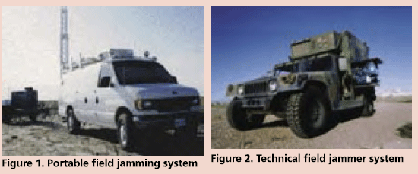
The 746th Test Squadron (746 TS) has conducted complex GPS jamming experiments since the early 1990s and played a key role “behind the scenes” creating multiple high-profile jamming environments for programs such as the Joint GPS Combat Effectiveness (JGPSCE) exercises and Quick Reaction Tests. These programs, conducted to support real-world operations, enhanced the 746th TS’s ability to recreate realistic jamming environments and resulted in the 746 TS earning the reputation as the recognized experts for open-air GPS vulnerability testing.
Applanix launches the DSS 322
Applanix has announced the launch of its next generation Digital Sensor System, the DSS 322. The new system incorporates a 22 megapixel CCD array, Aerolens™ custom-manufactured optics, and TruSpectrum ™ technology engineered to maximize the system’s capability in generating high-quality color and CIR (color infrared ) digital geospatial imaging products. Applanix has also announced the release of its new POSTrack system designed for streamlined airborne direct georeferencing and in-flight task automation. The new system combines the latest integrated Inertial/GPS technology from Applanix with the Flight Management System (FMS) expertise of Track’air B.V. in The Netherlands.
airborne@applanix.com
November 2005
International Conference: “Earth Observation foaterr vegetation …






 (5.00 out of 5)