



Readers may recall that Coordinates printed Implementation Guidelines of the Indian National Map Policy (NMP) in June. We present here some more observations

IRNSS to be independent of other constellations
The Indian Space Research Organisation (ISRO) will be establishing a satellite navigation system on the lines of the US GPS. The proposed Indian Regional Navigation Satellite System (IRNSS), which will consist of a constellation of eight satellites, is likely to be operational in six years time.
The Union Cabinet had approved the Rs 1,600 crore project in May this year. According to Madhavan Nair, Chairman ISRO the IRNSS would be developed indigenously and will be independent of other constellations.

The Government of India has formally approved the National Spatial Data Infrastructure (NSDI) programme – I told myself AT LONG LAST, IT IS DONE!!! I also heaved a sigh of relief – a sigh which has been weighing on my mind for the past 5 years (from February, 2001 onwards). In that sense of relief – that marked a feeling of achievement and success for the benefit of the country, I closed my eyes and …
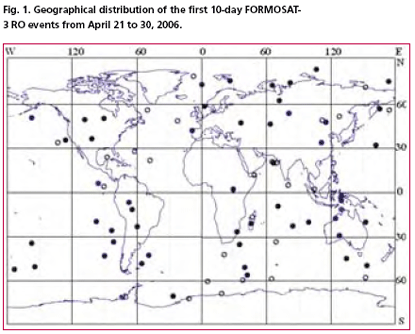
Six tiny FORMOSAT-3 satellites that were sped into space on April 15, 2006 are designed for systematic mass scale radio occultation (RO) studies of the Earth atmosphere and ionosphere at different altitudes by use of the GPS signals. Termed as the Formosa Satellite-3/ Constellation Observing System for Meteorology, Ionosphere, and Climate (FORMOSAT-3/COSMIC) mission, the new constellation’s primary science goal is to obtain in near real time the vertical profiles of temperature, pressure, refractivity, and water vapor in the neutral atmosphere, and the electron density in the ionosphere with global coverage. The measurements during five years of mission life will provide about 2,500 soundings per day, thus generating extensive information to support operational global weather prediction, climate change monitoring, ionospheric phenomena, and space weather research. The theory of RO measurements has been described previously (Gurvich and Krasilnikova, 1988; Yunck, 1988; Yakovlev, 2002; Hajj et al., 2002). During last four years, essential modernization in the RO technique has been introduced (e.g., Liou et al., 2002, 2006; Pavelyev et al., 2004 and references therein).
Personal navigation most profitable LBS in Europe
Berg Insight made the survey among LBS professionals at mobile operators, vendors and consultancies. There were two sets of questions asked to the 200 respondents, one to operators and another set to vendors and consultancies. We asked the operators which LBS applications they already have deployed and got the reply that the most common services today are information services. On second and third place came navigation services and tracking. We also asked the operators which positioning technology they think will be the most important the coming years. The majority, 65 percent, replied a combination of two or more technologies, while 35 percent said A-GPS. It is obvious that satellite positioning is coming up as a preferred technology among operators in Europe.www.lbsinsight.com
$2.4 million for satellite imaging
Mr. Gary Lunn, Minister of Natural Resources, announced a five-year, $2.4-million project to provide access to new, high-quality satellite images of Canada and also the improved and standardized satellite images will be available to all Canadians for free over the Internet.
The newer and higher-quality images will be used for mapping, monitoring Canadian wetland areas and managing natural resources, and will support government decision and policy makers in the fields of public safety, health and the environment, as well as our northern and Aboriginal communities. Natural Resources Canada will coordinate and manage the project, ensure the quality of the data and liaise with the contractors, TELUS Corporation and Iunctus Geomatics Corp., who are supplying the satellite images.
www.NRCan.gc.ca
Geospatial industry poised for growth
Information systems alone, based on maps and satellite imagery is set to touch Rs 576 crore by 2010. At present, the market estimates for these services are Rs 12 crore. The optimism is based on the current growth rates of around 200 per cent and the huge potential. Geospatial Today and Spatial India, geospatial publications in association with Antrix Corporation and Survey of India, have brought out the report. According to the highlights of the report, the domestic market estimates for these geospatial services amounted to about Rs 562 crore in the financial year 2005. The market for these services is expected to grow at a CAGR of 17.57 per cent per annum and reach Rs 1,824.98 crore by year 2010. The key driver for this increased growth is the expected investments in land information systems (ILIS) in several states of the country. It also provides an optimistic overview in as much as the total market in our country (domestic and exports markets) is expected to record a potential growth from Rs 962 crore in the year 2005 to Rs 2,820.30 crore at a CAGR of 14.5 per cent. India has emerged as a major data conversion centre for geospatial services. In FY 2005, this sector marked Rs 720 crore with an expected growth rate of 20 per cent.
www.blonnet.com
july 2006
GeoWeb 2006
24 – 28 July, Vancouver, BC, Canada
khenton@gita.org
2006 IEEE International Geoscience …
Indonesian military plane to map quake-hit areas
The Indonesian Defence Forces (TNI) have assigned a CN-235 airplane to carry out aerial photography on areas in the Yogyakarta region affected by 27 May 5.9-magnitude earthquake. The activity is aimed at making a detailed map of areas devastated by the quake.
TNI had also sent a Hercules C-130 plane carrying a TNI field medical team and three helicopters to evacuate victims.http://news.xinhuanet.com

With the launch of GPS in the 1980s, the task of providing control points for mapping purposes was greatly simplified, leading to economy and ease of operation. The technique of LASER mapping, which existed decades before GPS, also received a boost due to GPS, as instantaneous precise positioning of the exposure station during the mobile LASER mapping operation was made possible by GPS, thus solving a major problem in LASER mapping…






 (5.00 out of 5)