



More than 100 million users of mobile LBS in Europe by 2012
According to Berg Insight, more than 100 million mobile subscribers in Europe will use LBS by 2012. Mapping, navigation and search are believed to become the top applications, followed by social networking and tracking. johan.fagerberg@berginsight.com
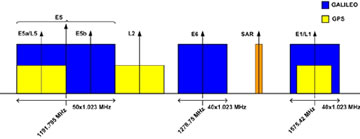
E5 band (1164 -1215 MHz), composed of E5a and E5b bands, is part of the spectrum allocated by ITU for new Radio Navigation Satellite Services in 2000. E5 signal has the wider bandwidth (51.150 MHz) never used in satellite navigation. Galileo E5 signal is composed by two data components and two pilot components broadcasted together by means of the multiplexing scheme AltBOC(15,10). E5a band will be used for Freely/NAV message (Open Service) and the codes of data and pilot components are uncripted, E5b band will be used for Integrity/NAV message for Safety of Life and Open Service. Integrity of signal is probably the most advanced service introduced by Galileo [1]. One of the main feature of E5 band is that the signal can be received in two ways: the first is to filter and demodulate only one of side bands E5a or E5b (see Fig. 1) the second is to process the overall received signal containing the components of both bands [2],[3]. In this sections is considered the second way because it will be adopted by professional receivers and this will avoid to obtain all the advantages of Galileo signal. E5 is the most promising signal in terms of performance in multipath environment and positioning for critical applications but also the most challenging for a receiver or a simulation. In this paper will be presented the simulation of the transmission and reception of E5 signal. It will be first described the generation of codes, then it will be illustrated Galileo AltBOC(15,10) signal structure and its differences with a conventional AltBOC, it will be shown a way for the generation of that signal and some basic characteristics for the development of a software receiver for E5.
Spirent delivers 3 carrier solution, launches GSS8000
The architecture of Spirent’s systems is designed to support coherent simulation of multiple GNSS signals together. The SimGEN for Windows® software enables control and flexibility over multiple satellite constellations as well as interference sources and augmentation systems such as EGNOS and WAAS. It operates in real time to generate simulated RF signals across all GNSS and interference signals. Spirent Communications has also recently launched new Spirent GSS8000 simulation system, a signal generator unit for GPS, Galileo and GLONASS testing. It tests advanced satellite navigation technologies and offers enhanced capability, increased flexibility and improved signal fidelity.This new solution supports processing rates as low as 4 ms with pseudorange accuracy at 1 mm for many scenarios. Its new design allows for a wide variety of configurations from GPS L1 right up to comprehensive multi-RF output and/or multi-constellation test systems. http://www.spirent.com
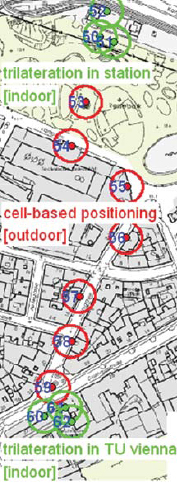
Alternative location methods for absolute positioning in areas where no GNSS position determination is possible due to obstruction of the satellite signals are needed in mobile positioning. Active RFID (Radio Frequency Identification) can be used also for position determination, although the system was not only developed for positioning and tracking but mainly for identification of objects. Using RFID in positioning, different approaches can be distinguished, i.e., cell-based positioning if the RFID tags are installed at active landmarks (i.e., known locations) in the surroundings, trilateration if ranges to the RFID tags are deducted from received signal strength (RSS in RFID terms) values and location fingerprinting where the measured signal power levels are used directly to obtain a position fix. Using Cell of Origin (CoO) the achievable positioning accuracy depends on the size of the cell and is therefore usually several metres up to 10’s of metres using long range RFID equipment. Higher positioning accuracies can be obtained using trilateration and fingerprinting. In this paper the use of trilateration is investigated.
May 2008
International Conference: “Studying, Modelingand Sense Making of Planet Earth
1 – 6 June, 2008
Department of Geography, University of the Aegean, Mytilene, Lesvos , Greece
http://www.aegean.gr/geography/earthconference2008/en/main_fr.htm
Navigation and Location Europe 2008
4 – 5 …
Nokia launches global Ad campaign for GPS-enabled N82 handset
“The Urbanista Diaries,” is the new global campaign by Nokia to promote the recently launched Nokia N82 that features a 5 megapixel camera and integrated GPS. The campaign engages bloggers, journalists, and everyday people to promote the phone.
3D-Laser Scanning possible up to 2000m
RIEGL has recently launched 3D laser scanner LMS-Z620, especially optimised for long range topography and mining applications. It is providing a maximum measurement range of 2000m on natural targets and a reduced beam divergence of just 0.15 mrad, performance data which are unrivalled in the market of high-speed laser scanners. It has RiSCAN PRO´s backsighting and Multi Station Adjustment functionality as well. www.riegl.com
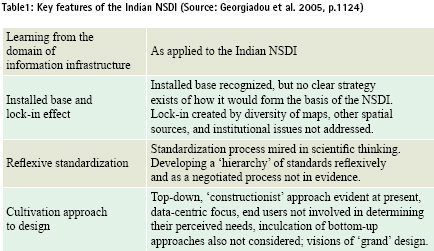
Special characteristic of spatial data is that it can be shared and used for many other purposes than the one, for which, it was originally produced. To facilitate its efficient sharing and reuse, it needs to be properly managed in the form of infrastructure i.e. Spatial Data Infrastructure (NSDI). This is one of the reasons that many countries are developing National Spatial Data Infrastructure (NSDI). But the challenge of developing a successful NSDI depends largely on its implementation which is so significant that none of the two key stakeholder groups i.e. public or private sectors can address it at their own. Therefore, if efforts are made to implement such initiatives by only one of the key stakeholder groups then the result may be partially if not totally failure to get the tangible benefits truly intended from such initiatives. As an example, Indian NSDI is explored in this context.

This note is about two developments in the mapping world that should be of interest to professionals in the geospatial industry. One took place in the United States where a group of surveying professionals have asked the courts for a ruling on who may be able to tender for public contracts to draw ‘maps’. This development should raise the concern of most geospatial professionals. The second took place at the opposite end of the world in Australia where the Copyright Agency representing surveyors has sought a ruling on the ownership of intellectual property rights of surveyor’s maps. While these two cases are interesting such developments are indicative both of the maturing of the geographic information (GI) profession and the willingness of professionals to assert their ‘rights’.
May 2008
IEEE/ION PLANS 2007
Co-sponsored by IEEE and
Institute of Navigation
May 5-8, 2007
Monterey, California, USA
http://www.plansconference.org
June 2008
International conference: “Studying, Modeling and Sense Making of Planet Earth”
1 – 6 June, 2008
Department of Geography,
University of …






 (5.00 out of 5)