


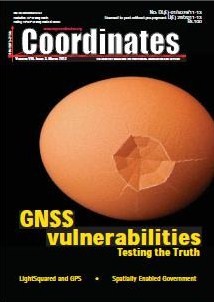
GNSS vulnerabilities: Testing the Truth: Dr C S Dixon, Dr C J Hill, Dr M Dumville, Dr D Lowe;
The realization of [the] geocentric datum for Brunei Darussalam 2009: Dr Kazimierz Becek, Dr Adam Lyszkowicz;
Too Fast, Too Furious Was Haste: Gavin Schrock;
Cloud services are transforming the remote sensing industry: Brian Rohde;

Despite the good performance of GPS, there are more than a few GNSS vulnerabilities and threats. Categorisation into unintentional and intentional is sometimes done to aid understanding. Unintentional disruptions include natural phenomena such as high levels of ionospheric disturbance and solar flares, as well as man-made phenomena including system errors (satellite or signal), and unwanted radio frequency transmissions (TV, microwave communications, radar, …).

Replacing the horizontal datum of a country is a complicated and difficult project. The decision to embark on such a “revolutionary” move should only be taken after in-depth studies to identify compelling reasons for such replacement. Here, we comment on the article by Tahir et al. published in the September 2011 issue of Coordinates.

By definition, ‘spatial enablement in action’ means that we (governments) must make our spatial information “actionable”. That is, it must be used and leveraged beyond just for mapping. It must form the enduring fundamental authoritative spatial data layers of a nation, and do so in a way so that it is able to support evidence-based decision making for the many social, economic and environmental drivers challenges that face our Governments. It is incumbent on us doing so. Should we not do so, we seriously risk “spatial stagnation”, and have a rich resource of geoinformation that remains largely untapped and with significant unrealised potential.
April 2012
6th International Satellite Navigation Forum, 17-18 April, 2012,
Moscow, Russia, https://mycoordinates.org/the-6thinternational-satellite-navigation-forum/;
Interexpo Geo-Siberia, 17-19 April, 2012,
Novosibirsk, Russia, http://itcsib.ru/event/4-INTEREKSPO_GEO-SIBIR;
Today, Hemisphere GPS and Carlson Software announced a strategic alliance. This alliance will provide a roadmap for new, integrated solutions for land survey, mapping, construction, mining and other key machine control markets. Carlson Software is a leading developer of field and office-based land development software.
This strategic alliance is part of Hemisphere GPS’s recent formation of …

Choosing the best path: Global to national coordinate transformations: Joel Haasdyk, Dr Volker Janssen;
Building national capacity through spatial standards policies:Steven Ramage;
Locating dangerous zones prior to drilling the 57 km long Gotthard Tunnel in Switzerland:Edi Meier, Ulrich Sambeth;

For the purposes of this paper, the vehicle was tele-operated from the nearby BS with the operator manoeuvring with the aid of three onboard video cameras and a display of the LiDAR data in realtime. Autonomous operation using the LiDAR data and was demonstrated in Whitty et al. (2010)(For videos, see our YouTube channel: www. youtube.com/UNSWMechatronics).

Obviously, before any datasets can be compared or combined, they must be brought together onto the same datum (Janssen, 2009). The practice of transforming from one datum to another is not diffi cult and the necessary parameters are available in many different software packages. However, with the increased number of datums comes an increased number of ways to transform between datums.
The Global Spatial Data Infrastructure SDI Cookbook defines SDI as the “… collection of technologies, policies and institutional arrangements that facilitate the availability of and access to spatial data.” This definition (which predates the cookbook) is more than fifteen years old, and over the course of fifteen years much progress has been made toward the SDI vision of abundant, easily shared, easily used geospatial information.






 (5.00 out of 5)