


The intense public debate on how rapidly the Himalayan glaciers are retreating highlights the necessity for the constant monitoring of glaciers worldwide by satellites. Considering the valuable role satellites can play in determining the state of Earth’s glaciers, the Global Climate Observing System (GCOS) has called for the systematic monitoring of glaciers by satellites in …

INDUSTRY | LBS | GPS | GIS | REMOTE SENSING | GALILEO UPDATE
LORAN-C signal termination
LORAN-C was originally developed to provide radio-navigation service for US coastal waters and was later expanded to include complete coverage of the continental US as well as most of Alaska. It was approved …
March 2010
Munich satellite navigation Summit
9-11 March
Munich, German
www.munich-satellite-navigation-summit.org
Geoform+’2010
30 March- 2 April
Moscow, Russia
www.geoexpo.ru
Digital Preservation of Archaeological Heritage
10-12 March, 2010
IIT Kanpur, Kanpur, India
arch3d@iitk.ac.in
www.iitk.ac.in/arch3d
CARIS 2010
22-25 March
Miami, Florida, USA
www.caris.com/caris2010
April 2010
XXIV FIG International Congress 2010
11 – 16 April 2010
Sydney, Australia
www.fig2010.com
Geo-Siberia 2010
27-29 April
Novosibirsk, Russia
www.geosiberia.sibfair.ru
ASPRS 2010
26-30 April
San Diego, CA, USA
www.asprs.org/SanDiego2010
May 2010
TIDES 2010
20-21 May
Taipei, Taiwan, R.O.C.
derc@mail.pccu.edu.tw
International Conferences on Integrated Navigation Systems
31 May -02 June …
Septentrio Satellite Navigation announced the next generation GNSS measurement engine, the AsteRx3™. AsteRx3™ Product Series is designed for integration in precision positioning, navigation, and automation applications such as land and maritime survey, machine control, UAV payloads, amongst others. To support these applications an embedded suite of algorithms called GNSS+™, which provides users with tools for …
Trimble introduced a new version of its Trimble® 4D Control software, the core of Trimble monitoring solutions that combines GNSS and optical technologies for real-time deformation monitoring applications. The software is ideal for monitoring dams, bridges, buildings, pipeline support piers, large-scale construction and excavation sites, underground and open pit mines, landslides, tunnels, and other structures. …
e-Governance Project for Panchayati Raj institutions (e-Panchayat) in India includes decentralised database and planning, budgeting and accounting, implementation and monitoring of central and state sector schemes, citizen-centric services, unique codes to Panchayats and Individuals and essential GIS based applications. This project will cost 450,000,000,000 INR in the span of three years. Under this project, Internet …
Creative Force Maps announced the first royalty-free, vector map of Washington DC to include building footprints, property lines, and land use. The digital map contains all building footprints and service alleys for 11 square miles in the heart of DC and, for maximum versatility, is available in Adobe Illustrator and PDF formats.
www.creativeforce.com
Minister Mah Bow Tan said Singapore’s land use planning for the next 10-15 years has to take into account new trends and emerging issues. Many of these issues are complex and may involve trade-offs between different objectives. He also launched a public consultation to seek public views on shaping Singapore’s physical landscape. The Urban Redevelopment …
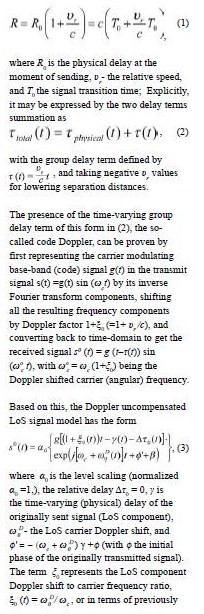
GPS ranging is based on the reception of the LoS component of the signals transmitted from the constellation of GPS satellite vehicles (SV), and on measuring the time elapsed in the propagation of appropriately time-marked signal signatures. Even in the absence of any reflected (multipath) signal components, the determination of physical separations between SVs and receiver is tied to a subtlety arising…
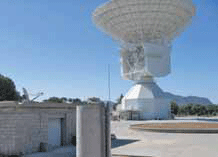
For interplanetary missions, the determination of S/C state vector (position and velocity) is required both for navigation purposes and science operations. The main error sources affecting S/C tracking data are the solar corona and the interplanetary plasma, which could be removed by using the multifrequency link technique between the probe and the ground station [1]. Once solar plasma noise has been removed…






 (5.00 out of 5)