
| Applications | |
Mainstreaming and Safeguarding Fragile Informal Settlements in Delhi
The recent collapse of buildings in Said-ul-Ajaib village and fires in Hauz Rani, Tughlakabad Extension, Palam and Vivek Vihar raise the question on the safety of buildings in the Capital’s urban villages and unauthorised colonies. There is an urgent need for safeguarding and mainstreaming them in to planned development. |
 |
|
The Master Plan for Delhi 2047 promotes the redevelopment/ regeneration and densification of existing urban areas. The Plan promotes in-situ rehabilitation of slums and JJ clusters, in line with the principle of “Jahan Jhuggi, Wahan Makan”, providing safe, dignified and affordable housing along with supporting social and physical infrastructure while enabling residents to remain within their communities. It also provides a comprehensive framework for the planned improvement, regularisation and redevelopment of unauthorised colonies through infrastructure augmentation, enhanced connectivity, improved public amenities and appropriate development norms, thereby integrating these areas into the formal urban fabric and improving the quality of life of their residents.
Master Plan for Delhi -2047
Slums in Delhi are an inseparable part of the national Capital with residents living there decades. An immediate halt to demolition drives in the Capital’s slum clusters an unavoidable all future removals will be accompanied by advance rehabilitation.
Delhi Chief Minister, Rekha Gupta (1st August 2025)
Delhi Slum and Rehabilitation Policy (2026) has extended the cutoff date for slum dwellers eligible for rehabilitation by 10 years (January1, 2025).
The Indian Express, June 18th 2026.
Ours is a welfare state and accordingly the right to adequate shelter, if denied to citizens, amount to violation of fundamental rights enshrined in part III of the Constitution of India. It is, therefore, the bounden duty of the government and its agencies to ensure that people who are homeless and seeking medical care are provided shelter.
Delhi High Court Order Dated 14th January 2026
A fire in Lucknow building left 15 people dead on 22th June 2026. The usual suspects-building code violations and civic neglect are evident. Another factor turning burning building into death trap is the electronic door lock.
Times of India, 24th June 2026
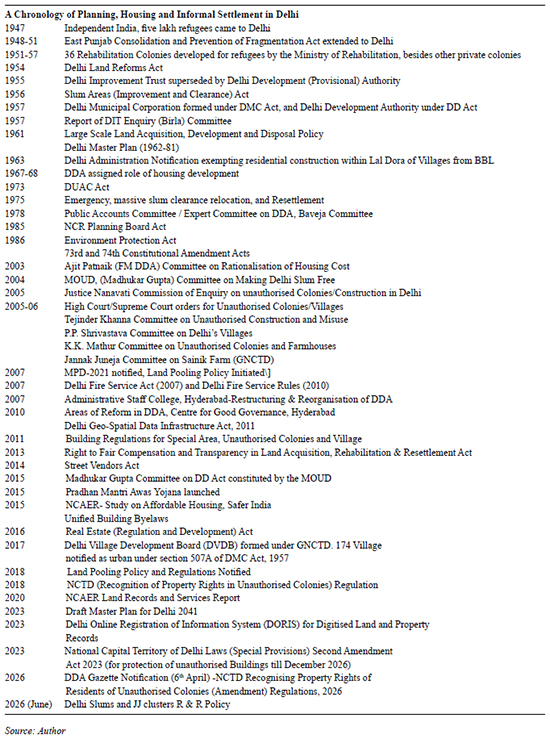
Delhi, the National Capital with a population of 23.078 million (2026), is a symbol of coexistence of planned development and informal growth. About half of its population is living in the slums and informal settlements. Delhi’s 5.50 million households live in 2025 planned residential schemes (as per MCD Property Tax Guide), Old City, 57 pre-Independence Residential Areas, 36 Rehabilitation Colonies, 126 plotted Cooperative Societies and about 900 cooperative Group Housing Societies, 60 odd Site and Services/Resettlement Schemes, and public/Government Housing. Another half of its population is living in 675 slums and Jhuggi-jhompri clusters (covering 968 Ha), 367 villages and 1797 unauthorised colonies. These unplanned areas are called informal settlements.
The process of metropolisation of Delhi has been linked to the phenomena of sub-urbanization with an increased differentiation and segmentation of the metropolitan area (Dupont, 1995). The urban limits have advanced upon the fringe of the city, by which some of the villages have been embraced, and few of them obliterated. The ‘peri-urban’ invasions are the unauthorised extension of village settlements, occurring through land grab or purchase of rural land through the nexus of property agents, local politicians and officials. The level of security of illegal construction corresponds to the strength of the patrons and their proximity to the power structure.
The unauthorised developments are broadly categorized as follows:
- Buildings which violate the building bye laws, such as fire safety, structural safety, height, floor area and ground coverage;
- Land Use and development in contravention of the Development Controls and Sub-division Regulations of the Master Plan, Zonal Plan and layout plan.
- Illegal transfer of agricultural land for urban use;
- Illegal sub-division and disposal of lands.
- Encroachment and appropriation of public, commercial lands, such as roads, railways, parks, public facilities and utilities.
- Violation of other Acts, such as Delhi Land Reforms Act, Stamp Duty Act, Property Registration Acts, etc.
Most of the informal settlements in Delhi have grown on agricultural land, lack municipal services, building plan approval, registration and secure tenure. Infrastructure is often fragile and deficient. Recent surveys indicate a growing trend of ‘neo-colonisation’ by the ‘neo-rich’ urban class. The general impression is that punitive action and demolition are faced by the common man, while rich and powerful manage to escape the law. The residents often face congestion, overcrowding, narrow streets fragile structures and deficient infrastructure. Due to lack of formal property rights, they are vulnerable to exclusion and threats of buying out. Institutional barriers stem from weak governance, corruption, lack of enforcement of building byelaws, fire safety regulations and absence of participatory planning framework. Municipal authorities often lack the capacity or political will to engage communities meaningfully, while lack of transparency undermines trust between the residents and state institutions.
Justice Nanavati Commission of Inquiry (JNCI) Report
The Justice Nanavati Commission of Inquiry, constituted by the Central Government on 30 August 2000, submitted its report on 3 September 2005, recommending the regularisation of existing unauthorised colonies and constructions, subject to planning and building regulations, with appropriate relaxations. It proposed excluding areas involving reserved forests, protected monuments or impediments to infrastructure, and commercial plots beyond petty shops of up to 50 sqm. Regularisation charges and penalties should be sufficiently high to discourage unauthorised development. The Commission also emphasised minimising displacement, resettling affected residents within or near their colonies, and using acquired vacant plots for rehabilitation and civic amenities. To ease pressure on Delhi’s housing, it further recommended developing satellite towns and relocating government offices and industries not essential to the capital.
CAG Report on Unauthorized Colonies (2013)
The CAG report (2013) points out that Delhi Government had distributed provisional regularization certificates to 895 unauthorised colonies in 2008. However, in only about 70 colonies development work had been carried out. About 580 of these colonies had come up on government land and another 300 came up on private land but have some plots on government land. The report says that the UD department released Rs 3,666.81 crore between 2007 and 2013, of which Rs 3,029.21 crore were spent on regularization, but there was no monitoring of the physical and financial targets. Basic work on roads and drains remains incomplete in 416 colonies out of 895. The report finds that in 91 colonies inspected, DJB failed to supply water in 33. In almost all the colonies RWAs have not submitted ownership documents and the colonies were regularized without scrutiny of records submitted by the RWAs.
Regularisation of Unauthorised Colonies
The Master Plan for Delhi 2047 provides the policy framework for improving and regularising unauthorised colonies. It supports in-situ rehabilitation of slums and JJ clusters, affordable housing and essential services, and the planned redevelopment of unauthorised colonies through better infrastructure, connectivity and public amenities.
With the expansion of Delhi, most urban villages and unauthorised colonies have become an integral part of the urban fabric. Owing to increasing population, changing livelihoods and rising land values, these areas have undergone rapid densification and vertical redevelopment without corresponding augmentation of infrastructure and public spaces. Many urban villages and informal settlements also contain heritage buildings, historic water bodies, temples, mosques, havelis, orchards and other cultural assets that require conservation through area-based regeneration. Their regeneration shall be undertaken through Area Improvement Plans and Road Network Plan (RNP) with all roads to a minimum ROW of 7.5m.
The Master Plan of Delhi (MPD 2047) allows the amalgamation of fragmented plots to a combined area of 2000 sqm on a minimum street width of 7.5 m. Additional floor area ratio (FAR) may incentivise the owners of fragmented plots to form a cooperative for a composite redevelopment of illegal/unauthorised colonies into group housing, with proper roads, parks, parking spaces and safer structures. MPD 2047 provides an FAR of 500 with 50% of FAR for market sale to make redevelopment of slums self-financing and viable for private sector participation.
According to the Gazette Notification dated 29th October 2019, 1,797 unauthorised colonies were listed for regularisation and for grant of ownership rights. Subsequently, vide Gazette notification dated 6th April 2026, “The National Territory of Delhi (Recognition of Property Rights of Residents of Unauthorised Colonies) Regulations, 2026, the work of the regularisation of property rights in unauthorised colonies is transferred from DDA to the Government of National Capital Territory of Delhi. Every unauthorised colony specified in the notification issued under sub-regulation (1) shall be regularised on as is where is basis and the absence of an approved or notified layout plan of such unauthorised colony, or any part, or cluster thereof, shall not be a bar to consider them for regularisation.”
Under the NCT of Delhi (Recognition of Property Rights of Residents in Unauthorised Colonies) Amendment Regulations, 2026, 1,511 unauthorised colonies are being given legal sanctity on ‘as-is where is’ basis, and the residents are not required to submit layout plan of the area to get their property registered. This may run counter to mainstream the informal settlements into planning framework of Master Plan for Delhi-2047, Building Byelaws, Delhi Fire Service Act, besides DD Act, National Disaster Management Act 2005 and DMC Act, 1957.
Building Safety in Informal Settlements
Earlier in 1963, the village abadi (Lal Dora) was exempted from building permission, except the factories, warehouses, slaughter-houses, etc. This was later made applicable to the extended Lal Dora areas. This has led to massive, unplanned development. The peripheral areas of the villages have rapidly been built upon with illegal multi-storied buildings mainly for speculative gains. Although, after Delhi High Court Order (2003), the exemption of villages from Building Byelaws was withdrawn, in practice construction continues with blatant violation of land use and Building Byelaws.
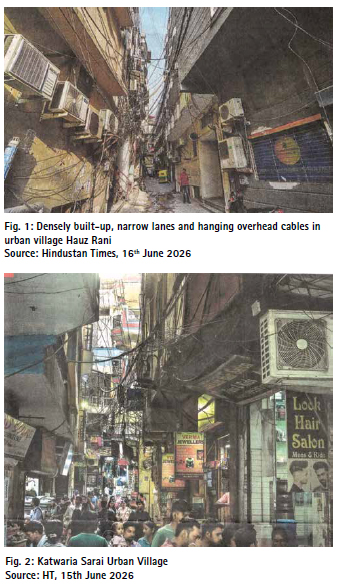
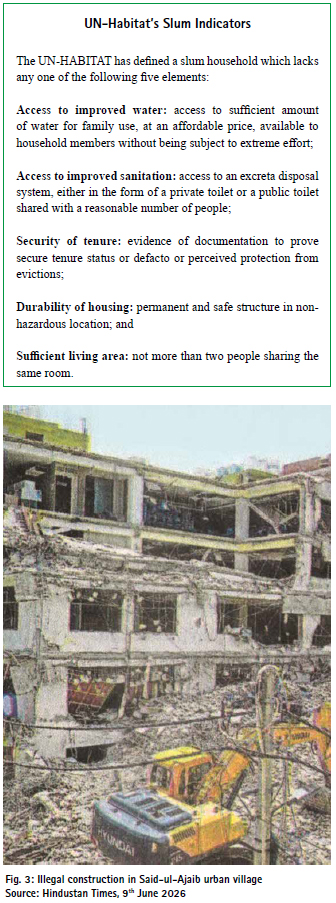
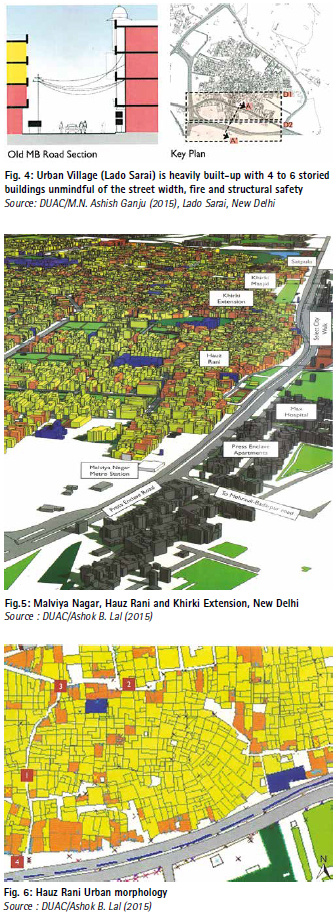
The studies indicate that the villages cum unauthorised colonies like Zamrudpur, Mohammadpur, Shahpur Jat, Kotla Mubarakpur, Hauz Rani, Hauz Khas, Jia Sarai, Kalu Sarai, Katwaria Sarai, Yusaf Sarai, Lado Sarai, Said-ul-Ajaib, Khirki, Ashok Nagar, etc. during last 30 years have grown from 300-600 buildings to 10,000 to 15,000 buildings having up to seven floors. These have overstressed services and civic amenities to a breaking point (Fig. 1 to 6). The illegal constructions have posed danger to the lives of the inhabitants with frequent incidences of fire and structural failures, since as Delhi falls in Seismic Zone IV, where earthquakes may be severe.
According to Delhi Government there were 543 deaths due to fire incidents between 2019 and 2026 with 66 deaths in 2026 alone.
Ensuring safety is a fundamental imperative and the safety of the people is a basic human right. The city should not have any unsafe building irrespective of type of development, land ownership or land use. Every building without a structural and fire safety certificate should be sealed and a warning board should be put that building can not be occupied for use. The Master Plan for Delhi-2021 (MPD 2021) and Delhi High Court already stipulate that all buildings, especially in unauthorized colonies, villages and traditional areas should be structurally and fire safe. For access in emergency, building collapse or fire, sufficient road width should be available, clear of parking and encroachments to ensure access of emergency vehicles.
According to the MCD order dated 9th December 2011, the building plans in unauthorised colonies and village abadi shall be submitted with an affidavit by the owner/applicant along with required undertakings for compliance of building byelaws. For ensuring safety of structures, there is a need of regular monitoring, to check, retrofit and rebuild the non-engineered buildings.
As Delhi falls in Seismic Zone IV, it may be catastrophic overlooking building safety codes. In its action taken report before the Delhi High Court (September 2026) MCD said that it has identified 4762 high-risk structures. Notices were issued to 4571 of them, but structural audit reports were received in only 1155 cases. Demolition were carried out in 56 cases and retrofitting in 47.
It is also necessary to rescind impugned 1963 Notification of Delhi Administration exempting residential construction within Laldora of villages from Building Byelaws. Another Act that needs to be repealed is the NCTD Laws (Special Provisions) Second Amendment Act, 2023 which provides legal shield for protection of unauthorised buildings built up to June 2014. Initially it was meant for one year, it has been extended for over 20 years since 2006. This has created a legal loophole, since it is difficult to ascertain the age of the structure.
It is time to ponder upon whether the regulatory function of buildings can be independent of the political apparatus and is demunicipalised. It is necessary to devise a method of taking suo-motto cognisance of the massive illegal/risky constructions taking place without submission and approval of building plans. Can it be possible to constitute an interdisciplinary and interdepartmental Delhi Building Regulatory Authority with members from the judiciary and experts in planning, digital/GIS, urban design, architecture, engineering/structures and disaster management (fire and other risks). It should deploy new technologies, such as artificial intelligence, drone surveillance, Geospatial AI, high resolution satellite imagery digital twins, data-driven Real-Time Morphological Tracking and LiDAR, which can remotely monitor and detect unauthorised constructions with least human interface, thus reducing corruption and pressures.
Delhi Disaster Management Plan
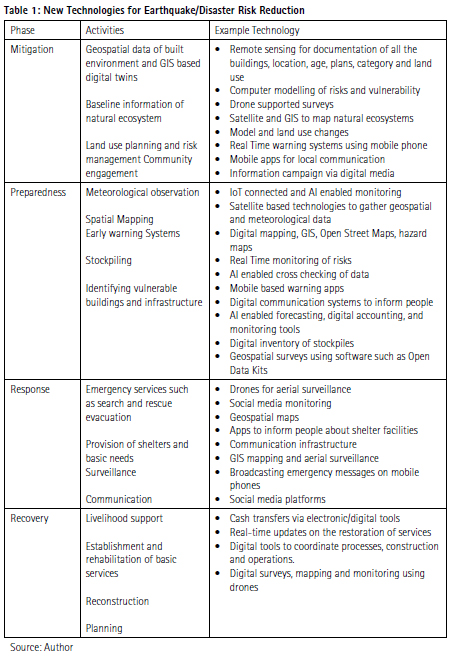
Under Section 31 of the Disaster Management Act, 2005, the GNCTD has formulated the District Disaster Management Plan (DDDMP), focusing on mitigation, preparedness, response and recovery. Its priorities include integrating disaster mitigation with development plans, strengthening communication and institutional mechanisms, using modern information technology, promoting insurance and public awareness, and involving the private sector. However, implementation is hindered by the lack of updated geospatial building data and disorganised, inaccessible records maintained by Urban Local Bodies (ULBs). These records need to be systematically organised using new technologies to assess earthquake, fire, structural and other risks. Since loss of life and property often results not from natural hazards themselves but from unsafe buildings and construction, integrating spatial and non-spatial data to prepare a comprehensive District Hazard Risk Map is essential for effective disaster planning (Table 1 and Fig. 3).
GIS Based Digital Twins
Recognising the immense capabilities of digital twins, the Government of India is investing in digital infrastructure by combining the prowess of 5G, IoT, AI, AR/VR, 6G, Digital Twins and next-gen computational technologies. GIS based digital twins incorporating temporal dimensions, enables users to track changes over time, facilitating better decision making and planning by integrating real-time data, predictive analytics and comprehensive understanding of dynamic environment and disaster risks.
Data registries enable the planners to have access to common sets of data as a shared resource to improve collaboration and decision making. The strength of the micro-service-based stack approach is that each new program creates reusable services, increasing the speed of delivery.
The Bureau of Indian Standards (BIS), IIT (Kanpur), CBRI, BMPTC, NDMA, NIDM, etc. have evolved useful guidelines to safeguard the buildings from disasters, damages and earthquakes. The seismic damage in buildings has been categorised as given in Table 2 with empirical measures for each of them.
Integrated Command and Control Centre (ICCC)
An Integrated Command and Control Centre (ICCC) has been established in Delhi (August 2026). It coordinates multiple municipal functions such as water supply, solid waste management, property tax, environment and security, monitoring services, transportation, weather, crimes and disasters. The focus of ICCC is not the safety of individual building, but of the people and neighbourhoods. On September 21, 2026 during dark hours a 17-year-old woman was raped inside 142-acre Ashtha Kunj Park. This is not only isolated incident, but women everyday travel precariously often on foot or by bus and after dark commonly described as trip chaining. Their safety and security needs more than gender safety audits for parks, transit corridors, neighbourhoods or housing areas. This requires provision of CCTV, last mile connectivity, public toilets and inclusive spaces. It is not about policing. Unsafe infrastructure cannot be made safer by more patrolling but by better lighting, vibrant and safer spaces, and a result oriented ICCC.
ABCDE of Safe Construction
The basic principle of safe construction can be summed up as ABCDE –
A – Anchorage
B – Bracing
C – Connections
D – Detailing
E – External Environment
Usually, in old buildings due to dampness, the steel may get corroded, and concrete may lose strength because of ageing, fires, structural failure, overloading, vibrations and earthquakes. As such, it is necessary that structural audit is undertaken for the structures older than 50 years. For repair of concrete pillars, beams, slabs, balconies, chajjas, staircases, etc., whenever necessary, reinforcement steel may be replaced, along with strengthening of the joints, supports, walls, pillars, etc. To protect buildings from earthquake effects, Base Isolation Devices and Seismic Dampers can be adopted to detach (isolate) the building from the ground. These act as the shock absorbers and prevent building damage from an earthquake.
Informal Settlements as a Resource
The informal settlements require a conceptual foundation that bridges incrementalism, inclusivity, participation, design and vernacular resilience. The informal growth needs to be seen not as a deficit, but as a resource. John Turner (1976) argued that multilateral and inclusive housing should be understood as a process, rather than a product, with residents shaping their environments. N Hamdi (2004) highlighted the effectiveness of small scale, community-based interventions in a fragile context, while N.J Habraken (1972) proposed structural and design supports that allow residents to adapt changes over time. Arnstein’s (1969) Ladder of Participation emphasises the importance of genuine power sharing in planning process as demonstrated in his Orangi Pilot Project.
The World Urban Forum (WUF) at Baku, Azerbaijan (May 2026)
The WUF under the theme ‘Housing the World: Safe and Resilient Cities and Communities, underscored that residents of informal settlements are not passive beneficiaries but active producers of housing, investing labour, resources and social organisations. Reiterating John F.C. Turner, the forum stressed that people are often the best judges of their own housing needs and they can produce housing solutions better suited to their circumstances than standardised, top-down provision. This needs a shift from criminalising people-led housing process towards creating enabling policies that provide secure tenure, basic services, infrastructure, technical support, and access to land and finances. The WUF underlined that that housing shapes not only where people live but also how they access opportunities, experience safety, maintain health and build families and communities. The commodification of housing production has deepened the housing crisis. About 80% of housing is self-produced, yet it is treated as illegal, marginalised and informal. As a result, the social function of housing seems largely broken, considering the millions living in insecure, undignified and inadequate conditions.
It underlines that housing is not simply an outcome of urban development, but as a foundational pillar of inclusive, resilient and just cities. The five basic principles of housing justice are availability, accessibility, affordability, acceptability and adaptability. The WUF reminded that inadequate housing is not about delivery, but about support, processes, power and justice. The supports-based model comprises several options, such as In-situ Upgrading, Supports-Infill, Incremental Reconstruction, Relocation, Land Sharing and Reblocking. This necessitates the changing the perceptions of urban planning and unplanned growth. This may need starting from the bottom with more participatory and enabling approaches, together with alternative, net zero buildings and services, viz. power supply, transport, water supply, disposal of wastes.
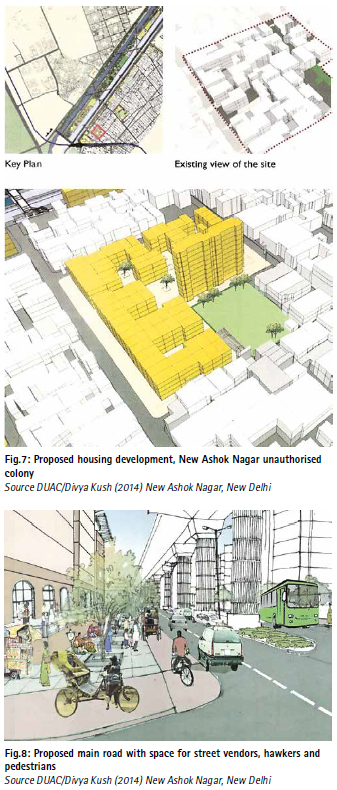
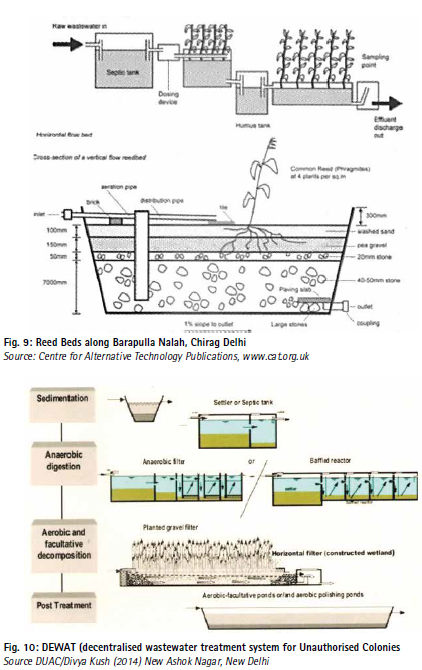
The DUAC has demonstrated alternative approach in its proposals for Malviya Nagar/Hauz Rani, Lado Sarai, Chirag Delhi, Mohammadpur, Aya Nagar and New Ashok Nagar (2014-15). These encompass a more comprehensive design approach, considering urban mobility and decentralised services, integrating environmental sustainability and provision of health, security and community facilities (Fig. 7 to10).
Ownership/Tenure Rights
A central issue is the ownership rights in slums and illegal colonies. Conventional top-down strategies often reproduce the barriers they aim to resolve. Instead, there is a need to adopt a bottom-up human cantered approach and participatory solutions. The first step in this endeavour is the establishment of secure tenure. Clear ownership of property is essential for safer construction and approval of building plan, safeguarding residents’ rights as mandated vide NCT of Delhi (Recognition of Property Rights of Residents in Unauthorised Colonies) Regulations, 2026.
Secure land tenure is the foundation of development of slums and unauthorised colonies. The communities can negotiate their own tenure arrangements through strategies such as cooperative land purchase, long-term lease contracts, land-swapping or user rights. The emphasis is on obtaining collective, rather than individual land tenure. As such, the government should encourage formation of cooperative housing societies, especially of about 20-30 persons rather than insisting on 60 or more members. Government should devise a mechanism whereby up-to-date records of land and houses in the NCTD are maintained.
Once ownership has been regularised, the Area Improvement Plans and Road Network Plans are developed for provision of essential facilities and infrastructure networks, such as water, electricity, sanitation and transportation. This enables the inhabitants to build in accordance with planning and building regulations, making a transition from informality to structured, state-supported development. The provision of greens and public spaces enhances the urban environment, reduces excessive density, improves ventilation and promotes social diversity.
Aligning Informal Settlements with Viksit Bharat
According to the Niti Aayog, in view of India’s fast-growing economy/GDP, per capita residential space in India should increase from the present 5.9 m2 to 35 sqm in 2047. This means a quantum leap in housing standards and its quality. The housing needs to be more inclusive enhancing the relationship between the city and women, children, homeless, destitute and the poor. These needs mandatory reservations for social, rental housing, public facilities and services. It should be carefully considered that whether increasing the Floor Area Ratio (FAR) and density could be counter-productive by making multi-storied apartments as a commodity. Whether such housing would be accessible to the poor and meet the aim of poverty reduction, gender equity and security? Another pertinent factor to be considered in housing is making it net zero with sustainable building materials and self-sufficient in water and energy.
Incremental and participatory reconstruction is cost-effective, adaptable and rapid. It preserves social cohesion and cultural identity, builds trust between citizens and institutions, and aligns with inclusivity and sustainability. It is not only about housing, but building dignity, memory and identity within the urban fabric. Mainstreaming and safeguarding the informal settlements in Delhi can be crucial resources in providing affordable housing for all.
References
Arnstein, S.R, A Ladder of Citizen Participation, Journal of American Institute of Planners, 1969
Centre for Alternative Technology Publications, www.cat.org.uk
Delhi Development Authority Delhi Master Plan, New Delhi, 1962
DDA, Master Plan for Delhi-2021, Delhi Development Authority, New Delhi, 2007.
Dovey K & King R, Forms of Informality, Morphology and Visibility of Informal Settlements, Built Environment, 2012
DUAC/Sameer Mathur and R.B. Singh, Delhi Greenways, DUAC, New Delhi, 2014.
DUAC Ashok B/Lall, Malviya Nagar, Hauz Rani and Khirki Extension, DUAC, New Delhi, 2015
DUAC/Divya Kush, New Ashok Nagar, New Delhi, 2014
DUAC, Raj Rewal, Mohammadpur, New Delhi, 2014
DUAC/M.N. Ashish Ganju, 2014, Lado Sarai Urban Development, New Delhi
DUAC/Arun Rewal, Chirag Delhi, DUAC, New Delhi, 2014
Dupont, V Slum Demolition in Delhi Since the 1990s: An Appraisal, Economic and Political Weekly, Vol. 43, 28, 2008, pp. 79-8.
Habraken N.J., Supports: An Alternative to Mass Housing, Architectural Press, 1999
Hamdi N., Small Change: About the Art of Practice and the Limit of Planning in Cities, Earthscan, 2004
Hasan A, Participatory Development, The Story of Orangi Pilot Project
ISOCARP, Review of World Planning, Practice, Cities and Region-Pathways to Resilience, ISOCARP, Netherlands, 2025
Jain A.K., Jahan Jhuggi Wahan Makaan- In-situ Slum Rehabilitation, Coordinate, September 2025
Jain A.K. The Informal City, Readworthy, New Delhi, 2011
Jain, A.K., Transforming Delhi, Bookwell, New Delhi, 2015
Jain A.K., Housing and Community Planning, Discovery Publishing House, New Delhi, 2020
Ministry of Urban Development, Report of the Committee on Making Delhi Slum Free, 2004
Mitchell, W.B.M., & Patwari, S., Learning from Delhi: Dispersed Initiatives in Changing Urban Landscapes (1st ed.)., 2010, Routledge, London
Royal College of Fine Arts and Architecture, Dharavi, Documenting, Informalities, Academic Foundation, New Delhi, 2009
Turner, John, Housing by People: Towards an Autonomy in Building, Marion Boyers, London, 1976
UN Habitat, The Challenges of Slums, Earthscan, London, 2003
UN Habitat, The New Urban Agenda, Nairobi, Kenya, 2015
World Bank, Reconsidering Site and Services, The World Bank, Washington, 2022






Leave your response!