
| My News | |
Tracking system for goods
|
|||||||||||||||
As the world becomes a smaller place, countries are becoming more dependent on each other in many fields. Goods like industrial products, food and other materials are easily exported and imported by every country. A Secure and Safety Tracking System is indispensable from the viewpoint of defense of country especially in the field of food security and safety. Also when international accidents happen, for inter-police investigation between countries, we need some objective criteria for the problem between different countries.
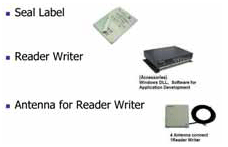
Current situationThere are many commercial logistics tracking systems between countries, however, each commercial logistics tracking system is standalone, and there is no interoperability between the systems in various countries. Actually, these commercial logistics tracking systems are operating well for tracking of products within their internal central control system. Customers can trace their baggage on the Internet by using a bar code or certain tracking number. We will show two examples. First example: FedEx has many variations of the tracking system (1) like, shipping, tracking, website management, and business solutions, however, the elements of FedEx commodities are limited to Package/Envelope or office/Printing service. The users can trace their commodities both from surface to air and from domestic to international. More over, the commodities are displayed on a map by GPS tracking information. If FedEx deals in commodities such as modified materials (i.e. food materials) they are not part of the FedEx order system. Second example: Hitachi Information & Control Solutions, Ltd. has Supply Chain Management Implementation System. (2) The Hitachi system is a good implementation example for a major Transportation Company and a Fuel Distribution Company. The Supply Chain Management Implementation System for major Transportation Company consists of four subsystems (3) • Transportation Management subsystem: TMS • Geographic’s Information subsystem; GIS • External System interface subsystem: EXS The purpose of this Supply Chain Management Implementation System is expansion of output and reduction of lead-time. The tracking of customers’ products is traced either by purchase order number or customized unique number; however, these numbers are not fixed for covered packages. A universal criteria like both timestamp and position stamp would be needed. In this research, we considered the application of Global Navigation Satellite System (GNSS) on a Secure and Safety Tracking System. GNSS is global and is useful on a worldwide scale. However, in a localized area a local navigation satellite system (e.g. The Japanese Quazi-Zenith Satellite System (QZSS)) (4) is sometimes more useful. The combination of QZSS and RFID is much more suitable for the Secure and Safety Tracking System. RF-ID (i.e. µ-Chip Hibiki) (5) is attached to the target industrial product, food, or material, and so on. The benefit of RF-ID is that the information is stored inside. The RF-ID reader can read this information. If the RF-ID is re-writable new information can be added to this RF-ID again and again. The point of combining of the QZSS and µ-Chip Hibiki is to trace logging information by position and time stamp. The monitoring of the position and time stamp is achieved with QZSS receiver. This QZSS receiver consists of a RF-ID reader and writer with GNSS receiver (including QZSS receiver). ProblemsTo realize the Secure and Safety Tracking System between different countries, Bible methodology will be important. All major countries should accept the methodology. The problems to be solved will be as follows: • The uncertainty of tracking routes from producer to consumer through logistic and Value added reseller from country to country. • The uncleanness of tracking route from export country to import country and checkpoints like immigration, customs, means of transportation. • The un-certification of tracking route and the lack of authorized agency certification. • The un-clearness of inter-police investigation, the lack of methodology and absence of international rules. Basic elementsTo solve the above problems, we propose basic elements of the technology and system solutions. We propose ISO standard activities for the Political and methodology points of view; however, this is still under consideration. Therefore this point will be discussed in another paper. Basic elements of the technology (1) Satellite: we are approaching the multi GNSS age. Outside of Japan, both GPS in the United States (under modernization) and Galileo project in Europe (now under demonstration stage) would result in the creation of an international network of satellite positioning systems. That would enable a high rate of utilization of real-time spatiotemporal information on a global scale. On the other hand, inside Japan, the satellite positioning technology derived from the Quasi-Zenith Satellite System has been incorporated into the Basic Program for Science and Technology, and has been further strengthened by its recognition as a national critical technology. By 2012 we will have over 60 satellites on the earth. (2) RF-ID: There are many types of RF-ID all over the world, However, we will focus on Hitachi’s RFID, µ-Chip Hibiki, because the µ-Chip-Hibiki has unique features and is suitable to the application of a Secure and Safety Tracking System. We have shown the features of a “µ-Chip Hibiki” in Figure-1 • UHF band RFID • Secure RFID protocol (Air Protocol • Standard • Large Re-writable Memory • Target cost Fig-1 current products of “μ-Chip Hibiki” Secure RFID protocol (Air Protocol) is the most important and suitable feature for the application of a Secure and Safety Tracking System. Secure RFID protocol (Air protocol) of a “µ-Chip Hibiki” has three features. These are privacy protection, user data protection and apply to standard. • Privacy Protection Communication distance between reader and tag is minimized by special command. • User Data Protection User memory area can be protected by password to read lock and write lock. User memory area is divided into 5 areas (max) and each area can have its own password (max 5). • Standard This Air Protocol is compliant with ISO/IEC 18000-6 Type C.
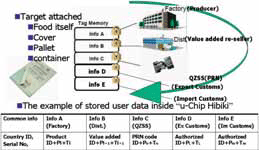
Fig-2 current products of “μ-Chip Hibiki” The semiconductor process has rapidly progressed, and on commercial basis, GPS chipset is sold from many semiconductor venders at less than 10$ for volume quantities. We find that the size and cost of GNSS Receiver with µ-Chip Hibiki Reader/Writer is almost same as current products. (4) Database: Trace data of a Secure and Safety Tracking System is stored inside “µ-Chip Hibiki”. As we explained at 4.1 (2), user memory area is divided into 5 areas (max.) and these user memory areas can be protected by password (Read lock and write lock) and addition to that, each password (max. 5) can provide protection for each area (max. 5). The size of user area inside “µ-Chip Hibiki” is 1.5Kbits and can be re-writable. According to the tracking system, “µ-Chip Hibiki” is attached to the target Goods (itself, cover, pallet, container). We have shown these images in Figure-3
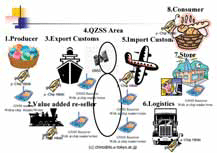
(5) Display: When food/ food materials are displayed in the show case, the manager of the Retail (store) can read the “µ-Chip Hibiki” tracking time stamp data by POS, to check if the tracking data is false or true. The example of stored user tracking time stamp data is shown at Figure-3. The country ID, Serial Number is common information. According to the Tacking stage, each information A, B, C, D and E are added inside “µ-Chip Hibiki” with position and Time stamp data (Pi + Ti). System Solutions (6) QZSS implementation: Japanese local Navigation Satellite System QZSS is suitable for the measurement of position and timestamp. QZSS is fully compatible with GPS in USA. The accuracy of positioning with QZSS is almost the same as that with GPS. In high-speed transportation vehicles like airplanes, the accuracy is near to 10 or 20 m. In static positioning, the accuracy is near to cm-level. This accuracy is enough for this tracking application, because the accuracy of positioning is not as important as tracking the trace of position. (7) RF-ID registered by authorized institution: There are two major RF- ID institutes in the world the EPCglobal and the Auto-ID center. A “µ-Chip Hibiki” is compliant with EPCglobal. There are several advantages of “µ-Chip Hibiki” in authorization. In production phase, EPCglobal authorizes country code and Serial number when a vender issues the “µ-Chip Hibiki” to customers. A pair of Country code and serial number is unique. A Vender can identify the customer that the “µ-Chip Hibiki” is sold to. In operation phase, when “µ-Chip Hibiki” goes thorough Export/ Import Customs at an Airport or Ship port, each country has their own authorized ID for Customs. By reading the authorized ID inside the user data of “µ-Chip Hibiki”, it is easily recognized which country the Goods are exported from and which country the Goods are imported to. (8) Total cost vs. Security cost ; For the marketing points of view, the key points for expanding this type of a Secure and Safety Tracking System is up to system construction cost + system operation cost. If the logistic private company decides to use a Secure and Safety Tracking System, a consideration would be that the total cost (construction cost and operation cost) must be minimized and optimized. However, a security cost is enough reason to pay additional charge for a Secure and Safety Tracking System. For the political points of view, the safety and security of Food and Food materials would be first priority in operation of agriculture politics. In public sector, some regulation to protect the safety and security of foods would be considered in the near future. Once the food import regulations are established, the security cost would be an indispensable cost for a Secure and Safety Tracking System. We have shown total system image of “Concept of Secure and Safety Tracking System using QZSS and RF-ID” in Figure-4 System Image in Section 5.
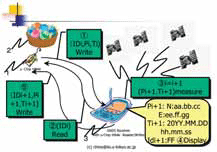
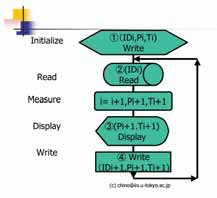
OperationSystem Image and system flow We will explain the process of how the food materials are transferred from 1. producer to 8. consumer in Figure-4 The point is that Position + Time stamp by GNSS receiver (including QZSS receiver) is linkage to a µ-Chip Hibiki ID code and the Position+time stamp is stored with new ID at different memory area (refer to Figure-3). Producer • µ-Chip Hibiki is attached to Goods like food/food materials/food cover. • The country ID, Serial Number is common information and is assigned by Authorized agency. UsingGNSS receiver with µ-Chip Hibiki reader/ writer, Producer writes (product ID+Position+Time) to Information A field of µ-Chip Hibiki user data (refer to Figure-3). At the same time Producer reads µ-Chip Hibiki (the country ID, Serial Number) of common field of µ-Chip Hibiki user data (refer to Figure-3). Value added re-seller(including warehouse) Expert customs • Export Customs read tracking data inside µ-Chip Hibiki • Export Customs mark (authorized ID+ position + time) in Information D field of µ-Chip Hibiki user data (refer to Figure-3) by GNSS receiver with µ-Chip Hibiki reader/writer QZSS area • Transportation tool (Ship or airplane) come into the QZSS Area • If GNSS receiver reads PRN code of QZSS, (PRN code+Position+Time) it is stored to Information C field of µ-Chip Hibiki user data. • GNSS receiver will update new (position + time) after certain interval (i.e. 30 minutes) • Update procedure will automatically repeat. Import customs • Import Customs read current data (ID + Time + position and its history) by µ-Chip Hibiki reader • Import Customs marked (authorized ID+ position + time) to Information E field of µ-Chip Hibiki user data (refer to Fig-3) by GNSS receiver with µ-Chip Hibiki reader/writer Domestic logistics • According to the Logistics layer, µ-Chip Hibiki is attached to food itself, food cover, food box, food container and marked by related ( ID+Time+position) • At the same time, GNSS receiver with µ-Chip Hibiki reader/writer read ID and write time and position Store • When food/ food materials are displayed to show case, the store read the µ-Chip Hibiki tracking time stamp data by POS, if the tracking data is false or true. • If the data is vaguer, omit the applied food / food materials Consumer • After checking the food property, they buy food / food materials, if they agree with the data. • At purchasing, the tracking data will be printed out from POS and they buy Secure and Safety products. Tracking data update methods We will discuss tracking data update methods as shown in Figure-5. If products are packed again and again with cover, box, container, and so on, a pare of (IDi, Pi, Ti) and next pare of (IDi+1, Pi+1, Ti+1) is the time domain relationship of the same product. This update idea is unique for ID+ position +timing criteria and these three elements (ID, Position, Time) will be key measurements to find out: What is it? Where is it? When is it?
One of the traditional RF-ID applications was Factory Automation like production line control system. (6) In this production line control system, RF-ID was active tag and read/ Write tag, so on going forward. RF-ID active tag read instruction from reader connected line Programmable Ladder controller, on the contrary, RFID active tag wrote its status information to RF writer. But there was no timestamp function at all. In production line, the important information was ID information and position. Tracking data update flowchart It is important for position +time stamp function to realize the Secure and Safety Tracking System between different countries. Especially the update of Tracking data (ID, Position, Time) is essential for this system. We have shown Tracking data update flowchart in Figure-6. In this flowchart, GNSS receiver measures new position data, and the measured new position data is stored to µ-Chip Hibiki user memory area linked to ID.
ConclusionWe have proposed basic concepts of how to realize the Secure and Safety Tracking System (especially for food, food material) between different countries. The problems to be solved are cleared as follows: • The certainty of tracking route from producer to consumer through logistic and Value added re-seller over country to country. AcknowledgmentsWe thank Mr. Shigeru MATSUOKA, of SPAC for his support and comments on our research. References[1] http://www.fedex.com/us/ |
|||||||||||||||
|
|||||||||||||||
|
|||||||||||||||
|
|||||||||||||||
|





 (No Ratings Yet)
 Loading...




Leave your response!