
| GNSS | |
GNSS (SBAS) Constellation Specific Monthly Analysis Summary: June 2026
The analysis performed in this report is solely the author’s work and his opinion. |
 |
|
Introduction
This article continues the monthly performance analysis of the GNSS/SBAS constellation. Readers are encouraged to refer to previous issues for foundational discussions and earlier results. The focus for this month’s issue is a preliminary assessment of Dual Frequency Multi Constellation (DFMC) SBAS. The goal is to examine representative DFMC SBAS test-bed data and compare the DFMC integrity concept with legacy single-frequency SBAS. Particular attention is given to DFC corrections, DFRE residuals, sigma construction and protection level generation.
1. Introduction
Legacy SBAS relies on a single-frequency measurement and therefore requires ionospheric corrections and GIVE bounds. The user variance model is largely driven by UDRE and GIVE parameters. In DFMC SBAS, dual-frequency ionosphere free measurements remove the dominant first-order ionospheric effect. Consequently, DFMC introduces Dual Frequency Corrections (DFC), DFRE monitoring, degradation models and revised variance propagation. The integrity budget shifts from prominent ionospheric uncertainty to correction, residual uncertainty and geometry. Details on the technical terms (like UDRE, GIVE..) and mathematical parts can be found in this analysis published in mycoordinates: https:// mycoordinates.org/gagan-performanceassessment-for-aircraft-precision-approach/.
Similarly, for the DFMC technical terms and mathematical parts, readers are encouraged to read this article: https:// curate.curtin.edu.au/articles/journal_ contribution/Preliminary_Performance_ Analysis_of_a_Prototype_DFMC_ SBAS_Service_over_Australia_and_ Asia-Pacific/31708315?file=62761321
Message Structure Differences
In L1 SBAS, integrity is driven by UDRE and GIVE concepts. In DFMC SBAS, the system broadcasts DFMC-specific correction and integrity information. The central user concepts become DFC, DFC Sigma, DFRE and degradation terms. The user no longer depends on a sampled ionospheric grid for routine positioning.
DFMC SBAS differs fundamentally from legacy single-frequency SBAS because the user no longer relies on SBAS ionospheric grid corrections and GIVE integrity bounds. Instead, dual-frequency measurements (e.g., GPS L1/L5 or Galileo E1/E5a) form an ionosphere-free observable that removes the dominant first-order ionospheric error directly. As a result, the traditional fast correction, long-term correction and ionospheric correction framework of L1 SBAS is replaced by a correction-residual framework based on Dual-Frequency Corrections (DFC), DFC sigma, DFRE sigma and degradation terms. While the underlying satellite clock and orbit corrections still exist within the ground segment, they are effectively merged into the DFC information supplied to the user, greatly simplifying user processing. The elimination of ionospheric grid messages also makes DFMC SBAS significantly more efficient in terms of GEO broadcast bandwidth, allowing that capacity to be used for multi-constellation support and enhanced integrity information. The integrity focus therefore moves toward correction residual bounding represented by DFC and DFRE uncertainties.
Dataset
The dataset analyzed corresponds to SouthPAN DFMC SBAS test-bed observations processed with gLAB using GPS and Galileo. The selected date is day of year 183, 2019. Statistics and plots are generated from DFMC correction, variance and SBAS output files. The data is taken from this server: https://server.gage.upc.edu/PhD/Ibanez_ Deimos/Ibanez_Deimos_Phd_files.7z.
2. Results and Interpretation
Figure 1 shows HPL95 of 13.11 m and VPL95 of 20.55 m. Both remain comfortably below LPV-200 alert limits of 40 m and 35 m. Protection-level peaks coincide with reductions in the number of satellites used. This demonstrates that geometry remains a dominant driver of integrity performance even in DFMC SBAS. The large spike around 16.5 hours appears to be associated with a temporary degradation in geometry and/or integrity bounding rather than a persistent increase in ranging uncertainty.
In Figure 2, GPS and Galileo exhibit nearly identical behaviour. Mean total sigma is approximately 1.23 m for both constellations and the 95th percentile remains near 1.55– 1.57 m. The similarity indicates consistent treatment of both constellations inside the SouthPAN DFMC processing chain. The recurring U-shaped trajectories correspond to elevationdependent error behaviour, where multipath, receiver noise and atmospheric mapping effects increase at lower elevations.
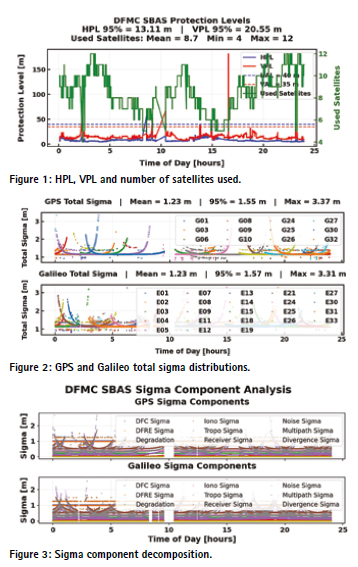
Figure 3 provides the strongest evidence of the DFMC integrity philosophy. DFC sigma is the largest contributor throughout most of the day. Receiver and multipath terms are secondary contributors. Tropospheric uncertainty remains modest. The ionospheric sigma contribution is nearly negligible compared with DFC and receiverrelated terms. This is a fundamental departure from single-frequency SBAS where ionosphere frequently dominates the protection-level budget. The resemblance between GPS and Galileo component distributions further indicates a harmonized DFMC integrity model.
3. Conclusions
Overall, Figure 3 shows that DFC sigma is the dominant contributor to the integrity budget, while ionospheric sigma is almost negligible; Figure 2 shows that GPS and Galileo maintain nearly identical total sigma performance, with 95th-percentile values around 1.55–1.57 m; and Figure 1 shows that despite a few geometry-driven events, HPL95 and VPL95 remain well below LPV-200 alert limits. Together, the three figures illustrate the central objective of DFMC SBAS: integrity performance is no longer limited by ionospheric uncertainty but is instead governed primarily by correction residuals, receiver effects and satellite geometry.
In DFMC SBAS, ionospheric uncertainty is largely removed by the dual-frequency observable. The limiting factor therefore becomes confidence in the broadcast correction itself and the residual error remaining after monitoring. DFC sigma and DFRE sigma provide conservative bounds on those residuals. The results reveal that correction uncertainty— not ionosphere—is now the principal contributor to the integrity budget. This behavior is exactly what would be expected from a mature DFMC SBAS architecture.
The analyzed representative SouthPAN test-bed dataset demonstrates successful DFMC SBAS performance. Protection levels remain well below alert limits, GPS and Galileo show nearly identical statistics, and the sigma budget confirms the migration from ionosphere-driven integrity to correctiondriven integrity. The plots collectively demonstrate how DFC residual uncertainty, receiver effects and geometry govern user protection levels in modern DFMC SBAS systems.
Data sources and Tools:
https://cddis.nasa.gov (Daily BRDC, RINEX OBS); http://ftp.aiub.unibe. ch/CODE_MGEX/CODE/ (Precise Products); BKG “SSRC00BKG” stream; IERS C04 ERP files
SBAS Mentor, ESA
gLAB GNSS, https://gage. upc.edu/en/learning-materials/ software-tools/glab-tool-suite
serenad-public.cnes. fr (SBAS data)







Leave your response!