
| GNSS | |
GNSS (SBAS) Constellation Specific Monthly Analysis Summary: July 2026
The analysis performed in this report is solely the author’s work and his opinion. |
 |
|
This article continues the monthly performance analysis of the GNSS/SBAS constellation. Readers are encouraged to refer to previous issues for foundational discussions and earlier results. The focus for this month’s issue is the clock stability and precision of the latest operational satellites from the Galileo and GPS constellations—Galileo E28, Galileo E32, GPS G20, and GPS G21. Using the IGS Final Clock Product as a reference, the analysis evaluates the onboard atomic clock performance through Modified Allan Deviation (MDEV) and compares broadcast clock corrections against precise clock data.
1. Introduction
The most recent operational satellites in the Galileo and GPS constellations— Galileo E28 and E32, and GPS G20 and G21—mark a significant milestone in global navigation infrastructure. Galileo E28 and E32, corresponding to satellite vehicle numbers SAT 33 and SAT 34, were launched in December 2025 during the fourteenth Galileo launch campaign aboard Ariane 6 from French Guiana. They were declared operational in mid2026, completing the third orbital plane of the constellation. Each satellite carries a combination of Passive Hydrogen Maser (PHM) and Rubidium Atomic Frequency Standard (RAFS) clocks, designed to provide exceptional longterm stability. GPS satellites G20 and G21, part of the Block III series, were launched between 2024 and 2026 and declared operational shortly after commissioning by the U.S. Space Force. Operating in semisynchronous Medium Earth Orbit at approximately 20,200 km altitude, they are equipped with advanced Rubidium atomic clocks that offer improved shielding and thermal control compared to earlier generations. These satellites differ from their predecessors by incorporating enhanced clock technology, improved broadcast ephemeris accuracy, and refined signal designs, all of which contribute to greater timing reliability and interoperability across GNSS systems.
Analysis
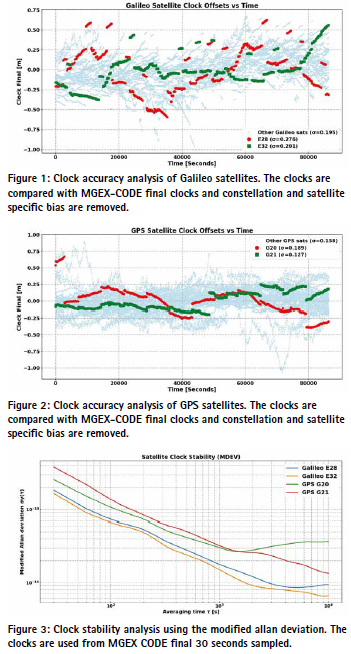
The analysis was conducted using the IGS Final Clock Product as the reference truth for precision evaluation. Clock stability was assessed through the Modified Allan Deviation (MDEV), which quantifies frequency stability over varying averaging times and distinguishes shortterm noise from longterm drift. Accuracy was evaluated by comparing broadcast clock corrections from GPS and Galileo navigation messages against the IGS final clock product, allowing the determination of mean offsets, standard deviations, and RMS values. The results are visualized in three plots: the first showing Galileo clock offsets versus time, the second showing GPS clock offsets versus time, and the third presenting a comparative MDEV plot across the four satellites. These plots provide a clear picture of temporal variations, noise levels, and comparative stability. The randomly selected date is day of year 179, 2026.
Results and Interpretation
The Galileo results reveal that E28 and E32 perform consistently within the constellation, though with subtle differences. In Figure 1, E28 shows slightly higher scatter clock noise, with a standard deviation of approximately 0.276 m, suggesting minor shortterm fluctuations likely linked to orbital or thermal effects. E32, with a standard deviation of about 0.201 m, demonstrates smoother behavior and lower noise, confirming excellent stability. Other Galileo satellites cluster tightly around a mean offset with a standard deviation near 0.195 m, validating the robustness of the constellation’s timing system. In the MDEV plot (Figure 3), both E28 and E32 maintain deviations below 10– ¹³ for averaging times greater than 1000 s, confirming the superior longterm stability of their PHM clocks. Their performance surpasses earlier satellites but well within the expected range among the FOC satelliets, reflecting improvements in clock conditioning and onboard management. Note that the scattered noise and jumps in Galileo satellites could also come from granularity of 10 minutes (whic is relatively freqeunt update of the broadcast clock data every10 minutes in comparison to 2 hours for GPS).
The GPS analysis (Figure 2) shows that G20 and G21 also deliver strong performance, though with distinct characteristics. G20, with a standard deviation of about 0.189 m, exhibits moderate variation and visible periodic trends, likely associated with orbital temperature cycles. G21, with a narrower standard deviation of 0.127 m, remains remarkably stable, forming a tight offset band around zero. Other GPS satellites show slightly higher dispersion, with a standard deviation near 0.158 m, consistent with the mixed aging of Block IIF and Block III units. In the MDEV comparison, GPS clocks demonstrate deviations in the range of 10– ¹³ to 10–14, with G21 outperforming G20 at longer averaging times. This indicates excellent frequency stability, though still below the longterm performance of Galileo’s PHM clocks.
Overall, the noise floor for all satellites lies within submeter clock offset levels, confirming the maturity of current GNSS timing systems. Orbital environment effects introduce small periodic modulations visible in the timeseries plots, but these remain well within operational tolerances.
(Note : in the monthly analysis series in coordinates (2024- 2025) it was observed that Galileo satellite clocks were providing better constellation wide clock accuracy in comparions to GPS. Though GPS performance was gradually getting better from March 2024, this was reported in one of the monthly issues. In this specific analysis, GPS is slightly outperforming. It was reported in As monthly performance analysis for GPS and Galileo clocks have not been done in 2026, it is an interesting topic to be explored later.)
3. Conclusions
The analysis of Galileo satellites E28 and E32 alongside GPS satellites G20 and G21 demonstrates that both constellations continue to deliver exceptional timing performance, consistent with the high standards established by earlier generations. The results confirm that Galileo’s Passive Hydrogen Maser clocks provide superior shortterm stability, with low noise and minimal drift across averaging times, while GPS Rubidium clocks remain highly reliable and predictable, particularly in their longterm behavior. Galileo clocks provide better performance in both short and long term. Although E28 and E32 do not represent a stepchange improvement over earlier Galileo FOC satellites, they reinforce the constellation’s reputation for robust clock quality and operational consistency. Similarly, G20 and G21 show performance in line with the Block III generation, with G21 exhibiting particularly strong stability. Together, these satellites ensure continuity of precise timing across GNSS, supporting improved synchronization, positioning accuracy, and interoperability between Galileo and GPS.
Data sources and Tools:
https://cddis.nasa.gov (Daily BRDC, RINEX OBS); http://ftp.aiub.unibe. ch/CODE_MGEX/CODE/ (Precise Products); BKG “SSRC00BKG” stream; IERS C04 ERP files
SBAS Mentor, ESA
gLAB GNSS, https://gage. upc.edu/en/learning-materials/ software-tools/glab-tool-suite
serenad-public.cnes. fr (SBAS data)
allantools, python







Leave your response!