
| UAV | |
AITL-WING-HITL: Telemanipulation of autonomous drones using DTs of aerial traffic interfaced with WING
The system is designed to intervene in scenarios, where an autonomous AI agent – the ‘‘new driver’’ – encounters conditions too complex or unorthodox for autonomy alone to handle. We present here the concluding part of the paper. The first part was publsihed in June‘26 issue |
 |
|
 |
|
 |
|
 |
|
 |
|
 |
|
 |
|
 |
|
 |
|
 |
|
 |
|
4. Experimental design
The developed platform – AITL-WINGHITL – needs to be assessed first in the environment of a simulation, then in the drone containment cage, and finally in real-field environments to ensure that the targeted objectives are achieved. The performance of humans while teleoperating multiple A-UAVs using the WING, as well as the functions of the platform, was evaluated in the simulation module of the developed platform. Volunteers were needed to test the developed platform for an hour, which aims to investigate further advancements through scenario-based experiments to improve the techniques and approaches before real-world tests. The AITL-WING-HITL platform, with simulation capabilities (Supplement III (Fig. 2, G.1)), provides an easy way to establish varying scenarios with multiple A-UAVs with their particular routes. One HTM can manipulate multiple drones using one WING in a one-tomany intervention mode. We would like to measure if the HTM can adjust their hand impedance sufficiently — application of hand force and releasing of the force (i.e. the translated input force into sub-movement microstructure states in Supplement I: Yaw (Tables I, II, Figs. 1, 2) and Roll (Tables III, IV, Figs. 3, 4) and Pitch (Tables V, VII, Figs. 5, 6) channels) at the desired time intervals to trigger the targeted actuation. Several scenarios were generated to measure (i) the capability of the user in adapting to the dynamically scaling DT environments and (ii) the efficiency of the responses to different scenarios using the WING with the various intervention modes (Fig. 15). HTMs are expected to improve their skills in real-world implementations as they immerse themselves in the platform over time, using the relation between the amplitude of the mouse movement, which is based on the force applied in channels, and the observed actuation displayed on the interface.
4.1. Policies followed before, during and after the experiment
Participation in the experiments was entirely voluntary, and participants were free to withdraw from the study at any time without providing a reason. No personally identifiable information was recorded, and all data were fully anonymised. Participants granted permission for the experimenter to access anonymised system-generated data and anonymised questionnaires completed during the study. Individuals with diagnosed chronic conditions (e.g. epilepsy) were not permitted to participate. Participants were informed that the anonymised data would be used for research purposes and shared with the academic community through publications. All data will be securely stored and protected for the next seven years in accordance with ethical guidelines (Section 10).
4.2. Environmental settings
University staff and students were voluntarily registered for the evaluation of the AITL-WING-HITL platform through some designed scenarios. An individual’s designated code, age and sex information were recorded; no other personal information was registered. The demographics of participants are shown in Supplement-V (the third column of Table 1). The age ranges from 19 to 55. No volunteer came forward from the female gender group, where the number of females is significantly less than the number of males gender in the School of Engineering and Computing from which most of the participants volunteered. The participants are grouped into sub-classes as experienced staff, non-experienced staff, experienced students and nonexperienced students as displayed in Supplement-V (the second column of Table 1) based on the second and third questions in the Overall Quality Questionnaire (OQQ) (Supplement IV Table 2). The participants who both answered the second question as ‘‘e’’ (>20) and the third question as ‘‘c’’ (<5 years) or ‘‘d’’ (<10 years) or ‘‘e’’ (>10 years) were grouped as experienced. 4 staff out of 11 and 7 students out of 12 were tagged as experienced (Supplement-V (Table 1)). These sub-groups were incorporated into the analysis of the platform, in particular, the evaluation of the WING’s capacity to manipulate A-UAVs, which concerns other close-range aerial vehicles, for the purpose of mitigating collision risks. It is noteworthy to emphasise that discomfort could arise during the non-stop, long test of 6 experimental episodes, and one objective was to measure the emerging discomfort. All participants knew that they could quit the test at any time they wished. Alternatively, the test can be ended by the mentor at any time. In this respect, 3 participants decided to withdraw from the experiment in the middle of the experiment, and the mentor decided to stop the experiment for one of the volunteers due to increasing tension. These volunteers were excluded from the experiment, and no data from these volunteers were included in the assessment of this report. The user-friendly application provides a co-simulation environment coupling real and simulated A-UAVs. Manipulating co-simulated A-UAVs is carried out using the aerial DT interface that is integrated with the WING to avoid the risk of collisions by allowing the user to readily respond to developing situations regarding all other manned or unmanned flights in the environment. The simulation interface makes it easier to repeat the same experiments.
The experimental episodes conducted in this simulated environment were designed to: (i) analyse participants’ task performance; (ii) enhance immersive navigation experiences using the WING system to accelerate task performance through human sensorimotor adaptation –where human perception continuously recalibrates in response to new inputs; and (iii) assess Simulation and Cyber Sickness (SCS) symptoms prior to realworld field tests, in order to identify mitigation strategies that improve the functionality of the AITL-WING-HITL platform. Participants were required to complete the Simulation Sickness Questionnaire (SSQ) at three stages: before the orientation training, after the orientation (but prior to the experimental episodes), and after completing all episodes. This allowed for tracking changes in physiological symptoms throughout the experiment. Additionally, they were asked to complete an Overall Quality Assessment Questionnaire (OQQ) at the end of the experiment to evaluate potential areas for further improvement. To maintain experimental continuity and minimise duration, SSQ measurements were not taken between scenarios/ episodes, thereby avoiding interruptions and allowing for an uninterrupted assessment of symptom severity.
A 13-minute orientation was provided to help participants familiarise themselves with the AITL-WING-HITL platform and the WING system. Specifically, the experimental session began with a training phase. Participants first received a brief 5-minute tutorial on the interface, during which the experiment mentor demonstrated how the WING’s combined functionalities could be used to control drones via the platform. Key scenarios were demonstrated to clarify the experiment’s objectives – for example: ‘‘What happens if neither the human nor the system intervenes, resulting in a collision?’’ and ‘‘How does the platform autonomously respond to impending, probable, and imminent collision risks using a minimum deviation strategy?’’ Following the tutorial, participants engaged in a 7-minute practice session, supported by the experimenter. During this time, they freely explored the system’s features to assess how quickly they could adapt to its functionalities. The participants were made aware that the primary objective of the experiment was to avoid collisions using the fewest possible manoeuvres and to maintain minimal deviation from the original flight paths – ensuring safe separation between drones through the WING system.
Each participant was scheduled for an episode duration of seven minutes, with the trial comprising six episodes, each designed to achieve a distinct objective. These episodes incorporated three different scenarios, with each scenario being repeated twice across the six episodes. Based on prior research, it is expected that prolonged continuous exposure can result in more severe symptoms of Simulation Sickness (SS) compared to multiple shorter exposures [46]. Specifically, as observed by Kennedy et al. [47], two key temporal phenomena are associated with SS: the severity of symptoms tends to increase with longer exposure durations during a single session, while repeated exposure to simulation over time can lead to adaptation, reducing symptom severity [46]. To explore these dynamics, the experiment was designed as a continuous, long trial with no breaks between episodes, which may heighten participants’ susceptibility to SS if symptoms occur. Each participant completed the full trial in approximately 55 min – comprising a 13-minute orientation followed by six episodes of seven minutes each (6 × 7 = 42 min). If a participant failed an episode (e.g. by causing a collision), the episode was repeated, extending the total trial duration by an additional seven minutes. Although environmental settings remained constant across episode repetitions, participants were instructed to avoid collision risks using different features of the WING system, each involving distinct intervention modes (Fig. 15). Participants could control multiple drones at risk of collision, with capabilities such as altering and locking navigational direction, forcing drones to hover in a safe location, or instructing them to orbit a defined geospatial point until released. All drone movements and granular actuation data were tracked and recorded for later analysis, allowing assessment of both precision and consistency across trials. Participants received real-time warnings upon detection of imminent collision risks. In such cases, the system automatically transitioned from the HOTL state to the HITL state to enable immediate human intervention.
The experiment designed in this study aims to assess both participants’ task performance and the unpleasant symptoms experienced during the sessions. Researchers and developers utilising flight simulators or DT technologies must remain mindful of SCS, as it can negatively affect experimental outcomes. Consequently, before widespread adoption, all VR technologies should be rigorously tested for their potential to induce discomfort in users [46]. Analysing the symptoms associated with SCS in relation to specific user interactions within the application can inform system enhancements that may significantly reduce symptom severity. To establish a baseline, participants were assessed prior to the experiment to capture any pre-existing symptoms. This is critical, as individuals can exhibit considerable variability in their tolerance to environmental changes, necessitating pre- and post-test comparisons to determine statistically significant differences. Additionally, a questionnaire (i.e. OQQ), consisting of both Likert-scale and openended questions, was administered to evaluate the current functionality of the system and to identify areas for further improvement regarding user experience and task performance. The full questionnaire is provided in the supplementary materials (Supplement IV, Table 2). To measure the severity of SS symptoms, the widely adopted SSQ developed by Kennedy et al. [47] was used. SCS is a syndrome similar to motion sickness, often encountered in simulator or immersive environments, akin to what sailors experience at sea [48]. The SSQ includes 16 symptoms (listed in Supplement IV, Table 1) and primarily captures physiological discomfort and autonomic nervous system activation. Each symptom in the SSQ is rated on a four-point scale: 0 (‘‘none’’), 1 (‘‘slight’’), 2 (‘‘moderate’’), and 3 (‘‘severe’’). The symptoms are categorised into three subscales – Nausea (N), Oculomotor Disturbances (O), and Dis-orientation (D) – as well as an overall Total Severity Score (TS). Some symptoms contribute to multiple subscales; for instance, ‘‘Difficulty focusing’’ is included in both the ‘‘oculomotor’’ and ‘‘disorientation’’ categories. Subscale scores are calculated by summing the symptom ratings within each category and multiplying by particular weights: 9.54 for Nausea (range: 0–200.34), 13.92 for Disorientation (range: 0–292.32), and 7.58 for Oculomotor Disturbance (range: 0–159.18). Rather than a simple sum of raw scores, this weighted scoring system, constructed by Kennedy et al. [47], offers a more accurate and nuanced measure of overall SCS, as it accounts for the varying severity levels across its three subscales. The total symptom score is obtained by summing all 16 symptom ratings and multiplying the result by 3.74, yielding an overall SSQ score ranging from 0 to 179.52.
4.3. Test in simulation
The experimental test began with a training session. Participants were first provided with a concise 5-minute tutorial on the interface. The experiment mentor then demonstrated how the 6DoF functionalities of the WING system could be employed to control A-UAVs via the AITL-WING-HITL platform. Two key scenarios were demonstrated to clarify the experiment’s objectives: (1) what occurs when neither the human operator nor the system intervenes, resulting in a collision; and (2) how the AITL-WINGHITL platform autonomously responds to impending, probable, and imminent collision risks using a minimum-deviation strategy. These scenarios were illustrated using two 7-minute recorded videos, ‘‘01_ No-intervention-no-CA.wmv’’ and ‘‘02_ No-intervention-with-CA.wmv’’, available in [49]. Following the demonstration, participants engaged in a 7-minute hands-on practice session with support from the experimenter. During this session, they freely explored the platform’s functionalities to assess how quickly they could adapt. It was emphasised that the primary objective throughout the episodes was to avoid collisions using the fewest possible manoeuvres via the WING system. In essence, participants were expected to complete each CA task by safely and minimally deviating from the original flight path. Participants were instructed to execute CA manoeuvres outside the ICTZone for safety, but as close as possible to it for efficiency — ideally within the PCTZone. They were also required to avoid creating any new collision risks with other nearby aerial vehicles while evading imminent collisions. A collision during any episode was considered a failure, requiring the participant to repeat that episode without interruption. Three challenging collision-avoidance tasks were assigned, each involving potential conflicts with other aerial vehicles. These three scenarios were repeated once, resulting in a total of six episodes. The repetition allowed for measuring user progress between the first and second attempts. Once participants were familiarised with all system setups, the independent experimental sessions were conducted. Participants were fully immersed in a simulated aerial environment through the WING interface. Given that latency in visual feedback can significantly impair haptic task performance [50,51], our application provided real-time visual updates of both the WING’s actions and the environmental interactions (SSA) with other flights. This ensured high transparency, enabling users to properly immerse themselves in the remote environment and promptly correct any un-desirable actions. Each participant completed the six episodes over 42 min, as previously described. For four participants, the test duration increased by seven minutes due to episode failures requiring repetition: two participants from the non-experienced student group in Episode 3, one from the non-experienced staff group in Episode 3, and one from the experienced staff group in Episode 5. All system-generated data produced by participants during the simulation were recorded for subsequent performance evaluation and statistical comparison.
Each participant was able to visually interact with specific A-UAVs and manipulate their navigation and trajectories in relation to nearby flights, with the goal of successfully completing the task without collisions and maximising task performance. All participants began with the first episode and proceeded sequentially through the second, third, fourth, fifth, and sixth episodes without interruption. The experiment concluded with the completion of post-test questionnaires. Upon finishing all six episodes, participants were asked to complete the SSQ and a function-specific evaluation – the OQQ – as previously described. These instruments were used to assess overall user experience and system effectiveness from multiple perspectives. In addition to the questionnaire data, system-generated records from each episode were analysed to evaluate both individual participant performance and overall system functionality. These records included: (i) the time taken to successfully complete each episode (e.g. time required for the HTM to resolve specific problems); (ii) the deviation distance from the original planned trajectory; and (iii) the number of failures, such as imminent collision alarms or actual collisions. The following sections provide detailed elaboration of the scenarios used in the experiment.
4.3.1. The first scenario within the first two episodes
The platform’s autonomous response to imminent collision risks using a minimum deviation strategy was demonstrated in the video titled ‘‘02_No-intervention-with-CA.wmv’’. Participants were expected to replicate similar manoeuvres during the first two episodes, specifically within the PCTZone. Entering the ICTZone significantly increases the risk of collision and is considered a weakness in participant performance. Any actual collision was classified as a failure, requiring the repetition of the episode. Upon entering the PCTZone, participants had a window of 3 s to reach the ICTZone, and up to 6 s before a collision would occur if no corrective action was taken. Participant performance was evaluated by comparing their manoeuvres to both the system’s benchmark trajectory demonstrated in ‘‘02_No-intervention-withCA.wmv’’ and to one another, primarily based on the deviation from the original flight path. To ensure the measurement of participants’ unassisted performance, the full-control (master– slave) intervention mode (Fig. 15) was employed. This configuration prevents the system from initiating any autonomous manoeuvres during imminent collision risks or actual collisions. Thus, the assessment reflects purely the participants’ capabilities without system interference. For an illustrative example of the manoeuvres expected in the first two episodes, readers are referred to the video titled ‘‘FirstScenario.wmv’’ in [49].
4.3.2. The second scenario within the third and fourth episodes
In this scenario, the co-activity (shared) intervention mode (Fig. 15) was employed. Participants were expected to perform vertical manoeuvres – either upward or downward – based on the altitudes and velocities of nearby flights posing collision risks. Entering the ICTZone significantly increases the likelihood of a collision, and if the system triggers an autonomous manoeuvre to avoid an imminent collision, the episode is considered a failure and must be repeated. Participants had a 3-second window to reach the ICTZone after entering the PCTZone, within which autonomous interventions are activated. Participant performance was evaluated by comparing their trajectories to the system’s benchmark manoeuvre (i.e. ‘‘02_No-intervention-withCA.wmv’’), as well as against one another, with particular attention to the deviation from the original trajectory.
4.3.3. The third scenario within the last two episodes
In the third and fourth episodes, participants were expected to per-form directional manoeuvres opposite to the detected threat: ascending when the potential collision path involved a descending trajectory, and descending when the collision threat came from below. The co-activity (shared) intervention mode (Fig. 15) was employed for this scenario. Entering the ICTZone significantly increased the risk of collision, and any autonomous manoeuvre initiated by the system to prevent an imminent collision was considered a failure, requiring the episode to be repeated. Upon entering the PCTZone, participants had a 3-second window to respond before the ICTZone threshold was reached and autonomous actions were triggered. Participant performance was assessed by comparing their manoeuvres against the system’s benchmark (i.e. ‘‘02_Nointervention-with-CA.wmv’’) and against one another, with a focus on the deviation from the original flight trajectory.
5. Experimental results
A dependent t-test for paired samples was conducted to evaluate the outcomes of the quantitative data collected during the experiment. The analysis was performed with a statistical significance level corresponding to a 99% confidence interval. A detailed summary of the experimental results is provided in Supplement V to facilitate further analysis and enable researchers to draw broader conclusions. The key findings from these results are outlined below.
5.1. Results: System-generated recordings
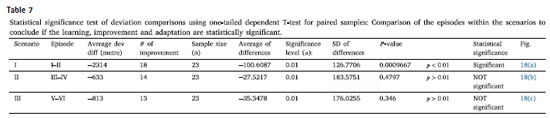
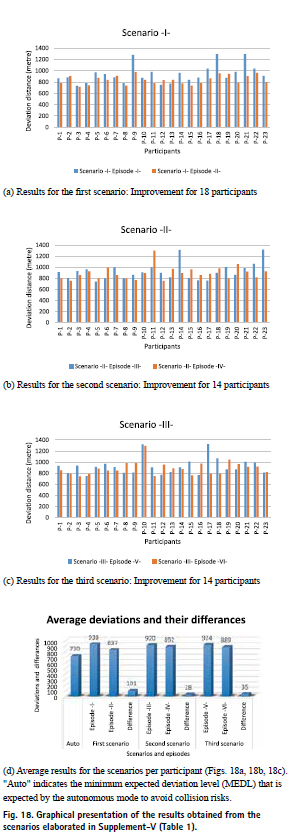
The summarised deviation results, autonomously recorded by the system during the experiments, are presented in Supplement V (Ta-ble 1). As shown in Table 7, which presents averaged data from Figs. 18(a), 18(b), and 18(c), Scenario I demonstrates a statistically significant improvement from Episode I to Episode II. In contrast, Scenarios II (Episodes III to IV) and III (Episodes V to VI) exhibit only minor, statistically insignificant improvements (i.e. 28 m and 35 m, respectively). A total of 18 out of 23 participants improved their performance in Scenario I, whereas only 14 participants improved in Scenarios II and III. This suggests that Scenarios II and III may require additional training for participants to achieve more substantial performance gains. These scenarios likely impose a higher cognitive load, as they demand greater attention to the real-time Situation Awareness (SA) and navigation data generated by the system. This increased demand may be attributed in part to the cognitive limitations associated with interpreting such information via the 2D GUI of the AITL-WING-HITL platform. Fig. 18(d) visualises the average deviation across all scenarios and episodes relative to the benchmark value – the Minimum Expected Deviation Level (MEDL) – recorded in the autonomous mode (i.e. 730 m). This visualisation highlights the relative differences in performance, both between participants and in comparison with the autonomous system. Participant performance is considered more favourable the closer the deviation is to the MEDL. Participant adaptation appears to be more effective in Scenario I, with the deviation in Episode II decreasing to 837 m – approaching the MEDL – likely due to the reduced cognitive load. In Episode I of Scenario I, where participants first began engaging with the WING and the interface, the deviation was higher (938 m), which is expected due to the initial learning curve. In comparison, the first episodes of Scenarios II and III yielded slightly smaller deviations (920 m and 924 m, respectively), likely due to prior exposure. How-ever, subsequent improvements in Scenarios II and III were minimal (892 m and 889 m, respectively), indicating that additional exposure alone may not be sufficient for significant performance enhancement in tasks involving greater cognitive complexity.
From a broader perspective, the classification of average deviation values across participant groups is visualised in Fig. 19, based on the detailed data provided in Supplement V (Table 1). The group-specific analyses are summarised below:
– Scenario I: All participant groups demonstrated performance improvements from Episode I to Episode II, with respective improvement values of 30 m, 172 m, 108 m, and 47 m. While it was expected that the expert group would perform best when engaging with the WING platform, the results indicate that both prior experience and familiarity with similar systems play a significant role in enhancing performance. The experienced staff group outperformed the others, achieving deviation values of 815 m in Episode I and 785 m in Episode II. Notably, the non-experienced staff showed the greatest improvement, reducing their deviation by 172 m. It is important to note that achieving improvements becomes increasingly difficult as performance approaches the MEDL, due to the elevated risk of collision. In this context, the experienced staff’s relatively modest improvement of 30 m is reasonable. Interestingly, the non-experienced students performed better than the experienced students, with deviation values of 840 m and 793 m, compared to 957 m and 849 m, respectively.
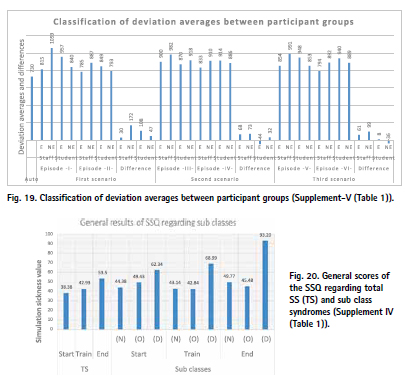
– Scenario II: All groups, with the exception of the experienced students (–44 m), improved their performance from Episode III to Episode IV, with improvement values of 68 m, 73 m, and 32 m. Although the experienced students initially outperformed the other groups with a deviation of 870 m in Episode III, their performance declined in Episode IV, with a deviation of 940 m. In contrast, the nonexperienced staff again achieved the highest improvement (73 m), demonstrating consistent learning and adaptation.
– Scenario III: All groups improved their performance from Episode V to Episode VI, except for the non-experienced student group, which showed a performance decline (–36 m). The most notable improvement was again observed in the non-experienced staff group, with a deviation reduction of 99 m. The experienced staff group maintained the best overall performance, with deviations of 854 m in Episode V and 794 m in Episode VI, while the non-experienced staff demonstrated the largest performance gain in this scenario.
5.2. Results: Simulation sickness questionnaire
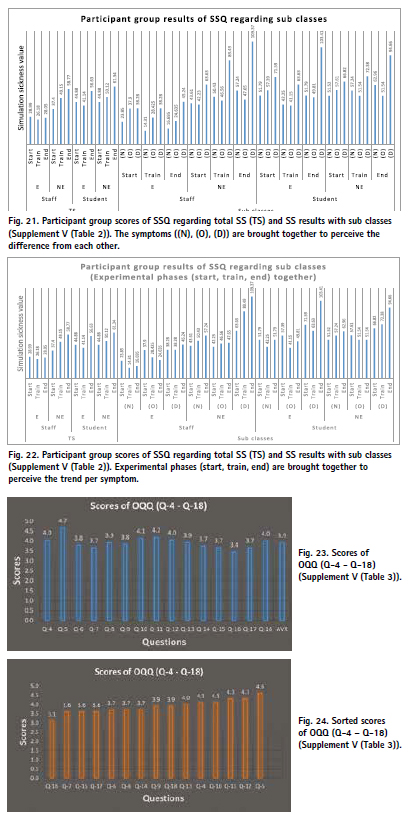
The computation of SSQ scores based on reported symptoms is detailed in Supplement IV (Table 1). While some studies (e.g. [52–54]) suggest that the severity of SS symptoms increases over time, others (e.g. [55]) argue that symptoms tend to decrease with continued inter-action with the system. Given these conflicting findings, the detailed SSQ results from this study are provided in Supplement V (Table 2). Fig. 20 presents the overall SSQ summary scores, including the TS and subscale scores. The total SS score increased from 38.38 at the beginning of the experiment to 42.93 after the training phase, and further to 53.5 by the end of the experiment. The increase from the start to the training phase was not statistically significant, whereas the increase from the training phase to the completion of all scenarios was significant (p < 0.01). Nausea (N) and Oculomotor (O) scores showed a slight, statistically insignificant decrease following the training phase and a slight, statistically insignificant increase by the end of the experiment (p > 0.01 in both cases). In contrast, Disorientation (D) scores showed a consistent and statistically significant increase across all three phases, rising from 62.34 at the beginning to 68.99 after training and reaching 93.20 by the end of the experiment (p < 0.01). It is important to note that even at the final measurement, the disorientation scores remained well below the maximum possible value of 292.32 (as shown in Supplement IV, Table 1).
Participant group SSQ scores are illustrated in Fig. 21, where symptoms – Nausea (N), Oculomotor (O), and Disorientation (D) – are combined to compare differences across groups, and in Fig. 22, where scores are grouped by experimental phase (start, training, and end) to highlight trends per symptom. As shown in Fig. 21, there was no noticeable increase in SSQ scores for the experienced staff across the experiment phases (i.e. 28.99, 26.18, 28.05). In contrast, a consistent and significant increase was observed for both the non-experienced staff (i.e. 37.4, 49.15, 58.77) and non-experienced students (i.e. 44.88, 50.12, 61.34) from the beginning to the end of the experiment. Al-though the training phase was designed to alleviate simulator sickness symptoms, it instead resulted in a significant increase in scores for the non-experienced staff (49.15) and non-experienced students (50.12). In contrast, the decrease in SSQ scores for the experienced staff (26.18) and experienced students (41.14) during the training phase was not statistically significant. Among all groups, the experienced staff consis-tently reported the lowest SS levels. In Fig. 22, while the experienced staff did not show a significant increase in total SSQ scores over time, the disorientation (D) subscale did increase significantly – from 38.28 to 45.24 – during the experiment. This increase is masked in the overall total due to decreases in the (N) and (O) subscales, which dropped to 16.69 and 24.63, respectively, compared to their initial values (N: 23.85, O: 37.9). The (D) symptom increased significantly across all participant groups. The (N) subscale decreased significantly for the experienced staff but increased for all other groups except the experienced students. The (O) Fig. 19. Classification of deviation averages between participant groups (Supplement-V (Table 1)). Fig. 20. General scores of the SSQ regarding total SS (TS) and sub class syndromes (Supplement IV (Table 1)). subscale decreased significantly for the experienced staff and both student groups, but increased for the non-experienced staff from the start to the end of the experiment.
5.3. Results: Overall quality questionnaire
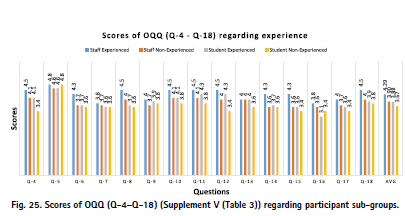
The OQQ is provided in Supplement IV (Table 2). Detailed results obtained from the OQQ are presented in Supplement V and summarised in Fig. 23 by question order, in Fig. 24 by score ranking, and in Fig. 25 by participant subgroup. The overall average score across all questionnaire items is 3.9 out of 5. Question Q-5 (‘‘Manoeuvring left/right is easy to implement with the WING’’) received the highest approval rating, with an average score of 4.7. In contrast, question Q-16 (‘‘I found the overall AITLWING-HITL interface as well as the WING easy to use and scalable to support a single HTM controlling more than one A-UAV synchronously’’) received the lowest score, averaging 3.4. Questions Q-5, Q-12, Q-11, Q-10, Q-4, and Q-13 were all rated highly, each scoring above 4 out of 5. Regarding participant subgroups (Fig. 25), the experienced staff group provided the highest overall rating, with an average score of 4.29. Conversely, the non-experienced student group gave the lowest ratings, with an average score of 3.67. The non-experienced staff and experienced student groups gave similar ratings (3.90 and 3.88, respectively). Notably, the experienced staff group scored highest across all questionnaire categories. The immersive capabilities of the WING in simulation environments were found to be highly effective. Participants reported that the AITLWING-HITL platform, in conjunction with the WING, met most of their expectations in manipulating A-UAVs. The responsiveness of the A-UAVs was considered highly satisfactory, particularly in terms of translating the WING’s discrete microstructural inputs into desired task-oriented outputs — such as trajectory adjustments, manoeuvres, velocity, altitude, and heading. Overall, participants responded positively to remote manipulation of A-UAVs in scenarios involving pending, probable, or imminent collision risks using the WING’s 6DoF functionality. Notably, 16 out of 23 participants – 7 of whom were experienced – expressed a preference for using the WING over traditional joysticks (Q-24 in Supplement V, Table 3). QoE can be assessed through measurable QoS parameters; a decline in QoS typically results in reduced QoE [56]. In this context, the immersive quality, comfort, and overall usability of the AITL-WING-HITL platform and the integrated WING were all rated highly. No significant effects of system latency were observed on task performance or responsiveness, indicating a high level of transparency in the simulation environment and, consequently, a high QoE. Based on participant feedback, the primary concerns and additional features to be considered for future integration into the system are outlined as follows.
– Executing manoeuvres above or below other vehicles requires close attention to real-time flight parameters – especially altitude –since discerning vertical separation between vehicles can be challenging in the platform’s 2D interactive interface (Fig. 17). This is particularly problematic when aircraft converge at similar latitude and longitude coordinates.
– Experienced participants, familiar with 3D simulation environments, recommended the development of a 3D visualisation mode for the platform to enhance spatial awareness.
– Manipulating vehicle trajectories along the Z-axis using the WING could be made more intuitive and functional, particularly when discrete altitude changes are needed – especially in the downward (Z-negative) direction of the device.
– The platform could assist users by suggesting optimal manoeuvring actions (e.g. ‘‘descend 50 m’’, ‘‘turn 15◦ left’’) based on real-time SSA and nearby aircraft data, as it already does for scenarios involving probable or imminent collision risks. Such features may help reduce cognitive load
6. Challenges
(i) Latencies in wireless communication between A-UAVs and HTMs are a clear limitation, hindering the development of highly transparent DT systems. From a broader perspective, time-varying delays are inevitable during collaborative operations – arising from communication lag, decision-making delays affecting the QoE of HTMs, the processing of large volumes of sensor data, and actuation delays. To enable effective telemanipulation of aerial robots – especially for CA – it is essential to develop transparent systems equipped with estimation-based predictive displays and directional aids (Figs. 9,10) that compensate for these latencies. Further studies on transparent systems, in particular, building the transparency standards, such as IEEE Std 7001-2021 [57], are of prime importance, considering the autonomous systems.
(ii) Malicious interference poses significant threat. A nearby radio transmitter can readily initiate a denial-of-service attack – e.g. via jamming – with reaction times on the order of tens of microseconds, significantly increasing packet loss rates in Vehicle-to-Vehicle (V2V) communication, as demonstrated in multiple studies [58–60]. Additionally, false data injections may occur, highlighting the need for robust authentication mechanisms to validate all inputs [7]. Given these risks, cybersecurity must be treated as a primary concern well in advance of the widespread deployment of telemanipulated A-UAV systems.
(iii Determining optimal obstaclefree trajectories for drones is a complex challenge, constrained by factors such as airspace structure, communication coverage, battery limitations, collision risk, and terrain avoidance [61]. All these constraints must be thoroughly considered in the design of telemanipulation approaches for A-UAV platforms.
7. Lessons learned
(i) 3D interface development for DT systems – excluding extraneous information – can substantially reduce cognitive load during telemanipulation, enhancing operator effectiveness and situational awareness.
(ii) Even with high-quality SA information, effective human telemanipulation remains highly dependent on the cognitive, perceptual, and motor abilities of HTMs, including spatial orientation skills [8]. To mitigate risks from erroneous decisions, it is critical to leverage local intelligence (i.e. AITL) at the remote site (Fig. 15).
(iii) Many drone operations can benefit from a unified framework that facilitates coordinated access to integrated airspace and efficient routing to task locations [62]. The development of robust telemanipulation platforms, as investigated in this study, supports the realisation of such frameworks.
(iv) A major challenge in non-faulttolerant and non-delay-tolerant telemanipulation of AVs lies in the requirement for real-time intervention with high perceptual awareness and minimal latency (i.e. rapid action-response capability) [8]. A human–teleoperator interface with low cognitive demand can streamline interaction and ensure compatibility with real-world AV capabilities [8]. Future systems must in-corporate advanced, safety-critical interface functionalities, supported by cutting-edge communication infrastructure and analytical tools, to enable tight, time-sensitive coupling between the cyber domain of HTMs and the physical domain of AVs [8]. This research focused on developing such a platform – designed to reduce cognitive load and support one-to-many A-UAV telemanipulation – by leveraging high-functionality coupling tools like the WING and interfaces such as AITL-WING-HITL.
8. Discussion
FA-UAVs are expected to execute their missions with minimal to no human intervention. However, in complex, realworld environments – particularly when multiple UAV missions are conducted by various organisations within a shared, integrated aerospace alongside manned aircraft – unforeseen situations may arise that exceed the autonomous capabilities of A-UAVs. The integration of A-UAVs into broader traffic management systems necessitates the use of coordinated platforms that support collective movement, ensuring safe and efficient mission execution while mitigating mid-air collision risks, as detailed in [42]. Such platforms foster the necessary cohesion to maintain safe separation distances between aerial vehicles. The HOTL and HITL paradigms remain vital in the operation of AVs. Despite decades of research and recent advancements by the tech industry and academia, significant gaps persist in AV capabilities [63]. Addressing unexpected issues remotely, through vehicle teleoperation (i.e. remote driving, manipulation, or control), is therefore critical — both for ensuring public safety and mitigating potential cybersecurity threats [8]. This research aimed to develop an integrated, collaborative approach that enables humans and intelligent drones to co-work in resolving operational challenges (e.g. CA, mission-specific task execution). The proposed platform –AITL-WINGHITL – was designed to provide HTMs with comprehensive monitoring of aerial traffic and direct manipulation capabilities over A-UAVs through advanced intervention tools. Central to this platform is the WING – a force-sensitive, precision control device that facilitates immersive, multimodal interaction. By enabling a high level of synergistic collaboration between human operators and A-UAVs, the WING ensures effective task execution through an intelligent and responsive interface.
The AITL-WING-HITL platform was evaluated through participant testing using measurable parameters to identify areas for further improvement in the developed interface and techniques, as outlined in Section 4. The outcomes – derived from system-generated recordings, Kennedy’s SSQ, and the OQQ – are presented in Section 5, supported by figures, tables, and detailed analyses of group performances. Overall, participants found the platform easy to use, particularly highlighting the high functionality of the WING. This conclusion is based on participant feedback, analysis of user experiences, and preliminary quantitative results gathered during the experimental sessions. While two participants expressed dissatisfaction with the placement of certain interface elements, efficient interactions were generally observed when using the WING. Participants were able to generate trajectories closely aligned with the ideal data set (i.e. MEDL), which was created by the AITL system as a benchmark based on the most optimal trajectories. These results support the conclusion that the trajectory data sets produced by participants using the WING are efficient, and that users can collaboratively and coactively telemanipulate A-UAVs to achieve near-optimal mission outcomes using this intuitive and deployable device. Furthermore, the trajectory waypoints, speeds, and azimuth angles obtained from AITL–HITL co-activity highlight the WING’s ease of implementation and manipulation in a practical and effective manner. Additionally, four participants remarked that a wireless version of the WING would enhance user immersion by allowing more freedom of movement within the DT environments of aerial traffic.
The experimental results validate the effectiveness of the proposed AITLWING-HITL architecture. The WING enables HTMs to perform omnidirectional control in telemanipulating A-UAVs. By combining translational and rotational movements, the WING facilitates the generation of multiple DoFs and functions, allowing users to accomplish highly complex tasks through varied input combinations. The frame-work, with its robust capabilities, is scalable to accommodate multiple A-UAVs operating within mixed aerial traffic environments. Through its immersive system design and synchronous communication features, AITL-WING-HITL enables a single HTM to simultaneously manipulate multiple A-UAVs, even under uncertain, unstructured, and dynamic conditions. This research demonstrates that the proposed framework enhances HTM effectiveness by integrating AITL and HITL co-activity, supporting a wide range of automated, user-friendly functions along-side highfidelity telepresence and telemanipulation capabilities. More-over, the results indicate that most participants adapted to the platform with ease, requiring minimal training. The AITL-WING-HITL system is highly flexible, addressing the complex, multidimensional dynamics inherent in A-UAV operations. However, based on the analysis of results from Scenarios II and III – compared to Scenario I – participants’ perceptual accuracy showed a slight decline due to increased cognitive load. This was particularly evident when generating manoeuvring trajectories that required flying over or under other vehicles, where altitude differences were difficult to perceive in the platform’s 2D interactive environment. These findings highlight the potential benefits of 3D telemanipulation interfaces in enhancing the spatial awareness of HTMs. Accordingly, the integration of 3D visual content is identified as a key direction for future development (Section 10). Overall, the experimental design and findings presented in this study offer valuable insights for researchers and developers engaged in similar efforts within the field of remote aerial vehicle manipulation.
9. Limitations of the system
Changes in heart rate, respiration rate, and central nervous system activity are key physiological indicators associated with SCS. Therefore, automatically monitoring these parameters – such as through Electroen-cephalography (EEG) and Electrocardiography (ECG) – could provide a more comprehensive and objective assessment. This approach may offer deeper insights into the onset and progression of SCS symptoms, potentially yielding more accurate and less biased results compared to self-reports. Numerous studies, including those by Dumaska et al. [46], have demonstrated a strong correlation between these physiological indicators and SCS. Additionally, the participant pool in our study comprised 23 individuals – 7 short of our target of 30 – which limited the breadth of our evaluation. Nonetheless, the results obtained from the experiment offered meaningful insights and demonstrated statistical significance in key findings.
10. Conclusion and future work
This research investigates the collaboration between human cognition and machine intelligence through the development of a synergistic collective platform – AITL-WING-HITL – which integrates several sub-systems into a unified architecture (Fig. 2). This architecture generates DTs of aerial traffic and incorporates an immersive control device –the WING (Section 3.1.1) – to enable HTMs to seamlessly interact with and manipulate A-UAVs within mixed aerial traffic environments. The AITLWING-HITL platform allows HTMs to switch between: (i) inter-vention modes, ranging from no-control (supervisory) to full-control (master–slave) teleoperation (Fig. 15), and (ii) motion modes, including translational motion (𝑥, 𝑣, 𝑧) and rotational orientation (𝛹, 𝛩, 𝛷) (Fig. 4), depending on the required manipulation task. Using the WING with 6DoF, the platform enables the remote extension of human expertise, offering HTMs the ability to telemanipulate A-UAVs with a high degree of precision and flexibility across various intervention modes. This capability supports: (i) achieving high levels of task performance, and (ii) ensuring that A-UAVs exhibit reliable autonomous behaviour under unanticipated conditions – both critical for maintaining aerial and ground safety. The system was evaluated in a range of simulated laboratory scenarios involving both experienced and inexperienced participants to assess platform functionality and the effectiveness of the WING in telemanipulating A-UAVs. Results indicate that teleimpedance manipulation via the WING is effective: participants were able to modulate hand impedance appropriately – that is, applying and releasing hand forces with precise timing – to perform the required actuation tasks successfully. The key outcomes of this research are summarised as follows:
– The WING, integrated within the AITLWING-HITL platform, provides HTMs with finely tuned, tightly coupled control of A-UAVs by translating its discrete microstructural signals directly into taskoriented actions with high responsiveness.
– The WING’s dexterous force-generation capability, combined with strong spatial, cognitive, and ergonomic features and minimal training requirements, enables efficient centralised telemanipulation of decentralised A-UAVs within the AITL-WING-HITL architecture, resulting in high task performance.
– The co-work and co-activity mechanisms between HTMs and A-UAVs, facilitated through the platform’s intervention modes – investigated here for the first time specifically in the context of A-UAVs –enable synergistic collaboration. This dual-intelligence system leverages both vehicle-side autonomy and human-side decision-making to achieve complex operational goals through effective human–machine dialogue.
– This research advances the understanding of A-UAV telemanipulation by exploring user immersion and adaptability within the AITL-WINGHITL framework. It provides valuable insights into how A-UAVs can be safely and efficiently manipulated – especially when the autonomous system (AITL agent), acting as the new ‘‘driver’’, encounters situations that exceed its autonomous capabilities.
Scalable systems such as AITL-WINGHITL offer a viable solution to the current limitations of A-UAV usage, enabling their integration into a wide range of applications without having to wait for the perfection of autonomous technologies – a milestone still years away. In the future, complex, time- and safety-critical realworld tasks will be performed coactively by HTMs and AITL-enabled A-UAVs. To enhance HTM perception and cognitive engagement, the current 2D GUI of the AITL-WING-HITL platform is planned to be replaced with a more immersive 3D visual environment. Additionally, key questions remain for future investigation: What is the optimal number of A-UAVs that a single highly skilled HTM can effectively manage? And how many HTMs should be assigned to a given region, city, or country, taking into account factors such as aerial traffic density, A-UAV automation levels, and task-specific assistance needs? These assessments aim to ensure the safe and efficient operation of aerospace systems within an integrated UTM+ATM framework. Another important future direction is the use of reinforcement learning (RL) – including Transfer Learning (TL) [64] and Federated Learning (FL) [65] – to train drones based on insights gained during HTM-led telemanipulation. This approach will help A-UAVs acquire greater autonomy by learning how to act under uncertain conditions. In the long term, our objective is to develop robust systems in which HTMs and A-UAVs collaborate seamlessly to accomplish complex tasks with high levels of performance.
CRediT authorship contribution statement
Kaya Kuru: Writing – review & editing, Writing – original draft, Visualization, Validation, Supervision, Software, Resources, Project ad-ministration, Methodology, Investigation, Funding acquisition, Formal analysis, Data curation, Conceptualization. Sam Worthington: Writing – review & editing, Validation, Resources. Darren Ansell: Validation, Supervision, Resources, Investigation, Funding acquisition. John M. Pinder: Writing – review & editing, Resources, Investigation, Formal analysis. Aadithya Sujit: Writing – review & editing, Resources, Investigation. Benjamin J. Watkinson: Writing – review & editing, Validation, Resources, Formal analysis. Keith Vinning: Writing – review & editing, Resources, Investigation, Data curation. Lee Moore: Writing – review & editing, Resources, Data curation. Chris Gilbert: Writing –review & editing, Resources, Formal analysis. David Jones: Writing –review & editing, Validation, Resources, Investigation. Claire Tinker-Mill: Writing – review & editing, Validation, Supervision, Project ad-ministration, Funding acquisition.
Declaration of competing interest
The authors declare that they have no known competing financial interests or personal relationships that could have appeared to influence the work reported in this paper.
Funding, ethics and acknowledgements
This report presents independent research funded by the European Regional Development Fund’s (ERDF) business support programme (Project Number: 19R19P03775). The funding agreement guaranteed the authors full independence in the design of the study, data interpretation, and the writing and publication of this report. The views expressed herein are those of the authors and do not necessarily reflect those of the funder. This research was conducted with ethical approval from the University of Lancashire (Science Ethics Review Panel Reference: SCIENCE 01031). The authors extend their sincere thanks to all participants who volunteered for the experiment, as well as to the anonymous reviewers for their valuable feedback and constructive suggestions.
Appendix A. Supplementary data
Supplementary material related to this article can be found online at https:// doi.org/10.1016/j.robot.2026.105486.
Data availability
Data will be made available on request.
References
[1] NewYorkTimes, A successful exhibition of electrical transmission without wires in the garden, 1898.
[2] T.K. Sarkar, R. Mailloux, A.A. Oliner, M. Salazar-Palma, D.L. Sengupta, History of Wireless, Wiley, NJ, USA, 2006.
[3] N. Tesla, Method of and apparatus for controlling mechanism of moving vessels or vehicles, 1898, U.S. Patent US613809A.
[4] J. Turi, Tesla’s toy boat: A drone before its time, 2014.
[5] K. Kuru, D. Ansell, W. Khan, H. Yetgin, Analysis and optimization of unmanned aerial vehicle swarms in logistics: An intelligent delivery platform, IEEE Access 7 (2019) 15804–15831, http://dx.doi.org/10.1109/ACCESS.2019.2892716.
[6] K. Kuru, W. Khan, A framework for the synergistic integration of fully au-tonomous ground vehicles with smart city, IEEE Access 9 (2021) 923–948, http://dx.doi.org/10.1109/ACCESS.2020.3046999.
[7] K. Kuru, Planning the future of smart cities with swarms of fully autonomous unmanned aerial vehicles using a novel framework, IEEE Access 9 (2021) 6571–6595, http://dx.doi.org/10.1109/ ACCESS.2020.3049094.
[8] K. Kuru, Conceptualisation of humanon-the-loop haptic teleoperation with fully autonomous self-driving vehicles in the urban environment, IEEE Open J. Intell. Transp. Syst. 2 (2021) 448–469, http://dx.doi.org/10.1109/OJITS.2021. 3132725.
[9] J.M. Bradshaw, V. Dignum, C. Jonker, M. Sierhuis, Human-agent-robot team-work, IEEE Intell. Syst. 27 (2) (2012) 8–13, http://dx.doi.org/10.1109/ MIS.2012. 37.
[10] M. Chowdhury, M. Maier, Toward dynamic hart-centric task offloading over fiwi infrastructures in the tactile internet era, IEEE Commun. Mag. 57 (11) (2019) 123–128, http://dx.doi. org/10.1109/MCOM.001.1800669.
[11] Y. Li, Trends in control and decision-making for human–robot collaboration systems [bookshelf], IEEE Control Syst. Mag. 39 (2) (2019) 101–103, http: //dx.doi.org/10.1109/ MCS.2018.2888714.
[12] M. Shahbazi, S.F. Atashzar, R.V. Patel, A systematic review of multilateral teleoperation systems, IEEE Trans. Haptics 11 (3) (2018) 338–356, http://dx. doi.org/10.1109/TOH.2018.2818134.
[13] W.R. Ferrell, T.B. Sheridan, Supervisory control of remote manipulation, IEEE Spectr. 4 (10) (1967) 81–88, http://dx.doi.org/10.1109/ MSPEC.1967.5217126.
[14] K. Kuru, Trustfsdv: Framework for building and maintaining trust in self-driving vehicles, IEEE Access 10 (2022) 82814–82833, http://dx.doi. org/10. 1109/ACCESS.2022.3196941.
[15] V.R. Garate, S. Gholami, A. Ajoudani, A scalable framework for multi-robot tele-impedance control, IEEE Trans. Robotics 37 (6) (2021) 2052–2066, http: //dx.doi.org/10.1109/ TRO.2021.3071530.
[16] Y. Nakauchi, T. Okada, N. Yamasaki, Y. Anzai, Multi-agent interface archi-tecture for human–robot cooperation, in: Proceedings 1992 IEEE International Conference on Robotics and Automation, Vol. 3, 1992, pp. 2786–2788, http: //dx.doi.org/10.1109/ ROBOT.1992.220012.
[17] T. Laengle, T. Hoeniger, L. Zhu, Cooperation in human–robot-teams, in: ISIE’97 Proceeding of the IEEE International Symposium on Industrial Electronics, Vol. 3, 1997, pp. 1297–1301, http://dx.doi.org/10.1109/ ISIE.1997.648935.
[18] T. Suzuki, K. Yokota, H. Asama, H. Kaetsu, I. Endo, Cooperation between the human operator and the multiagent robotic system: evaluation of agent monitoring methods for the human interface system, in: Proceedings 1995 IEEE/RSJ International Conference on Intelligent Robots and Systems. Human Robot Interaction and Cooperative Robots, Vol. 1, 1995, pp. 206–211, http: //dx.doi.org/10.1109/ IROS.1995.525798, vol.1.
[19] T. Fujita, H. Kimura, The design of software development system for multiple robots, in: Proceedings of 1993 IEEE/RSJ International Conference on Intelligent Robots and Systems, IROS’93, Vol. 2, 1993, pp. 1119–1125, http://dx.doi.org/ 10.1109/ IROS.1993.583331, vol.2.
[20] T. Fong, S. Grange, C. Thorpe, C. Baur, Multi-robot remote driving with collaborative control, in: Proceedings 10th IEEE International Workshop on Robot and Human Interactive Communication. ROMAN 2001 (Cat. No. 01TH8591), 2001, pp. 237–242, http://dx.doi.org/10.1109/ ROMAN.2001.981908.
[21] T. Fong, C. Thorpe, C. Baur, Multi-robot remote driving with collaborative control, IEEE Trans. Ind. Electron. 50 (4) (2003) 699–704, http://dx.doi.org/ 10.1109/TIE.2003.814768.
[22] T.W. Fong, C. Thorpe, C. Baur, Advanced interfaces for vehicle teleoperation: Collaborative control, sensor fusion displays, and remote driving tools, Auton. Robot.: Spec. Issue Teleoperation Interfaces 11 (1) (2001) 77–85.
[23] T.W. Fong, Collaborative Control: A Robot-Centric Model for Vehicle Tele-operation (Ph. D. thesis), Carnegie Mellon University, Pittsburgh, PA, 2001.
[24] I. Nourbakhsh, K. Sycara, M. Koes, M. Yong, M. Lewis, S. Burion, Human– robot teaming for search and rescue, IEEE Pervasive Comput. 4 (1) (2005) 72–79, http://dx.doi.org/10.1109/ MPRV.2005.13.
[25] S. Hirche, M. Buss, Human-oriented control for haptic teleoperation, Proc. IEEE 100 (3) (2012) 623–647, http://dx.doi.org/10.1109/ JPROC.2011.2175150.
[26] A.K. Mithal, S.A. Douglas, Differences in movement microstructure of the mouse and the finger-controlled isometric joystick, in: Proceedingsof the SIGCHI Conference on Human Factors in Computing Systems, CHI’96, Association for Computing Machinery, New York, NY, USA, 1996, pp. 300–307, http://dx.doi. org/10.1145/238386.238533.
[27] M. Martins, A. Cunha, L. Morgado, Usability test of 3dconnexion 3d mice versus keyboard+mouse in second life undertaken by people with motor disabilities due to medullary lesions, Procedia Comput. Sci. 14 (2012) 119–127, http: //dx.doi.org/10.1016/j. procs.2012.10.014, Proceedings of the 4th International Conference on Software Development for Enhancing Accessibility and Fighting Info-exclusion (DSAI 2012).
[28] M.J. Turner, T. Morris, M. Sandoval, 12DoF Interaction for Scientific Visualisa-tion, in: T.R. Wan, F. Vidal (Eds.), Computer Graphics and Visual Computing, The Eurographics Association, 2017, http://dx.doi.org/10.2312/ cgvc.20171274.
[29] M. Sandoval, Multiple Degrees-of-Freedom Input Devices for Interactive Com-mand and Control Within Virtual Reality in Industrial Visualizations (Ph.D. thesis), Department of Computer Science, The University of Manchester, Manchester, UK, 2023.
[30] M. Sandoval, T. Morris, M. Turner, Controlling 3D visualisations with multiple degrees of freedom, in: F.P. Vidal, G.K.L. Tam, J.C. Roberts (Eds.), Computer Graphics and Visual Computing, CGVC, The Eurographics Association, 2019, http://dx.doi. org/10.2312/cgvc.20191263.
[31] R.A. Suárez Fernández, J.L. Sanchez-Lopez, C. Sampedro, H. Bavle, M. Molina, P. Campoy, Natural user interfaces for human-drone multi-modal interaction, in: 2016 International Conference on Unmanned Aircraft Systems, ICUAS, 2016, pp. 1013– 1022, http://dx.doi.org/10.1109/ICUAS.2016.7502665.
[32] E. Peshkova, M. Hitz, B. Kaufmann, Natural interaction techniques for an unmanned aerial vehicle system, IEEE Pervasive Comput. 16 (01) (2017) 34–42, http://dx.doi.org/10.1109/ MPRV.2017.3.
[33] P. Abtahi, J.L.E.D.Y. Zhao, J.A. Landay, Drone near me: Exploring touch-based human-drone interaction, Proc. ACM Interact. Mob. Wearable Ubiquitous Technol. 1 (3) (2017) http://dx.doi.org/10.1145/3130899.
[34] K. Kuru, H. Yetgin, Transformation to advanced mechatronics systems within new industrial revolution: A novel framework in automation of everything (aoe), IEEE Access 7 (2019) 41395– 41415, http://dx.doi.org/10.1109/ACCESS.2019. 2907809.
[35] S. Bouabdallah, M. Becker, R. Siegwart, Autonomous miniature flying robots: coming soon! – research, development, and results, IEEE Robot. Autom. Mag. 14 (3) (2007) 88–98, http://dx.doi.org/10.1109/ MRA.2007.901323.
[36] G. Coppin, F. Legras, Autonomy spectrum and performance perception issues in swarm supervisory control, Proc. IEEE 100 (3) (2012) 590–603, http://dx.doi. org/10.1109/ JPROC.2011.2174103.
[37] M. Radovic, Tech talk: Untangling the 5 levels of drone autonomy, 2019.
[38] K. Nonami, Present state and future prospect of autonomous control technology for industrial drones, IEEJ Trans. Electr. Electron. Eng. 15 (1) (2020) 6–11, http://dx.doi.org/10.1002/ tee.23041, arXiv:https://onlinelibrary. wiley.com/doi/pdf/10.1002/tee.23041.
[39] A. Murray, J. Rhymer, D.G. Sirmon, Humans and technology: Forms of conjoined agency in organizations, Acad. Manag. Rev. 46 (3) (2021) 552–571, http://dx. doi.org/10.5465/ amr.2019.0186.
[40] M. Anderson, K. Fort, Human where? a new scale defining human involvement in technology communities from an ethical standpoint, Int. Rev. Inf. Ethics 31 (1) (2022).
[41] M. Say, Loti looks at ‘humans in the loop’ in ai deployments, 2025.
[42] K. Kuru, J.M. Pinder, B.J. Watkinson, D. Ansell, K. Vinning, L. Moore, C. Gilbert, A. Sujit, D. Jones, Toward mid-air collision-free trajectory for au-tonomous and pilot-controlled unmanned aerial vehicles, IEEE Access 11 (2023) 100323–100342, http://dx.doi. org/10.1109/ACCESS.2023.3314504.
[43] R.W. Osborne, Y. Bar-Shalom, P. Willett, G. Baker, Design of an adaptive passive collision warning system for uavs, IEEE Trans. Aerosp. Electron. Syst. 47 (3)(2011) 2169–2189, http://dx. doi.org/10.1109/TAES.2011.5937290.
[44] K. Kuru, Human-in-the-loop telemanipulation schemes for autonomous unmanned aerial systems, in: 2024 4th Interdisciplinary Conference on Electrics and Com-puter, INTCEC, 2024, pp. 1–6, http://dx.doi.org/10.1109/INTCEC61833.2024. 10603071.
[45] N. Amirshirzad, A. Kumru, E. Oztop, Human adaptation to human–robot shared control, IEEE Trans. Hum.–Mach. Syst. 49 (2) (2019) 126–136, http://dx.doi. org/10.1109/ THMS.2018.2884719.
[46] N. Dużmańska, P. Strojny, A. Strojny, Can simulator sickness be avoided? A review on temporal aspects of simulator sickness, 9, 2018, http://dx.doi.org/10. 3389/fpsyg.2018.02132,
[47] R.S. Kennedy, N.E. Lane, K.S. Berbaum, M.G. Lilienthal, Simulator sickness ques-tionnaire: An enhanced method for quantifying simulator sickness, Int. J. Aviat. Psychol. 3 (3) (1993) 203–220, http://dx.doi.org/10.1207/ s15327108ijap0303_3, arXiv:https:// doi.org/10.1207/s15327108ijap0303_3.
[48] K. Brunnström, E. Dima, T. Qureshi, M. Johanson, M. Andersson, M. Sjöström, Latency impact on quality of experience in a virtual reality simulator for remote control of machines, Signal Process., Image Commun. 89 (2020) 116005, http: //dx.doi.org/10.1016/j. image.2020.116005.
[49] K. Kuru, Telemanipulation of autonomous drones using digital twins of aerial traffic, 2024, http://dx.doi.org/10.21227/ kn5m-z290.
[50] C. Jay, M. Glencross, R. Hubbold, Modeling the effects of delayed haptic and vi-sual feedback in a collaborative virtual environment, ACM Trans. Comput.-Hum. Interact. 14 (2) (2007) 8–es, http://dx.doi. org/10.1145/1275511.1275514.
[51] C. Jay, R. Hubbold, Delayed visual and haptic feedback in a reciprocal tapping task, in: First Joint Eurohaptics Conference and Symposium on Haptic Interfaces for Virtual Environment and Teleoperator Systems. World Haptics Conference, 2005, pp. 655–656, http:// dx.doi.org/10.1109/WHC.2005.29.
[52] J.D. Moss, E.R. Muth, Characteristics of head-mounted displays and their effects on simulator sickness, Hum. Factors 53 (3) (2011) 308–319, http://dx.doi.org/ 10.1177/0018720811405196, PMID: 21830515. arXiv:https://doi.org/10.1177/ 0018720811405196.
[53] B.-C. Min, S.-C. Chung, Y.-K. Min, K. Sakamoto, Psychophysiological evaluation of simulator sickness evoked by a graphic simulator, Appl. Ergon. 35 (6) (2004) 549–556, http://dx.doi. org/10.1016/j.apergo.2004.06.002.
[54] J. Lee, M. Kim, J. Kim, A study on immersion and vr sickness in walking interaction for immersive virtual reality applications, Symmetry 9 (5) (2017) http://dx.doi.org/10.3390/sym9050078.
[55] S.V.G. Cobb, S. Nichols, A. Ramsey, J.R. Wilson, Virtual reality-induced symp-toms and effects (vrise), Presence: Teleoper. Virtual Env. 8 (2) (1999) 169–186, http://dx.doi. org/10.1162/105474699566152.
[56] K. Desai, S. Raghuraman, R. Jin, B. Prabhakaran, Qoe studies on interactive 3d teleimmersion, in: 2017 IEEE International Symposium on Multimedia, ISM, 2017, pp. 130–137, http://dx.doi. org/10.1109/ISM.2017.27.
[57] IEEE Standard for Transparency of Autonomous Systems, IEEE Std 7001–2021, 2022, pp. 1–54, http://dx.doi.org/10.1109/ IEEESTD.2022.9726144.
[58] K. Sjoberg, P. Andres, T. Buburuzan, A. Brakemeier, Cooperative intelligent transport systems in Europe: Current deployment status and outlook, IEEE Veh. Technol. Mag. 12 (2) (2017) 89–97.
[59] N. Lyamin, A. Vinel, D. Smely, B. Bellalta, Etsi dcc: Decentralized congestion control in c-its, IEEE Commun. Mag. 56 (12) (2018) 112–118.
[60] O. Punal, C. Pereira, A. Aguiar, J. Gross, Experimental characterization and modeling of rf jamming attacks on vanets, IEEE Trans. Veh. Technol. 64 (2)(2015) 524–540.
[61] S. Sekander, H. Tabassum, E. Hossain, Multi-tier drone architecture for 5g/ b5g cellular networks: Challenges and trends and prospects, IEEE Commun. Mag. 56 (3) (2018) 96–103.
[62] M. Gharibi, R. Boutaba, S.L. Waslander, Internet of drones, IEEE Access 4 (2016) 1148–1162, http://dx.doi.org/10.1109/ACCESS.2016.2537208.
[63] B. Goldfain, P. Drews, C. You, M. Barulic, O. Velev, P. Tsiotras, J.M. Rehg, Autorally: An open platform for aggressive autonomous driving, IEEE Control Syst. Mag. 39 (1) (2019) 26–55, http://dx.doi.org/10.1109/ MCS.2018.2876958.
[64] K. Kuru, Definition of multi-objective deep reinforcement learning reward functions for self-driving vehicles in the urban environment, IEEE Trans. Veh. Technol. 11 (2024) 1–12.
[65] K. Kuru, Management of geo-distributed intelligence: Deep insight as a service (DINSaaS) on forged cloud platforms (FCP), J. Parallel Distrib. Comput. 149 (2021) 103–118, http:// dx.doi.org/10.1016/j.jpdc.2020.11.009.
The paper is originally published in Robotics and Autonomous Systems, Volume 202, 2026.
The paper is republished with authors’ permission. https://doi.org/10.1016/j. robot.2026.105486.
© 2026 The Authors. Published by Elsevier B.V. This is an open access article under the CC BY license (http:// creativecommons.org/licenses/by/4.0/).







Leave your response!