
| GNSS | |
GNSS (SBAS) Constellation Specific Monthly Analysis Summary: April 2026
The analysis performed in this report is solely the author’s work and his opinion. |
 |
|
Introduction
This article continues the monthly performance This article continues the monthly performance analysis of the GNSS/SBAS constellation. Readers are encouraged to refer to previous issues for foundational discussions and earlier results. of the GNSS constellation. Readers are encouraged to refer to previous issues for foundational discussions and earlier results.
Satellite Based Augmentation Systems (SBAS) enable highintegrity GNSS navigation for all phases of flight, including precisionlike approaches with vertical guidance. In the Asia–Pacific region, several SBAS implementations are progressing at different maturity levels. This article presents a consolidated analysis of four systems—GAGAN (India), MSAS (Japan), KASS (Republic of Korea), and SouthPAN (Australia/New Zealand). The study combines (i) observed Horizontal and Vertical Protection Level behavior from a representative day in April 2026, (ii) officially declared SBAS service capabilities and supported aviation procedures, and (iii) spaceweather conditions on the analysed day. The results provide a coherent view of current SBAS readiness across the Asia–Pacific region, excluding the mature WAAS and EGNOS systems.
1. Observed performance analysis
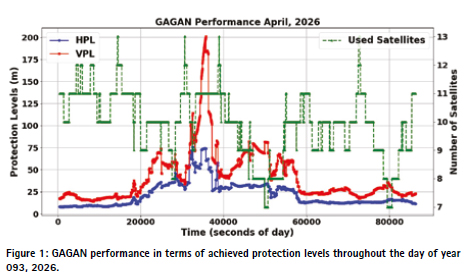
GAGAN exhibits significant degradation during disturbed conditions. Horizontal Protection Levels (HPL) increase from nominal values (~10–30 m) to peaks approaching 75 m. Vertical Protection Levels (VPL) show extreme behaviour, reaching values above 150 m and peaking near 200 m.
The major disturbance event observed around 33,000–36,000 seconds is not directly correlated with satellite geometry, indicating a strong ionospheric driver. Compared to the quiet‑day baseline, the system shows approximately three‑fold VPL inflation, confirming high sensitivity of equatorial SBAS to geomagnetic activity.
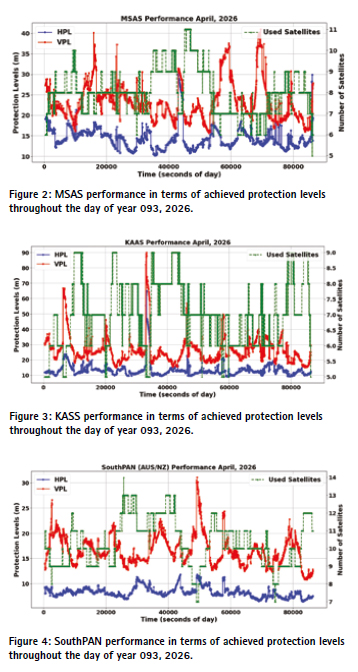
MSAS demonstrates comparatively stable behaviour under disturbed conditions. HPL remains largely unchanged (~11–18 m), while VPL increases moderately, reaching peaks of approximately 40 m
The absence of extreme spikes indicates robustness of MSAS in midlatitude ionospheric conditions. Compared with the quiet scenario, degradation is present but limited, with VPL increases remaining within operational tolerances.
KASS maintains stable horizontal performance (HPL ~10–15 m), but shows noticeable VPL excursions reaching up to ~90 m. These peaks occur partly during reduced satellite counts, indicating combined geometry and ionospheric effects.
Compared to the quietday baseline (VPL <30 m), the increase is substantial, highlighting moderate sensitivity to disturbed space weather conditions.
SouthPAN shows the most resilient performance among the analysed systems. HPL remains highly stable (~6–10 m), while VPL mostly stays within 13–22 m, with occasional peaks up to ~30 m.
High satellite availability (typically 9–13 satellites) contributes to robust geometry, while limited VPL inflation indicates effective ionospheric handling. Compared to the quietday scenario, degradation is minimal.
2. Officially declared performance and supported procedures
GAGAN is officially certified for RNP 0.1 and APVI with declared APV availability over most of the Indian landmass. MSAS supports enroute and limited terminal operations but does not declare APVI or LPV nationwide. KASS officially supports RNP APCH including LPV with published horizontal and vertical alert limits of 40 m and 50 m respectively. SouthPAN is designed to support APVI, LPV, and LPV200 and has published target VPL values below 35 m over its primary service region.
3. Space weather conditions on DOY 093, 2026
On 03 April (DOY 093) 2026, geomagnetic activity reached storm-level conditions with Kp values up to approximately 5–6, indicating a minor to moderate geomagnetic storm. Such conditions are known to induce enhanced ionospheric variability and degrade SBAS ionospheric modelling performance.
4. Conclusions
The results clearly show that storm time degradation predominantly affects the vertical domain. System operating in equatorial and low latitude regions (GAGAN) are most impacted, while midlatitude systems (MSAS, KASS) and advanced architectures (SouthPAN) demonstrate higher resilience.
SouthPAN maintains nearnominal performance even during disturbed conditions, highlighting the importance of redundancy and system design. Conversely, GAGAN shows severe degradation, indicating sensitivity to ionospheric disturbances.
Data sources and Tools:
https://cddis.nasa.gov (Daily BRDC, RINEX OBS); http:// ftp.aiub.unibe.ch/CODE_MGEX/CODE/ (Precise Products); BKG “SSRC00BKG” stream; IERS C04 ERP files
SBAS Mentor, ESA
gLAB GNSS, https://gage.upc.edu/en/learningmaterials/software-tools/glab-tool-suite serenad-public.cnes.fr (SBAS data)







Leave your response!