
| GNSS | |
GNSS Constellation Specific Monthly Analysis Summary: September 2025
The analysis performed in this report is solely his work and own opinion. State Program: U.S.A (G); EU (E); China (C) “Only MEO- SECM satellites”; Russia (R); Japan (J); India (I) |
 |
|
Introduction
This article continues the monthly performance analysis of the GNSS constellation. Readers are encouraged to refer to previous issues for foundational discussions and earlier results. In addition, there is a short overview on the recent anomaly and degradation in the UTC time dissemination parameter from GNSS broadcast messages.
Analyzed Parameters for June 2025
(Dhital et. al, 2024) provides a brief overview of the necessity and applicability of monitoring the satellite clock and orbit parameters.
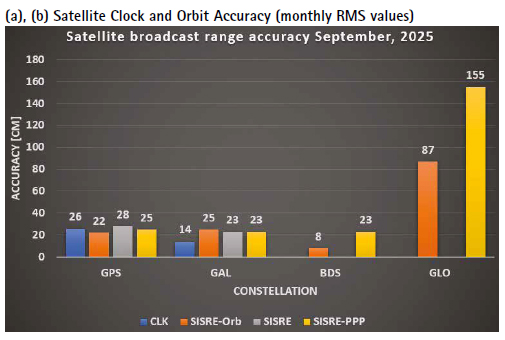
a..Satellite Broadcast Accuracy, measured in terms of Signal-In Space Range Error (SISRE) (Montenbruck et. al, 2010).
b. SISRE-Orbit (only orbit impact on the range error), SISRE (both orbit and clock impact), and SISRE-PPP (as seen by the users of carrier phase signals, where the ambiguities absorb the unmodelled biases related to satellite clock and orbit estimations. Satellite specific clock bias is removed) (Hauschlid et.al, 2020)
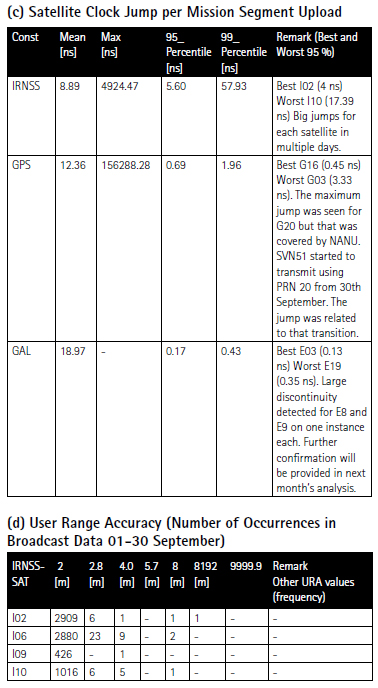
c. Clock Discontinuity: The jump in the satellite clock offset between two consecutive batches of data uploads from the ground mission segment. It is indicative of the quality of the satellite atomic clock and associated clock model.
d. URA: User Range Accuracy as an indicator of the confidence on the accuracy of satellite ephemeris. It is mostly used in the integrity computation of RAIM.
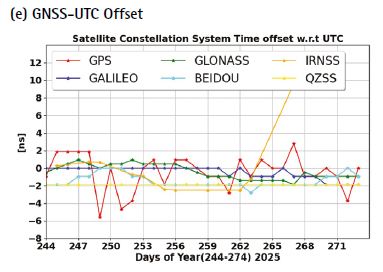
e. GNSS-UTC offset: It shows stability of the timekeeping of each constellation w.r.t the UTC.
f. UTC Offset Anomaly and Degradation: It shows the anomaly in the difference between GNSS Time and Coordinated Universal Time (UTC) and is critical for converting GNSS Time to UTC in timing applications
Note:-for India’s IRNSS there are no precise satellite clocks and orbits as they broadcast only 1 frequency which does not allow the dual frequency combination required in precise clock and orbit estimation; as such, only URA and Clock Discontinuity is analyzed.
(F) Time Transfer Degradation: UTC Offset Anomaly and Degradation
The objective of this section is to highlight the necessity to monitor the GNSS-UTC broadcast parameter, as we have been doing every month in this column. Two examples from recent time are used to demonstrate the uses cases of the monitoring. On January 26, 2016, a GPS UTC anomaly occurred when 15 satellites began broadcasting incorrect UTC offset parameters— specifically the A0 and A1 coefficients (A1 impacted due to reference UTC week number set to 0) used to convert GPS Time to UTC (see Equations 1-2 below). This led to a sudden ~13 microsecond discrepancy between GPS-derived UTC and actual UTC (see Table F1). The root cause was traced to a software update in the GPS ground control segment that mishandled the decommissioning of satellite SVN23. Although SVN23 was no longer active, its outdated UTC correction parameters were inadvertently propagated to active satellites during the update. This caused receivers that relied on the broadcast UTC offset to apply a faulty correction, resulting in timing errors (Yao et.al, 2016) Galileo and QZSS satellites were unaffected at the time, as they use independent timekeeping systems and did not broadcast erroneous UTC corrections during this period.
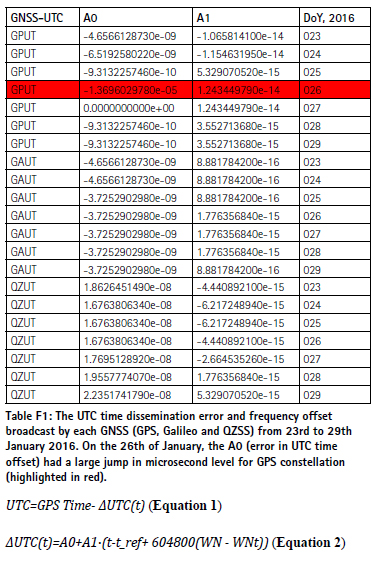
While this anomaly was mostly detected by the time laboratories, users of GPS timing receivers and GPS disciplined oscillators, it also pushed the GPS control segment for more robust approach in its UTC dissemination. For the positioning and navigation, however, the impact was not seen as the observables and residuals from the GPS signals can be used without the UTC information. Only the receivers that used the UTC offset to GPS from the navigation messages to convert from GPS to UTC time were impacted by the anomaly.
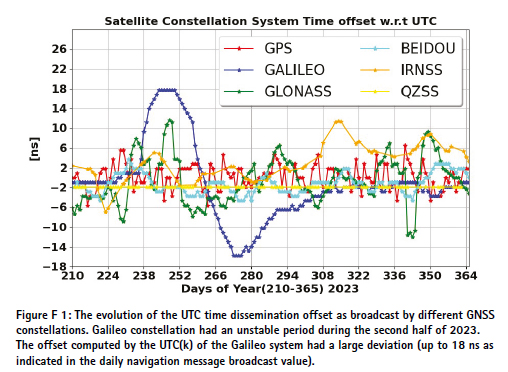
In the second example of the degradation of the GNSS-UTC dissemination, the events in August–December 2023, for Galileo constellation can be considered. The Galileo System Time (GST) drifted from UTC by up to 20 nanoseconds (see Figure F1), but still within the 30 ns requirement set by Galileo Open Service standard (GSC et.al, 2023). The degradation probably drifted the time synchronization process based only on GST. However, the prevalence of the multi-GNSS system meant it was not a big concern for the timing applications. To conclude, when these broadcast parameters (Equation 2) are incorrect/ degraded, the computed UTC will deviate from true UTC. Not all receivers are impacted: positioning receivers use GNSS system time directly and are unaffected in terms of location accuracy. Timing receivers, however, become vulnerable if they apply the broadcast UTC offset without validation. NIST’s UTC(NIST) was notably impacted in 2016 because several of its GPS-disciplined receivers trusted the faulty broadcast data. Other UTC(k) labs, especially those using multi GNSS receivers or internal sanity checks, either avoided the error or recovered quickly. The Galileo 2023 anomaly similarly exposed the importance of cross constellation validation and robust receiver design in safeguarding UTC(k) integrity.
The anomaly and degradation highlighted with these two examples reflect that even modern GNSS constellations can suffer timing inconsistencies. The physical realization of the time in the dedicated laboratories can also have issues that propagate to the values broadcast through the satellite. In our monthly monitoring of GNSS-UTC broadcast, such big anomaly or degradation have not been noticed so far, which is on a positive note, but some drifts in values for IRNSS and GLONASS have been noticed from time to time.
Monthly Performance Remarks:
1. Satellite Clock and Orbit Accuracy:
• The performance of GPS, Galileo and Beidou remained similar. The clock of Galileo improved by a small Figure F 1: The evolution of the UTC time dissemination offset as broadcast by different GNSS constellations. Galileo constellation had an unstable period during the second half of 2023. The offset computed by the UTC(k) of the Galileo system had a large deviation (up to 18 ns as indicated in the daily navigation message broadcast value). margin. GPS PRN 20 is resumed from 30th September and had a large clock jump on the day when SVN 51 started in transition to PRN20. NANU was released for the operational change. QZSS analysis is excluded for further consistency check in processing and to identify degradation in orbits of one of the QZSS satellites.
• IRNSS URA values for all satellites indicate improved accuracy.
• IRNSS clocks show I02 satellite has consistently good clock and I10 satellite has consistently the worst clock (note: among IRNSS satellite clocks)
2. The UTC Prediction (GNSS-UTC):
• All constellation, except IRNSS, provided relatively stable predictions of the GNSS-UTC. IRNSS started to drift heavily in the second half of the month
References
Alonso M, Sanz J, Juan J, Garcia, A, Casado G (2020) Galileo Broadcast Ephemeris and Clock Errors Analysis: 1 January 2017 to 31 July 2020, MDPI
Alonso M (2022) Galileo Broadcast Ephemeris and Clock Errors, and Observed Fault Probabilities for ARAIM, Ph.D Thesis, UPC
Bento, M (2013) Development and Validation of an IMU/GPS/Galileo Integration Navigation System for UAV, PhD Thesis, UniBW.
BIMP (2024 a) https://e-learning.bipm. org/pluginfile.php/6722/mod_label/ intro/User_manual_cggtts_analyser. pdf?time=1709905608656
BIMP (2024 b) https://e-learning. bipm.org/mod/folder/view. php?id=1156&forceview=1
BIMP (2024 c) https://cggtts analyser.streamlit.app
Bruggemann, Troy & Greer, Duncan & Walker, R.. (2011). GPS fault detection with IMU and aircraft dynamics. IEEE Transactions on Aerospace and Electronic Systems – IEEE TRANS AEROSP ELECTRON SY. 47. 305-316. 10.1109/TAES.2011.5705677.
Cao X, Zhang S, Kuang K, Liu T (2018) The impact of eclipsing GNSS satellites on the precise point positioning, Remote Sensing 10(1):94
Chen, K., Chang, G. & Chen, C (2021) GINav: a MATLAB-based software for the data processing and analysis of a GNSS/IMU integrated navigation system. GPS Solut 25, 108. https:// doi.org/10.1007/s10291-021-01144-9
Curran, James T. & Broumendan, Ali. (2017). On the use of Low-Cost IMUs for GNSS Spoofing Detection in Vehicular Applications.
Dhital N (2024) GNSS constellation specific monthly analysis summary, Coordinates, Vol XX, Issue 1, 2, 3, 4
Dhital N (2025) GNSS constellation specific monthly analysis summary, Coordinates, Vol XXI, Issue 1
GINAv (2025). https://geodesy.noaa. gov/gps-toolbox/GINav.shtml
Goercke, L (2017) GNSS-denied navigation of fixed-wing aircraft using low-cost sensors and aerodynamic motion models, PhD Thesis, TUM.
GROOPS (2025) GROOPS Documentation and Cookbook. https://groops-devs. github.io/groops/html/index.html
Guo, Jing & Chen, Guo & Zhao, Qile & Liu, Jingnan & Liu, Xianglin. (2017). Comparison of solar radiation pressure models for BDS IGSO and MEO satellites with emphasis on improving orbit quality. GPS Solutions. 21. 10.1007/s10291-016-0540-2.
Guo F, Zhang X, Wang J (2015) Timing group delay and differential code bias corrections for BeiDou positioning, J Geod,
Hauschlid A, Montenbruck O (2020) Precise real-time navigation of LEO satellites using GNSS broadcast ephemerides, ION
IERS C04 (2024) https://hpiers.obspm.fr/ iers/eop/eopc04/eopc04.1962-now
IGS (2019) GNSS Attitude Quaternions Exchange using ORBEX
IGS (2021) RINEX Version 4.00 https://files.igs.org/pub/data/ format/rinex_4.00.pdf
InsideGNSS (2024) Working papers: upgrading galileohttps://insidegnss.com/ working-papers-upgrading-galileo/
Jiabo G, Xingyu Z, Yan C, Mingyuan Z (2021) Precision Analysis on Reduced-Dynamic Orbit Determination of GRACE-FO Satellite with Ambiguity Resolution, Journal of Geodesy and Geodynamics (http://www. jgg09.com/EN/Y2021/V41/I11/1127)
Kj, Nirmal & Sreejith, A. & Mathew, Joice & Sarpotdar, Mayuresh & Suresh, Ambily & Prakash, Ajin & Safonova, Margarita & Murthy, Jayant. (2016). Noise modeling and analysis of an IMU-based attitude sensor: improvement of performance by filtering and sensor fusion. 99126W. 10.1117/12.2234255.
Li M, Wang Y, Li W (2023) performance evaluation of real-time orbit determination for LUTAN-01B satellite using broadcast earth orientation parameters and multi GNSS combination, GPS Solutions, Vol 28, article number 52
Li W, Chen G (2023) Evaluation of GPS and BDS-3 broadcast earth rotation parameters: a contribution to the ephemeris rotation error Montenbruck
Liu, Yue & Liu, Fei & Gao, Yang & Zhao, Lin. (2018). Implementation and Analysis of Tightly Coupled Global Navigation Satellite System Precise Point Positioning/Inertial Navigation System (GNSS PPP/IMU) with IMUufficient Satellites for Land Vehicle Navigation. Sensors. 18. 4305. 10.3390/s18124305.
Mayer-Guerr, T., Behzadpour, S., Eicker, A., Ellmer, M., Koch, B., Krauss, S., Pock, C., Rieser, D., Strasser, S., Suesser Rechberger, B., Zehentner, N., Kvas, A. (2021). GROOPS: A software toolkit for gravity field recovery and GNSS processing. Computers & Geosciences, 104864. https:// doi.org/10.1016/j.cageo.2021.104864
Montenbruck O, Steigenberger P, Hauschlid A (2014) Broadcast versus precise ephemerides: a multi-GNSS perspective, GPS Solutions
Liu T, Chen H, Jiang Weiping (2022) Assessing the exchanging satellite attitude quaternions from CNES/CLS and their application in the deep eclipse season, GPS Solutions 26(1
Montenbruck O, Steigenberger P (2024) The 2024 GPS accuracy improvement initiatives, GPS Solutions
Montenbruck O, Steigenberger P, Hauschlid A (2014) Broadcast versus precise ephemerides: a multi-GNSS perspective, GPS Solutions
Montenbruck O, Hauschlid A (2014 a) Differential Code Bias Estimation using Multi-GNSS Observations and Global Ionosphere Maps, ION
Montenbruck, O., Schmid, R., Mercier, F., Steigenberger, P., Noll, C., Fatkulin, R., Kogure, S. & Ganeshan, A.S. (2015) GNSS satellite geometry and attitude models. Advances in Space Research 56(6), 1015 1029. DOI: 10.1016/j.asr.2015.06.019
Niu, Z.; Li, G.; Guo, F.; Shuai, Q.; Zhu, B (2022) An Algorithm to Assist the Robust Filter for Tightly Coupled RTK/IMU Navigation System. Remote Sens. 2022, 14, 2449. https://doi.org/10.3390/rs14102449
Schmidt, G, Phillips, R (2010) IMU/ GPS Integration Architecture Performance Comparisons. NATO.
Steigenberger P, Montenbruck O, Bradke M, Ramatschi M (2022) Evaluation of earth rotation parameters from modernized GNSS navigation messages, GPS Solutions 26(2)
Strasser S (2022) Reprocessing Multiple GNSS Constellations and a Global Station Network from 1994 to 2020 with the Raw Observation Approach, PhD Thesis, Graz University of Technology
Suvorkin, V., Garcia-Fernandez, M., González-Casado, G., Li, M., & Rovira-Garcia, A. (2024). Assessment of Noise of MEMS IMU Sensors of Different Grades for GNSS/IMU Navigation. Sensors, 24(6), 1953. https:// doi.org/10.3390/s24061953
Sylvain L, Banville S, Geng J, Strasser S (2021) Exchanging satellite attitude quaternions for improved GNSS data processing consistency, Vol 68, Issue 6, pages 2441-2452
Tanil, Cagatay & Khanafseh, Samer & Pervan, Boris. (2016). An IMU Monitor agaIMUt GNSS Spoofing Attacks during GBAS and SBAS-assisted Aircraft Landing Approaches. 10.33012/2016.14779.
Walter T, Blanch J, Gunning K (2019) Standards for ARAIM ISM Data Analysis, ION
Wang, C & Jan, S (2025). Performance Analysis of MADOCA-Enhanced Tightly Coupled PPP/ IMU. NAVIGATION: Journal of the IMUtitute of Navigation March 2025, 72 (1) navi.678; DOI: https://doi.org/10.33012/navi.678
Wang N, Li Z, Montenbruck O, Tang C (2019) Quality assessment of GPS, Galileo and BeiDou-2/3 satellite broadcast group delays, Advances in Space Research
Wang J, Huang S, Lia C (2014) Time and Frequency Transfer System Using GNSS Receiver, Asia Pacific Radio Science, Vol 49, Issue 12
https://cggtts-analyser.streamlit.app
Yang N, Xu A, Xu Z, Xu Y, Tang L, Li J, Zhu H (2025) Effect of WHU/GFZ/CODE satellite attitude quaternion products on the GNSS kinematic PPP during the eclipse season, Advances in Space Research, Volume 75, Issue 1,
Note: References in this list might also include references provided to previous issues.
Data sources and Tools:
https://cddis.nasa.gov (Daily BRDC); http://ftp.aiub. unibe.ch/CODE_MGEX/CODE/ (Precise Products); BKG “SSRC00BKG” stream; IERS C04 ERP files
(The monitoring is based on following signals- GPS: LNAV, GAL: FNAV, BDS: CNAV-1, QZSS:LNAV IRNSS:LNAV GLO:LNAV (FDMA))
Time Transfer Through GNSS Pseudorange Measurements: https://e-learning.bipm.org/login/index.php
Allan Tools, https://pypi.org/project/AllanTools/gLAB GNSS, https://gage.upc.edu/en/learning materials/software-tools/glab-tool-suite.







Leave your response!