User stations for evaluation
Seven stations were selected out of
the GPS Earth Observation Network
(GEONET) stations operated by the
Japanese Geographical Survey Institute
(GSI) from Hokkaido (Northern Japan) to
Okinawa (Southern Japan) (http://www.
gsi.go.jp/). These seven stations cover the
whole domestic area of Japan. Figure 4
shows the locations of these seven stations.
The name for each station represents the
geographic region in Japan. The number
in each parenthesis is the specifi c ID for
each GEONET station. Raw data from
each of these stations was collected every
30 seconds during the periods examined.
MSAS and Single-Frequency
PPP performance during
solar-minimum period
In this analysis, three stations were chosen
from the set of seven shown in Figure 4:
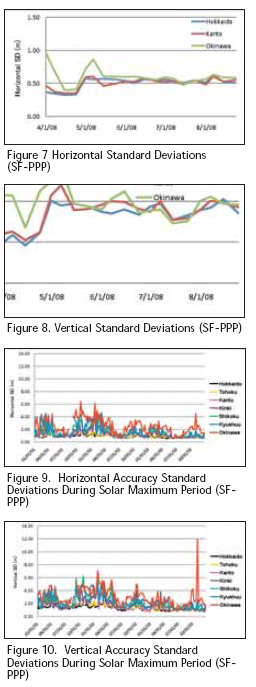
Hokkaido, Kanto, and Okinawa. Figure
5 shows the temporal variations of the standard deviations of MSAS horizontal
accuracy for these three locations from 1th
April 2008 to 24th August 2008. Figure 6
provides the same information for MSAS
vertical accuracy. Figures 7 and 8 provide
the same results for Single-Frequency PPP.
The estimated (sample) standard deviations
shown in these plots were calculated
every week. The results were mostly as
we expected. The horizontal and vertical
standard deviations for MSAS were almost
always below 1 meter, whereas SF-PPP
vertical standard deviations were often
near and sometimes above 1 meter. As can
be seen the results in Okinawa, Okinawa
station is affected by equatorial ionosphere
even during solar minimum. While MSAS
accuracy in these fi gures is somewhat
better than that of Single-Frequency
PPP, the difference is not large and is
now fairly well understood. Therefore
Single-Frequency PPP can be used to
roughly estimate MSAS performance.
Single-Frequency PPP performance
under solar maximum period
Figure 9 shows the temporal variations
of the standard deviations of horizontal
accuracy from Single-Frequency PPP
for all seven stations in Figure 4 from
1th January 2001 to 24th December 2003.
Figure 10 provides the same information
for the vertical accuracy of Single-
Frequency PPP over this period. As can
be seen from these results, positioning
performance was clearly degraded during
signifi cant fractions of this three-year
period compared with the results during
the recent solar-minimum period shown
in Figures 7 and 8. As the latitude moves
southward, positioning accuracy degrades
because the southern part of Japan is
closer to the equatorial region of the
ionosphere and is more affected by the
intense solar activity. When we examine
seasonal changes, we found that the error
decreased in summer, especially at the
southern stations. This tendency partially
coincides with the results given in [7].
Dual-Frequency based
ionospheric error estimation
As can be seen in Figure 9 and
(particularly) Figure 10, very large errors
can be seen around 1 November 2003 due
to a very large solar coronal mass ejection
(CME). This event created very large
ionosphere errors several times during
October and November 2003. Currently,
it is impossible for single-frequency
users to reduce ionospheric errors due to
unusual events like this one. One solution
is to use a dual-frequency receiver that
can estimate and remove ionospheric
delays in real time. We examined the
positioning errors on this day using
dual-frequency based ionospheric error
estimation and compared these results to
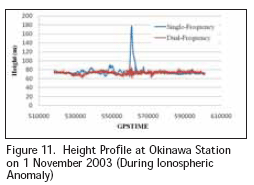
those derived from the IONEX fi le. Figure
11 compares the height (vertical) profi le
at the Okinawa station on 1 November
2003 for these two methods (note that the
actual height of the antenna at this station
is about 71.5 m). Since only ionospheric
error estimation differs between the
two lines shown in Figure 11, it is clear
that ionospheric error for standalone
single-frequency users exceeded 100
meters at the peak of this event, but
dual-frequency estimation dramatically
reduced the effects of this anomaly.
Conclusion
MSAS and Single-Frequency PPP
positioning were analyzed using raw -data
covering the Japanese islands in 2008.
The performance of these two systems
was similar, although MSAS accuracy
was somewhat better than that of Single-
Frequency PPP. Single-Frequency PPP
accuracy was analyzed during the more
active solar conditions of 2001 to 2003,
and its accuracy was signifi cantly degraded
at times. Therefore, it is predicted that
MSAS performance may also be degraded
during future periods of high solar
activity, although the degree of accuracy
degradation depends on locations, season
and time of date. The likely cause of this
accuracy is mis-modeling of Vertical TEC
by MSAS and GIM during very active
solar conditions. Dual-frequency based
ionospheric estimation can be used to
remove most of these increased errors.
Acknowledgments
The authors are very grateful to the
Geographical Survey Institute, Japan
(GSI) of Japan for providing the raw
data used in this research. The authors
also wish to thank Dr. Takeyasu Sakai
of ENRI for providing post-processing
software for MSAS analysis. The fi rst
author gratefully acknowledges the
Japan Ministry of Education, Culture,
Sports, Sciences and Technology.
References
• Imamura J. (2003). “MSAS program
and Overview, Proc.”, 4th CGSIC
IISC Asia Pacifi c Rim Meeting,
2003 Joint International Conference
on GPS /GNSS, Tokyo.
• Sakai T, Matsunaga K and Hoshinoo K and
Walter T. (2004). “Evaluating Ionospheric
Effects on SBAS in the Low Magnetic
Latitude Region”, 17th International
Technical Meeting of the Satellite Division
of Navigation (ION GNSS), 21-24
Sept.2004, Long Beach, CA, pp.1318-1328.
• Le.AQ.(2004). “Achieving Decimeter
Accuracy with Single Frequency
Standalone GPS Positioning”,17th
International Technical Meeting of
the Satellite Division of Navigation
(ION GNSS), 21-24 Sept.2004,
Long Beach, CA, pp.1881-1892.
• Misra, P. and Enge, P. (2006). “GLOBAL
POSITIONING SYSTEM, Signals,
Measurements, and Performance”,
Chapter 5, Ganga-Jamuna Press.
• Sakai T, Fukushima S, Aria N and Ito
K (2006) ,Implementation of Prototype
Satellite-Based Augmentation System
(SBAS),International Global Navigation
satellite System Society IGNSS Symposium
2006,17-21 July 2006,Australia.
• MOPS (2001), Minimum Operational
Performance Standards for Global
Positioning System/Wide Area
Augmentation System Airbone Equipment,
DO-229C, RTCA, Nov. 2001.
• Akio Yoshida, Takeshi Toya and
Makiko Yoshida (2004). “Solar-
Cycle and Semiannual Variations
of Magnetic Storms”, Journal of
Geography, 113(1), 2004, pp.107-124.
 Nyo Mi Saw Nyo Mi Saw
Tokyo University of Marine
Science and Technology,
Japan
|
 Dr Nobuaki Kubo Dr Nobuaki Kubo
Associate Professor Tokyo University of Marine
Science and Technology,
Japan
nkubo@kaiyodai.ac.jp
|
 Dr Sam Pullen Dr Sam Pullen
Senior Research Engineer,
Stanford University, USA
|
|
