 L P Sharma L P Sharma
National Informatics
Centre, Sikkim, India
lp.sharma@nic.in
|
 P Debnath P Debnath
College of Agriculture
Engineering and Post
Harvest Technology,
Ranipool, Sikkim, India
|
 Nilanchal Patel Nilanchal Patel
Department of Remote
Sensing, Birla Institute
of Technology, Mesra,
Ranchi, India
|
 M K Ghose M K Ghose
Department of Computer
Science, Sikkim Manipal
Institute of Technology,
Mazitar, Sikkim, India
|
Landslide is a common hazard in the
hilly regions which causes heavy losses
to life and properties every year. Since
1980 various researches and analyses have
been carried out in the GIS environment
to identify factors responsible for causing
landslides. The important conditioning
factors identified by the researchers
are slope, geological, geomorphologic
structures and land use coupled with
triggering factors like rainfall and a few
of the anthropogenic activities. Soil forms
the upper most part of he earth crust
and it is expected that the various soil
characteristics like depth, surface texture,
depth texture, soil erosion, hydraulic
conductivity, stoniness etc. play significant
role in causing landslide in an area. This
technical paper is an attempt to study
in depth the various soil characteristics
that may increase the landslide.
Landslide has been a perennial problem
of the hills and various models have been
designed for landslide vulnerabilities
(Jibson et al, 2000; Luzi et al,2000; Zhou
et al 2002; Carro et al 2003, Lee 2007,
Burrough and McDonnel, 1998, Miles
et al. 1999, Siddle et al 1991, Lee et al
1991, Hutchinson and Chandler 1991,
Hutchinson et al 1991, Morgan et al 1992,
Carrara et al 1991and 1992, Moon et al
1992,Wadge 1988, Gupta and Joshi 1990,
Wang Shu-Quiang and Unwin 1992,
Pachauri and Pant 1992,) .This study
makes a detail study of the importance
of various soil parameters with respect to
their influence on slope instability and
landslide vulnerability. The study area
for this investigation is Sang Revenue
Circle in east district of Sikkim, India and
includes 15 (Fifteen) revenue villages.
The area extends from east longitude 88o
26’ 40.17” to 88o 33’ 42.35” and North
Latitude of 27o 13’48.85” to 27o17’22.24”
covering an area of around 40 square
kilometers. Since 1968 there is a prominent
landslide at Sirwani Revenue Village that
blocks the road between Singtam and
Sirwani every year during the monsoon
season. The data used for the study has
been sourced from various agencies
including, NIC-GIS/NBSS&LUP, NRSA,
Rural Management Dev. Department,
Govt. of Sikkim, and Wikipamia.
Methodology
The spatial data required for this study was
acquired from the National Informatics
Centre, Sikkim State unit’s Spatial Data
Bank. Soil maps were in shape file format
with related attributes. Soil has eight
different characteristics namely depth,
inner texture, surface texture, erosion,
slope, stoniness, drainage and hydraulic
conductivity. Each of these parameters
have been categorized into 3 to 5 types by
assigning different weights with respect
to stability and landslide susceptibility
based on experts opinion and the common
logic. Each of such parameter categories
are assessed with respect to common logic
and experts’ opinion on one side and on
the basis of evidence of their behavior with
respect to landslide events on the other.
Important Soil Characteristics
Considered
Depth
Depth of the soil forms one of the
important factors for assessing the stability
of the soil and landslide susceptibility
of the land. With the increase of soil
depth, the tendency of soil to absorb
moisture is increased, resulting in
reduced runoff rate. Hence shallow soil
is considered to be more unstable and
prone to landslide than the deep soil.
Soil Texture
The texture of soil represents the relative
proportion of sand, silt and clay content.
Soils with high percentage of clay
form very stable aggregate resistant to
detachment. On the other hand, light soils
like sandy or coarse loams are easy to
detach as they have low organic matter
content (Das and Agarwal, 2002). Hence,
soil with more sand, high slope and
intensive rainfall which constitute most
dominant factors of landslide cause severe
damage to land (Patanakanog, 2001) .
Surface Texture
The texture on the surface of the
soil may be different from the
texture found below the surface.
Erosion
One of the principal reasons for landslide
is the progressive deterioration of soil due
to erosion. Soil erosion is the detachment
and transportation of soil material from
one place to another through the action of
wind, water in motion or by the beating
action of the rain drops. It is the outcome
of many factors in combination that
include the intensity of rains, porosity
of soil, physical as well as chemical
properties of rock. The slope of the land
has direct relation to the soil erosion
because soil erosion due to run-off is more
on sloping and denuded lands (Samra and
Sharma, 2002). As a result, the rate of soil
erosion is very high in such areas where
the soil is mostly sandy in nature, slope is
high and rainfall is frequent. Thus, with the
increase of soil erosion, the susceptibility
of an area to landslide also increases.
Soil is characterized by either severe
erosion, moderate erosion or low erosion.
Stoniness
Soil stoniness is also an important
characteristic of soil which influences
the intensity of landslide. It refers to the
proportion of stones (or rocks) within a
unit volume of soil or on its surface. Stones
left in place may provide for soil and water
conservation by protecting the surface against
raindrop impact or retarding water flow along
the surface. Therefore, soils with more stones
(or rocks) are less prone to the landslide as
compared to that of soil with less stones.
Slope
The degree and length of slope determine
the amount of runoff and extent of soil
erosion. As water flows down the slope, it
accelerates under the force of gravity. If the
percent of slope is increased four times, the
velocity of water flowing down is doubled.
Doubling the velocity quadruples the erosive
power. Sediment transport capacity of runoff
increases by 10 to 100 times at one percent
slope compared to 0.2 percent slope (Reddy
and Reddi, 1999). More so, during monsoon
season or heavy downpour, the hills get
saturated with water, resulting in instability
of land mass. The complete surface portion
of soil may slip down from its actual
position causing landslides (Wischmeier
and Smith, 1978). Since the study area is
characterized by steep to very steep slope
along with mostly sandy soil textures, it
indicates a high degree of landslide.
Drainage
Drainage of an area is one of the most
important aspects in determining the land use
pattern and landslide probability. Drainage
refers to the relative rate of outflow of
water to which the excess amount of water
can be absorbed by the soil. Slides often
occur following intense rainfall, when
storm water runoff saturates soils on steep
slopes or when infiltration causes a rapid
rise in groundwater levels. Human action
can exacerbate sliding when drainage
systems fail or when development increases
runoff near steep slopes (www.ecy.wa.gov/
programs/sea/landslides/help/drainage.html).
Hydraulic Conductivity
Hydraulic conductivity denotes the
proportionality constant in Darcy’s
law, which represents the amount of
water that flows through a unit crosssectional
area of an aquifer under a
unit gradient of hydraulic head. Thus, a
change in hydraulic conductivity greatly
influences ground water table and slope
stability. With the increase of hydraulic
conductivity, the movement of water in
the soil is increased. Therefore, higher
the level of hydraulic conductivity of soil,
higher is the probability of the landslide.
The study area is classified into high,
moderate and low hydraulic conductivity.
Parameter Ranking
Parameter ranking is done to understand
which of the soil parameters considered
are most influencing and which are the
ones that are least influencing. This was
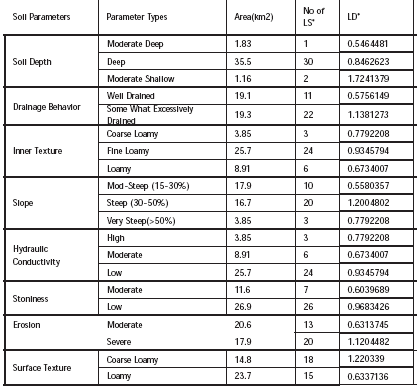
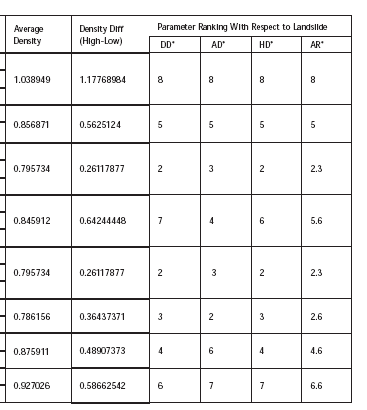
done on the basis of landslide density
in the area falling under each of the
variable parameter as shown in table 1.
Conclusion
We identified eight important soil
characteristics to deduce eight soil parameters
and listed their types from past references
and assigned weight to each parameter types
based on common logic and the experts’
opinion. Then based on the landslide
density in the study area under each of the
parameter types, three different parameters
ranks based on density difference, average
density and highest density were computed.
Though all three type of ranks weighted
almost equally, an average of them known
as average rank was computed. Ranking was
done in such a way that higher the rank more
influencing is the parameter with respect
to landslide. We deduced that soil depth is
the most influencing soil parameter and the
inner texture and the hydraulic conductivity
to be the least influential parameters. The
parameter type weights and the parameter
ranks both can be used in conjunction for the
study of landslide vulnerability. A landslide
vulnerability map of the study area prepared
on the basis of the deduced parameter is
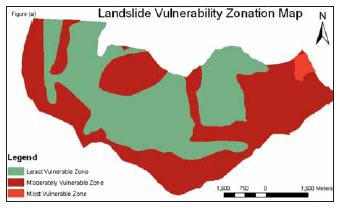
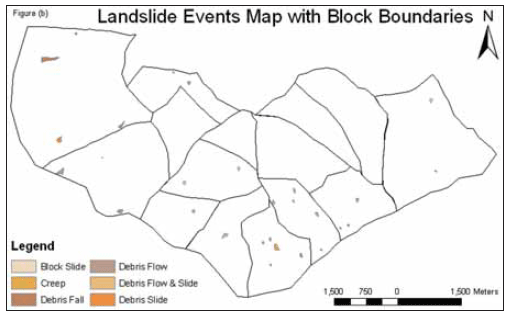
shown in figure 1 (a) where figure 1 ( b)
shows the landslide events of the study area.
References
Michael, A.M. and Ojha, T.P. (1999) Principles
of Agricultural Engineering. Ms Jain Brothers,
New Delhi, India, 2, pp.586-590.
Dhakal, A.S. and Sidle, R.C. (2002) Physically
Based Landslide Hazard Model ‘U’ Method and
Issues. EGS XXVII General Assembly, Nice, 21-26.
Bianca, C.V. and Nelson, F.F. (2004)
Landslide in Rio de Ianeiro: The role played
by variations in soil Hydraulic Conductivity.
Hydrological process. 18(4), 791-805.
Brady, N.C. and Weil, R.R. (2007) The
Nature and Properties of soils. Pearson
Education, Inc. New Delhi, pp.756-761.
Das, D.K. (2007) Introductory Soil Science.
Kalyani Publishers, New Delhi, India, pp. 475-483.
Sivakumar, G. L. and Mukesh, M. D. (2002)
Landslide analysis in Geographic Information
Systems. Department of Civil Engineering,
Indian Institute of science, Bangalore. India.
www.gisdevelopment.net/.../natural.../.
Saro, L. (2007). Application and
Verification of Fuzzy Algebraic Operators
to landslide susceptibility mapping.
Environmental Geology, 52, 615-623.
Wischmeier, W.H. and Smith, D.D. (1978)
Predicting rainfall-erosion losses-A guide to
conservation planning, Agricultural Handbook
No-537, US Department of Agriculture, USA.
Das, D.K. and Agarwal, R.P. (2002) Physical
Properties of Soil. Fundamental of Soil
Science, Indian Society of Soil Science,
IARI, New Delhi, India, pp. 75-77.
Samra, J.S. and Sharma, U.C.(2002) Soil
Erosion and Conservation. Fundamental
of Soil Science, Indian Society of Soil
Science, IARI, New Delhi, India, pp.162.
Patanakanog, B. (2001).Landslide Hazard
Potential Area in 3 Dimension by Remote
Sensing and GIS Technique. Land Development
Department, Thailand. (www.ecy.wa.gov/
programs/sea/landslides/help/drainage.html)
Reddy, T.Y. and Reddi, H.S. (1999).
Principles of Agronomy. Kalyani
Publishers, New Delhi, India, pp.338.
Carro, M., Amicis, M. D., Luzi, L. and Marzorati,
S. (2003) The application of predictive
modeling techniques to landslides induced by
earthquakes: the case study of the 26 September
1997 Umbria–Marche earthquake (Italy).
Engineering Geology, 69(1-2), 139-159.
George, Y. L., Long, S. C. and David, W. W.
(2007) Vulnerability assessment of rainfallinduced
debris flows in. Department of Earth
Systems and GeoInformation Sciences,
College of Science, George Mason University,
Fairfax, VA 22030, ETATS-UNIS. http://www.
springerlink.com/content/uj26871v2831nx44)
|
