There are generally 2 types of users
of DGPS for professional survey
one is the National Mapping Agency
and other large govt. organization who
undertake Survey projects and the 2nd
category is comprising of private survey
set ups most of whom are first time
users of DGPS and use DGPS to cut
down on the time and efforts Involved
in surveying with ETS (electronic total
station) along with spirit levels.
Conventional methods
National Mapping Agency e.g. Survey
of India have their established base lines
established by them and in use for decades.
Their procedure to evaluate accuracy of
DGPS is simple in which they ask the
venders to measure the base line vector and
compare it against their established value
and the agreement between the DGPS
measured vector and their known value
is an acceptable method of evaluation.
Similarly other government organization
adopts the same procedure as they are in
a position to acquire the base line data.
Which is not available to private surveyors
as a matter of government policy?
Private surveyors adopt a method where
in they check repeatability of vector
computed by DGPS or alternatively they
measure a vector by ETS and compare
the same with that obtained by DGPS.
Both the methods applied by private
surveyors are subjective and in cases
of disagreement private surveyors, who
have implicit faith on ETS do not ever
consider that ETS measurement could have
observational error. More over ETS need a
clear line of sight and is therefore restricted
to a vector limited to 4-5 km.To overcome
their subjectivity, we at Pan India resort
to a Geometric Solution independent of
comparison method as well as to obviate
the requirement of known control points,
so diffi cult & cumbersome to obtain.
Proposed method
The principal utilized by us in simple
term is solution called Trilateration. It is
a well established geometric solution by
which we can calculate internal angles
of a closed fi gure such as Triangles &
Rectangles When the vector length of
sides is known. We have developed a
small routine for this with due check by
mollweids formula. Thus for evaluation
purpose DGPS observation is made on the
vertex of a triangle rectangle and vector
length of sides is computed. With the
vector lengths we compute the internal
angles and sum up. For triangle the sum
should add up to 180° any agreement with
in ± one tenth of second is considered
satisfactory and thus indicates that the
vectors by DGPS have the requisite
accuracy stipulated in the system
brochure, which is ± 5mm + 1 ppm.
For verifi cation we arbitrarily alter the
length of any one side by more than 5mm
+ 1 ppm then recalculate the internal
angles sum of internal angles does not
come to 180° same procedure done by the
competitors DGPS shows their quality
and the customer can make objective
judgment of the quality evaluation. This
procedure when repeated with ETS will
also show the accuracy achievable and
procedural fl aws if any in measurements
taken by ETS. After internal angles have
been computed we also do a run down of
azimuth and the closing error in Azimuth
is shown to be less them one tenth of a
second which is the stipulated accuracy
of the DGPS being marketed by us. We
have performed these tests with both
single and dual frequency DGPS and have
found to be stable for both single and
dual frequency DGPS with in the distance
limits stipulated for both (15 km for Single
Frequency & 80 Km for dual frequency
DGPS). Almost all of our customers have
appreciated the logic of this evaluation
scheme and many controversies of DGPS
vis-à-vis ETS have been obviated.
Trilateration
While most surveyors are aware of
trilateration methods even so except for
the National Survey Organizations other
surveyors do not resort to trilateraties
as routine. Therefore we feel that a little
elementary explanation of trilateratior will
be helpful in appreciating the import of the
procedure explained above. In trilateration
we get all three sides of triangle and an
oblique triangle is any triangle that is
not a right triangle. It could be an acute
triangle (all threee angles of the triangle
are less than right angles) or it could be
an obtuse triangle (one of the three angles
is greater than a right angle). Actually, for
the purposes of trigonometry, the class
of "oblique triangles" might just as well
include right triangles, too. Then the study
of oblique triangles is really the study of
all triangles.
Let's agree to
a convention
for labelling
the parts of oblique triangles
generalizing the convention for right
triangles. Let the angles be labelled A,
B, and C, and let the sides opposite them
be labelled a, b, and c, respectively.

Solving oblique triangles
The trigonometry of oblique triangles is
not as simple of that of right triangles, but
there are two theorems of geometry that
give useful laws of trigonometry. These
are called the "law of cosines" and the
"law of sines." There are other "laws"
that used are but since the common use of
calculators, these two laws are enough.
The law of cosines
This is a simply stated equation:
c2 = a2 + b2 - 2ab cos C.
It looks like the Pythagorean theorem
except for the last term, and if C
happens to be a right angle, that last
term disappears (since the cosine of 90°
is 0), so the law of cosines is actually a
generalization of the Pythagorean theorem.
Note that each triangle gives three
equations for the law of cosines
since we can permute the letters
as we like. The other two versions
are then a2 = b2 + c2 - 2bc cos A,
and b2 = c2 + a2 - 2ca cos B.
The law of cosines relates the three
sides of the triangle to one of the angles.
We can use it in a couple of ways.
First, if we know one angle and the two
adjacent sides, then we can determine
the opposite side. For instance, if angle
C = 60°, side a = 5, and side b = 8, then
the law of cosines says c2 = 25 + 64 - 80
cos 60°. Since the cosine of 60° is 1/2, that
equation simplifi es to c2 = 49, so c = 7.
Second, if we know all three sides of a
triangle, then we can use it to fi nd any
angle. For instance, if the three sides are
a = 5, b = 6, and c = 7, then the law of
cosines says 49 = 25 + 36 - 60 cos C, so
cos C = 12/60 = 0.2, and, with the use of
a calculator, C = 1.3734 radians = 78.69°.
Note: When triangle is obtuse, the cos C
is negative. Suppose the three sides
are a = 5, b = 6, and c = 10. Then the
law of cosines says 100 = 25 + 36 - 60
cos C, so cos C = - 49/60 = - 0.81667.
As we can see in the graphs above, the
cosine of an obtuse angle is negative.
This is fi ne, and our calculator will
compute the arccosine properly. we'll
get C = 2.2556 radians = 129.237°.
The law of sines
The law of sines is also a
simply stated equation
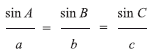
Note that the law of sines says that three
ratios are equal. Like the law of cosines,
we can use the law of sines in two ways.
First, if you know two angles and the
side opposite one of them, then we can
determine the side opposite the other
one of them. Second, if we know two
sides and the angle opposite one of
them, then we can almost determine the
angle opposite the other one of them.
Mollweide’s formula
In trigonometry, Mollwedie's formula,
sometimes referred to in older texts
as Molweide's equations, named
after Karl Mollwedie, this formula
describes relationship between
sides and angles in a triangle.
Let a, b, and c be the lengths of
the three sides of a triangle. Let ß,
and ? be the measures of the angles
opposite those three sides respectively.
Mollwedie's formula states that

Each of these identities uses all six
parts of the triangle - the three angles
and the lengths of the three sides.
Mollwedie's formula can be used
to check solutions of triangles.
Evaluation of elevation specs.
The known manufacturer of professional
DGPS specify the elevation accuracy
generally as double the horizontal
accuracy specifi ed e.g. if an OEM specifi es
horizontal accuracy as ±5mm + 1ppm,
their elevation specs generally are ± 10mm
+ 2 ppm. All DGPS output elevation as
ellipsoidal elevation and often the values
are large and many times as (-) this causes
ambiguity in appreciation of results.
Most processing software that come with
DGPS have an inbuilt programme for
conversion of ellipsoidal elevation to
optometric elevation using a geoid model
EGM-96, which is not very reliable for
India. Survey of India is developing a
geoid model for India and even when it
is ready its availability in public domain
remains uncertain. Like assassin the
horizontal specs, the elevation specs are
best evaluated when precise elevator
Benchmarks (BM) are available which at
present are in a classifi ed category and not easily available. One of the other
conventional practices of evaluation is
repeatability. A number of points are
considered and repeat observation of
elevation is computed with DGPS data and
mean and standard deviation is calculated
to arrive at the accuracy obtained which
should be in accordance of the accuracy
specifi ed in the technical specifi cation
of DGPS by the OEM. However it is
our experience that usual customers
are generally do not feel comfortable
with such a laborious exercise and large
volume of computational data which
necessarily involves a meticulous study
by the customers for which normal
customers neither have time nor patience
and many are not conversant with
statistical methods used for the exercise.
We at Pan India have therefore devised
a simply and self evident procedure
for evaluating the specifi ed elevation
specs of the OEM mentioned in the
technical brochure of the product. This
procedure in brief is as given below:
A base station in set up as suggested
by the customer and an arbitrary
elevation value of customers choice
is assigned to the base station ground
point a reccee of the area around base
station is undertaken and a few points
are selected for rover observation.
These points are so selected that they
should comprise of a pillar / parapet /
distance stone so that the measurement
is possible both at ground level as well
as at top of such a stone / parapet etc. A
series of observations are carried out with
rover DGPS at the ground level as well as
the top of such pillars / parapets etc. and
the data is processed using the assigned
elevation of base station and EGM-96.
After the data is post processed. The
difference in top and ground elevation
of these points are tabulated. The actual
difference of top and ground of these
points is carefully measured using
a standardized steel tape. The tape
measured value is then compared with
the DGPS computed value and max
and mini variation is recorded. These
this gives the customer a verifi able and
physically evident value of the accuracy
of elevation measurement by DGPS.
The results so for have always been
such that the maximum disagreement
between the DGPS measurement and
tape measurements has been well with
in the accuracy specifi ed in technical
brochure of the DGPS. The customer is
always encouraged to get this exercise
repeated with competitor DGPS and
arrive at this own evaluation.
Concluding remarks
We have utilized these procedures for
extension of control for a large project
of ONGC in fi eld of Geophysical
exploration. However, instead of triangles
we observed a network comprising
rectangles one diagonal of each rectangle.
 Vivek Bansal Vivek Bansal
Sr. Manager
Pan India, Gurgaon
|
|

 Brig (Rtd.) M C Dhamija
 Prashant Joshi